
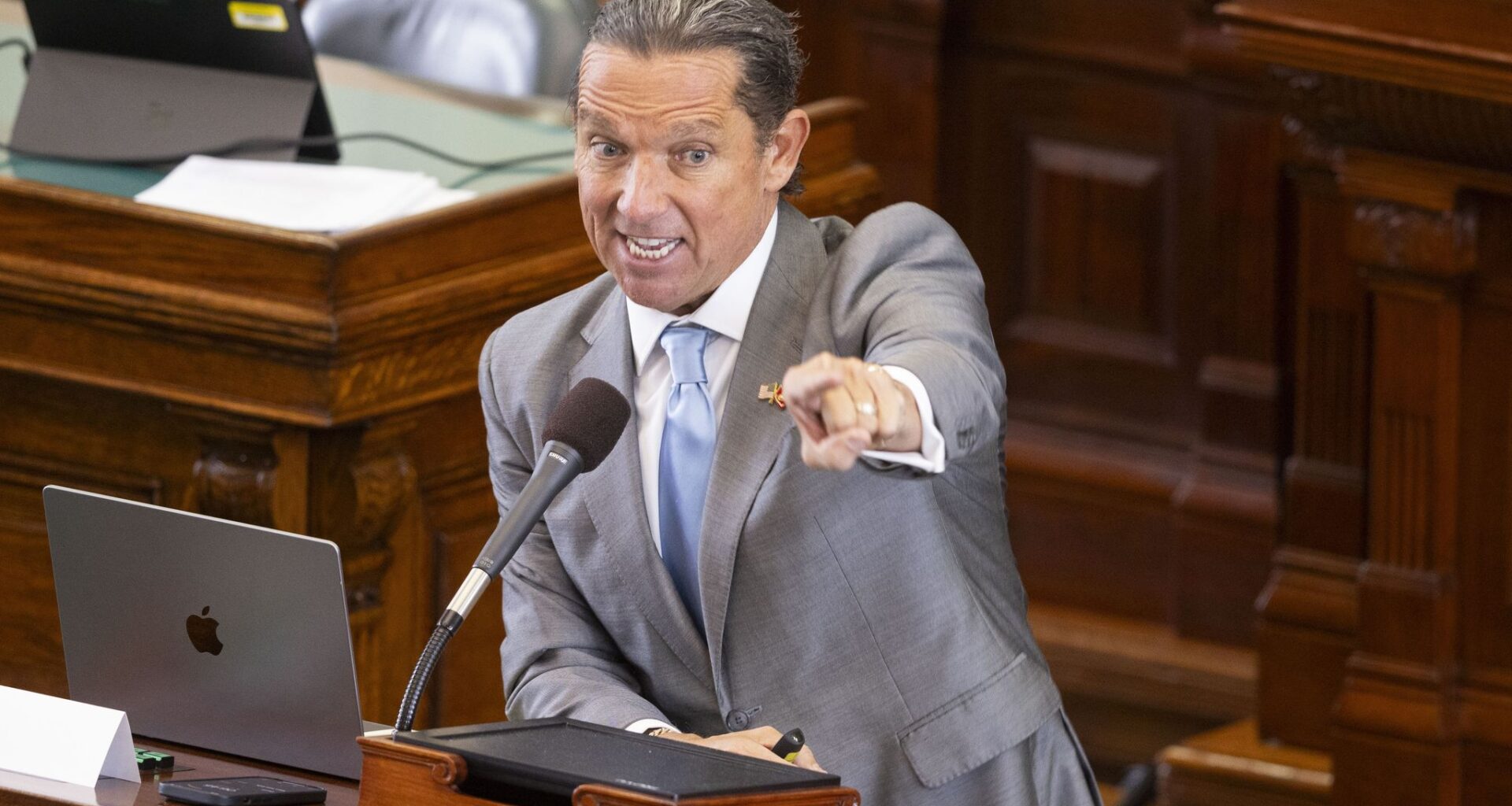
Attorney Tony Buzbee speaks while representing Texas Attorney General Ken Paxton in his 2023 impeachment trial at the Texas State Capitol in Austin. Buzbee also represented a seven-year-old boy in a child abuse lawsuit, which resulted in a $1.1 billion jury verdict in Dallas County March 25, 2026.
Juan Figueroa/Staff Photographer
When a Dallas County jury last week ordered a Texas oil heir to pay $1.1 billion for causing severe brain damage to his stepson, the boy’s attorney called it the largest child abuse verdict in U.S. history.

Whether the family can collect the record-setting award remains to be seen.
Article continues below this ad
State district Judge Dale Tillery has yet to issue a final judgement on the verdict, and he has the authority to reduce damages based on evidence presented at trial.
If the verdict stands, high-dollar civil damages in Texas are routinely reduced on appeal. Victims can also face challenges collecting judgments, especially those tied up in family trusts. It makes the 10-figure monetary decision a symbolic victory for the victim of a violent crime but a logistical uncertainty at this stage of the case, legal experts said.
“That’s not to say they won’t collect a very, very large amount of money” said Chad Ruback, a Dallas appellate lawyer.
Make Dallas News a preferred source so your search results prioritize writing by actual people, not AI.
Add Preferred Source
The March 25 verdict came as Charles Brooks Jr., 34, is serving a 40-year prison sentence for the 2021 assault.
Article continues below this ad
Brooks is the great grandson of a founder of Humble Oil, which later became Exxon. The jury awarded $291 million in compensatory damages and $810 million in punitive damages for the child identified in court records as B.S. and his mother Madison Ball.
Ball’s Houston attorney, Tony Buzbee, who also represented Attorney General Ken Paxton in his 2023 impeachment trial, said the jury sent a message that children should be valued in society.
“I hope that through this verdict this precious child gets all the care he will need and hopefully make his life as good as it can be made under the circumstances,” Buzbee said in a news release.
Attorney Daniel Karp, who represented Brooks in the civil case, did not respond to a call or email from The Dallas Morning News requesting comment. A final disposition hearing is set for May 15, according to court records.
Article continues below this ad
The boy, now 7, remains severely brain damaged five years after the assault, according to the lawsuit filed by his mother. He is bedridden, cannot walk, cannot survive for long periods without a breathing machine and will require 24-hour medical care for life, the complaint states.
Ball was at work in Texarkana on April 22, 2021 and arranged for Brooks, her then-husband, to watch her 2-year-old son, according to the lawsuit.
The complaint states Brooks took the boy three hours away to his Dallas home. That night, according to the lawsuit, he called Ball and said the boy had fallen off the kitchen table and hit his head.
During a Facetime call, Ball said she was calling an ambulance but Brooks responded he would snap her neck and kill her, according to the lawsuit.
Article continues below this ad
After paramedics arrived and transported B.S. to Medical City Dallas Hospital, the lawsuit states doctors found severe brain swelling, bruising across his body and bite marks – evidence of abuse.
Since then, the boy has spent most of his life confined to a hospital bed or under close medical care, according to the lawsuit. It states he has suffered multiple strokes, and the brain damage has impacted his ability to breathe.
Brooks was charged with felony injury to a child and in 2023 was sentenced to 40 years in prison.
While there are caps for punitive damages in certain civil claims in Texas, there is no limit for cases involving some felonies, including injury to a child.
Article continues below this ad
Even without a cap, Texas law requires damages to be reasonable and supported by evidence, according to Mollie Mallory, a partner at the Dallas-based Tillotson Patton law firm.
Mallory cases in appellate courts have widely debated what evidence meets that standard. At the same time, she said, there is common ground among justices and across courts of appeals that non-economic damages cannot be premised on passion or improper motives.
Judges in civil cases can consider the evidence and reduce the jury’s verdict when entering a final judgement, said Ruback, the Dallas appellate lawyer.
High-dollar civil damages in trucking and manufacturing cases are often reduced on appeal in a state as business friendly as Texas, said Steve Samples, a Fort-Worth appellate lawyer.
Article continues below this ad
Here, the verdict is for “a horrific crime” against a child rather than a standard corporate defendant, Samples said, but a $1.1 billion award could set a precedent for other standard personal injury cases.
“Texas is a business friendly state and the last thing the state of Texas wants is to have a record-setting, highest verdict ever,” Samples said.
Collecting a final award can present its own set of challenges.
It’s not clear what assets Brooks has, but Buzbee called him “an unemployed trust fund beneficiary.”
Article continues below this ad
Most trusts have provisions that protect the overall funds from creditors or outside parties, said Alisa Richman, a Dallas-based post-judgment collections attorney. Distributions made to the trust’s beneficiaries are typically “fair game,” she said, but are not easy to obtain if the beneficiary stops or reduces the payments.
Bank accounts can be garnished and oil and gas assets can be forcibly sold. Richman said money in a prison account can also be garnished to pay a judgment.
But getting money from an individual is more complicated than a business, she said.

By signing up, you agree to our Terms Of Use and acknowledge that your information will be used as described in our Privacy Policy.
Ruback, the Dallas appellate lawyer, said defendants can also propose a settlement in lieu of going through a lengthy appellate process that can drag on for years.
Article continues below this ad
Whatever happens in B.S.’s case, Morgan McPheeters, a partner in Kelly Watkins McPheeters LLP, said the jury’s verdict sent a clear message.
“Juries are the voice of the community,” McPheeters said. “A verdict of this size suggests that the community was really horrified by the evidence they heard during the trial and reached a verdict that they determined – as the fact-finders – would fairly and reasonably compensate this child for his injuries and also punish the defendant for his conduct.”