
What a water emergency may look like for Corpus Christi, including forced reductions in overall water use, may come into clearer focus in the upcoming weeks.
It is not known with certainty at this point when — or if — the city could face a water emergency, called when the city’s water supply is within about six months before the water supply is unable to fill demand.
“The actions taken during a level 1 water emergency are all meant to ensure that we always have enough supply to meet demand,” said Nick Winkelmann, chief operating officer of Corpus Christi Water. “Essentially, the efforts taken are meant to push back that 180-day mark until we bring on new water supplies, until reservoirs refill, until we have more availability for water.”
Some of the measures would be required, while others are options that the City Council would ultimately decide.
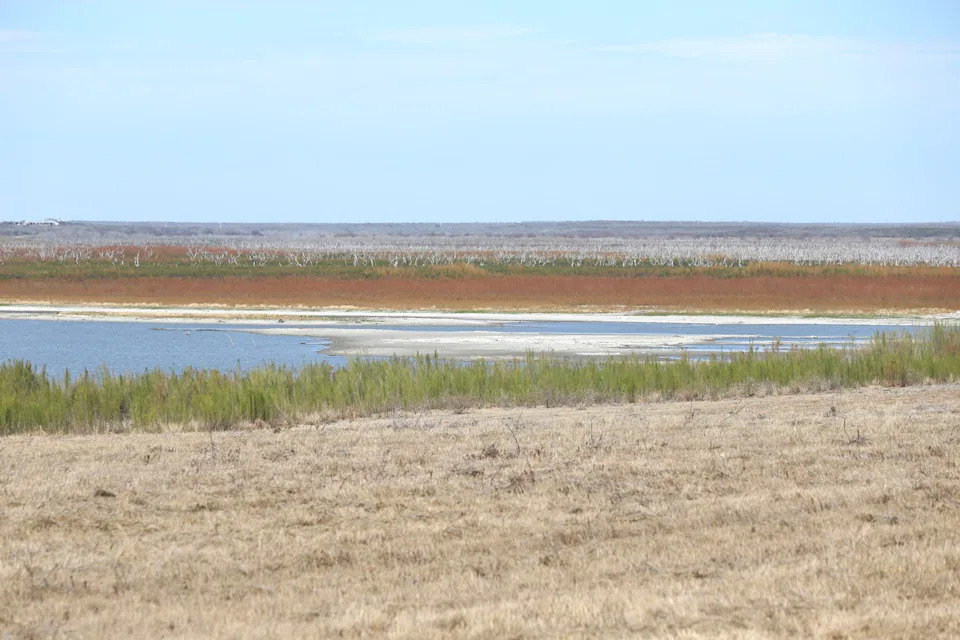
A view of Choke Canyon Reservoir near the Calliham Unit boat ramp on Feb. 8.
Officials heard on March 31 a review of a wide range of considerations that the council has on its hands, both required — such as approving the percentage of water cuts under curtailment — and optional, such as potential surcharges, fines for violations and policies that would ultimately curb new development.
Although an established drought contingency plan is something of a guidepost, it doesn’t include many details on some of the decision-making that lies ahead.
Curtailment
Curtailment, a word that has increasingly been raised since the city entered Stage 3 water restrictions, generally means a forced reduction in water use.
However, what that looks like on a practical level hasn’t yet been determined.
There isn’t a currently approved percentage of water cuts that all customers would be mandated to follow, although it would be a minimum of 5%, according to the drought contingency plan.
What is proposed may be more than 5%, depending on the water use reduction projected to be needed to stabilize supply meeting demand, according to staff.
The council will identify baselines — that is, a general “starting point” of water use volumes for residential, commercial and industrial accounts.
Any percentage determined of curtailment would apply across the board of all customer classes, officials have said.
The percentage approved, at least in part, will be influenced by updated projections of when the city may enter a water emergency.
The new projections are expected to be available in April.
Curtailment may not have a high impact on the majority of the city’s roughly 90,000 residential customers, who have already taken significant conservation measures to drive down water use, officials said.
“Our residents … are already doing just about everything that we can to conserve water,” said City Councilwoman Sylvia Campos. “If we were to have to go to curtailment, I don’t think it would affect most of us.”
As an example, if the residential water use baseline were set at a staff-recommended 7,000 gallons per month, and curtailment was approved at 10% reduction, the “ceiling” for allowed water use would be 6,300 gallons per month, according to the city’s formula.
However, most residential accounts’ water consumption is within a range of 4,000 gallons to 5,000 gallons per month, according to graphs shown in a presentation before the council.
Five thousand gallons per month would equate to roughly 30% curtailment under the 7,000-gallons-per-month example.
Commercial baselines would be identified through meter sizes, according to the presentation made before the council, but determining a baseline for industrial users would be more complicated, staff said.
That’s, in part, because of seasonal changes in water use, Winkelmann said.
The baselines would be individualized because of variances in use, and are expected to be established through a review of about two years of data, he said.
Although staff is expected to make recommendations, the council is who will set the baseline for customers, and also the percentage of curtailment — with options of 5% or higher.
Kirsten Crow covers city government and water news. Have a story idea? Contact her at kirsten.crow@caller.com.
Consider supporting local journalism with a subscription to the Caller-Times.
This article originally appeared on Corpus Christi Caller Times: Here’s what curtailment may look like in water emergency