
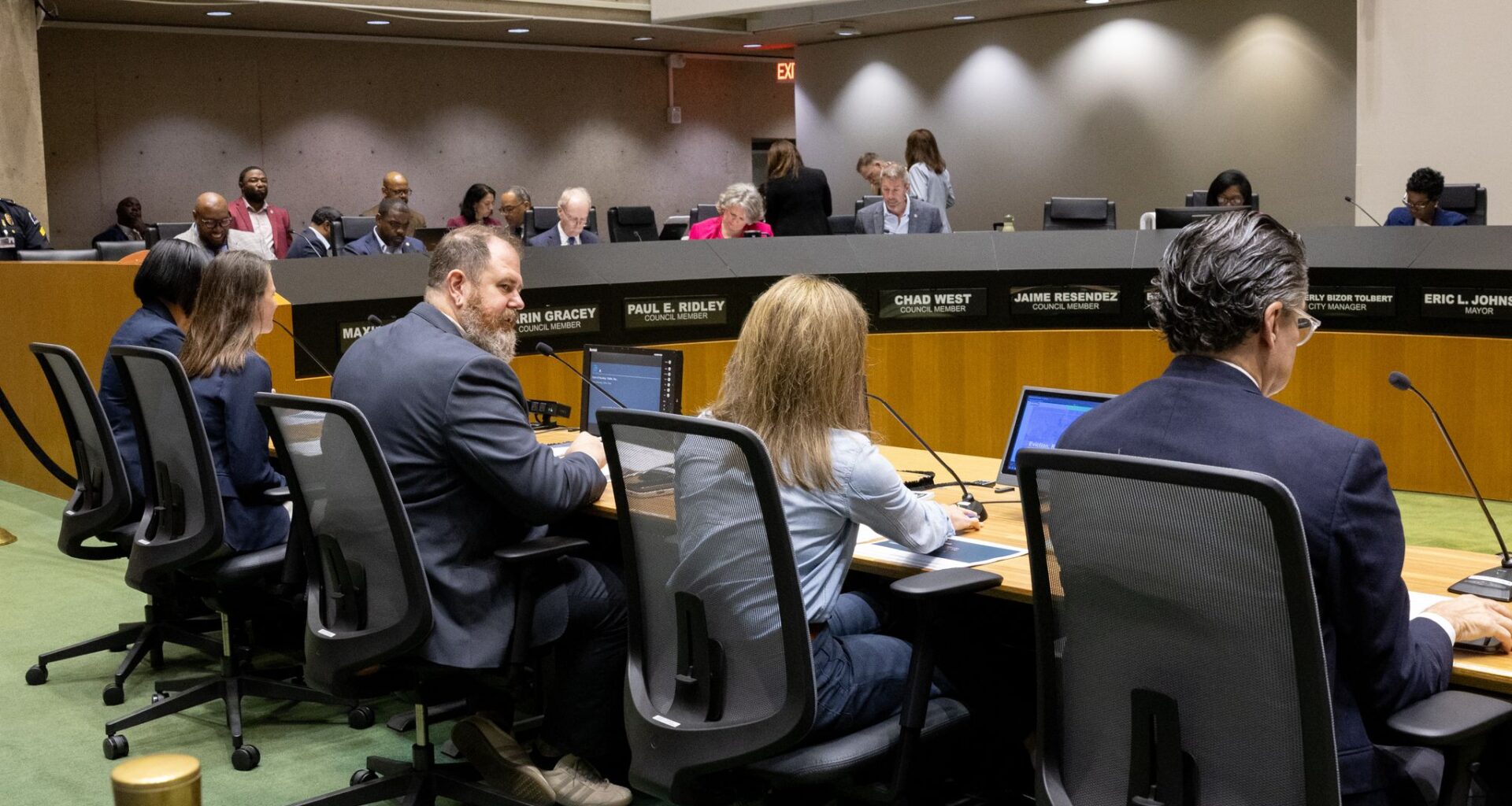
(From left at table) Nadine Dechausay, chief strategy and insights officer at Communities Foundation of Texas, Sarah Kahn, president & CEO of Housing Foward, Thor Erickson, director of the Office of Housing and Community Empowerment, Ashley Flores, chief of housing at Child Poverty Action Lab, and Cullum Clark, director of the Bush Institute-SMU Economic Growth Initiative, brief the Dallas City Council on the state of housing in the city at City Hall April 1.
Juan Figueroa/The Dallas Morning News
Dallas is facing a deepening housing affordability crisis.

A mismatch between supply and demand, especially for low-income residents, drove the conversation at Wednesday’s City Council meeting where council members were briefed on the city’s State of Housing report.
Article continues below this ad
Multiple organizations that work on housing policies and trends presented data on the lack of affordable rental units in the city, higher eviction rates, homeownership trends and potential new policies to maintain housing affordability for Dallas residents.
“The data is clear, we have a housing crisis in Dallas that we need to take seriously,” said council member Chad West, who represents District 1, which includes the Oak Cliff area.
Dallas is confronting not just an affordability problem, but a deep structural housing shortage that is reshaping who can afford to live in the city. With tens of thousands of affordable units missing, evictions rising and most low-income renters spending more than 30% of their income on housing, the pressures are mounting for residents across the region.
Make Dallas News a preferred source so your search results prioritize writing by actual people, not AI.
Add Preferred Source
City leaders now face a defining challenge: Can Dallas build and preserve enough housing to sustain its workforce, reduce homelessness and remain an economically competitive and inclusive city?
Article continues below this ad
During the meeting, Dallas City Manager Kimberly Bizor Tolbert introduced the new housing and homelessness policy, Dallas is Home.
“It’s a proposed framework that deals on the best practices of previous policies while pursuing a multipronged approach, reflecting Dallas’s diverse needs,” Tolbert said. “This is not a final policy; it is an opportunity for us to have a starting point, a structure that will require refinement with your guidance and with your vision.”
Affordable housing
While the city continues to grow and add housing, most new development leaves the most vulnerable households increasingly priced out, said Cullum Clark, director of the Bush Institute’s Southern Methodist University Economic Growth Initiative.
Article continues below this ad
Cullum Clark, director of the Bush Institute-SMU Economic Growth Initiative, presents as the Dallas City Council is briefed on the state of housing in the city at Dallas City Hall in Dallas, Wednesday, April 1, 2026.
Juan Figueroa/The Dallas Morning News
Dallas is short 46,000 units for low-income renters. This means tens of thousands of families cannot find housing they can afford. Only 28 units are available per 100 extremely low-income households.
Ashley Flores, chief of housing at Child Poverty Action Lab, said nearly all low-income renters spend more than 30% of their income on housing. Cost burden, when households overspend on housing and utilities, is linked to worse health, lower educational outcomes and economic immobility.
“It’s hard to be a renter in Dallas,” said Flores. “Renters in Dallas are using more and more of their household budget to cover rent and utilities. In the city of Dallas, 90 percent of all renters earning at or below 50 percent of the area’s median income are housing cost-burdened.”
Article continues below this ad
Flores said in Dallas, the rate of housing cost burden is not evenly distributed across the city. Council Districts 3 and 8 on the southern side of the city have the highest overall rate of renter cost burden at 58%. District 14, which includes Uptown, has the lowest overall renter cost burden at 37%.
Dallas delivered 8,395 new or rehabbed units in 2024. These new units came in every council district except Districts 5, which includes the Pleasant Grove area and 10 in far northeast Dallas. Districts 2, which includes downtown, and 6, which covers West Dallas, received the greatest number of newly delivered units.
“This is showing me a pattern of gentrification of what we’ve known is happening in West Dallas,” said council member Laura Cadena, who represents District 6.
Cadena asked to create a plan that addresses affordable housing preservation in the new housing policies moving forward.
Article continues below this ad
Evictions have surged
In 2025, about 27,995 evictions were filed in Dallas, averaging about 77 evictions per day.
Filings have more than doubled since COVID protections ended, Flores said.
In 2025, the largest number of evictions was filed in District 12, which includes Far North Dallas with 3,703, but District 8, on the southern side of the city, had the highest eviction filing rate, at 19%.
Article continues below this ad
Council member Cara Mendelsohn, who represents District 12, said the rates in her district were high because of the large number of apartment units, and that people working in the restaurant industry or similar were struggling to make ends meet.
Council member Bill Roth, who represents District 11, was skeptical of the data and said he would like to see more clarity.
“Eviction stat statistics are certainly an indication of some sort of economic, social housing-related deal,” said Roth. “But it’s just a number and you have to put stuff like that into context, and you have to explain that data is only as good as what it’s being analyzed for.”
Homelessness
Homelessness in Dallas is driven by systemic economic pressures Sarah Kahn of Housing Forward said. Kahn said the gap between incomes and housing costs leaves many households vulnerable to crisis.
Article continues below this ad
As a result, she said, thousands of new households fall into homelessness every year.
Sarah Kahn, president & CEO of Housing Foward, briefs the Dallas City Council on the state of housing in the city at Dallas City Hall in Dallas, Wednesday, April 1, 2026.
Juan Figueroa/The Dallas Morning News
Unsheltered homelessness tripled between 2015 and 2021, as the system in place took a fragmented approach. Since 2021, Dallas has shifted to a more coordinated, data-driven approach, improving prevention, outreach and housing placement.
This has led to a 28% reduction in street homelessness, even while the number of people entering homelessness has risen sharply, said Kahn.
Article continues below this ad
A major ongoing challenge for the city and Housing Forward is a system bottleneck, said Kahn. Not enough resources exist to move people out of shelters quickly, causing long stays and continued pressure on the system. In working toward a solution, she said the next phase of their Street to Home initiative aims to transform shelters into “launch pads” for self-sufficiency rather than waiting spaces.
Council member Maxie Johnson, who represents District 4 in southern Dallas, said he wants to see real solutions for individuals experiencing homelessness, especially for the youth.
A breakdown of Dallas homebuyers
In the Dallas-Fort Worth area, almost 60% of buyers are white, about 21% are Hispanic, about 13% are Asian and about 9% are Black.
Article continues below this ad
Nia Duggins, a senior Policy Representative with the National Association of Realtors, said in Dallas the median age of buyers is 41 and the median income is $126,440.
In 2025, for the first time in history, the median age of a first-time home buyer in the U.S. was 40 — an all-time high, Duggins said.
The median home price in Dallas County is $336,205, which is lower than the median home price in the country, at $405,400.
In 2023, 86.7% of Dallas homebuyers bought single-family detached homes, 5.9% single-family attached and 2.6% mobile homes.
Article continues below this ad
Moving forward
Council member Gay Donnell Willis said affordable housing, along with the programs and policies related to it, was important to help residents stay in stable housing.
Deputy Mayor Pro Tem Gay Donnell Willis speaks during a Dallas City Council briefing on the state of housing in the city at Dallas City Hall in Dallas, Wednesday, April 1, 2026.
Juan Figueroa/The Dallas Morning News
“We’re a prosperous city, and so it’s our obligation to take care of our residents,” Willis said.
Article continues below this ad

By signing up, you agree to our Terms Of Use and acknowledge that your information will be used as described in our Privacy Policy.
Thor Erickson, director of the Office of Housing and Community Empowerment, said this presentation will help the city move forward to shape Dallas is Home housing policies and programs.
From now to June, city staff will set up meetings with council members to deep dive into their districts and review district data, host community conversations and provide monthly updates.