
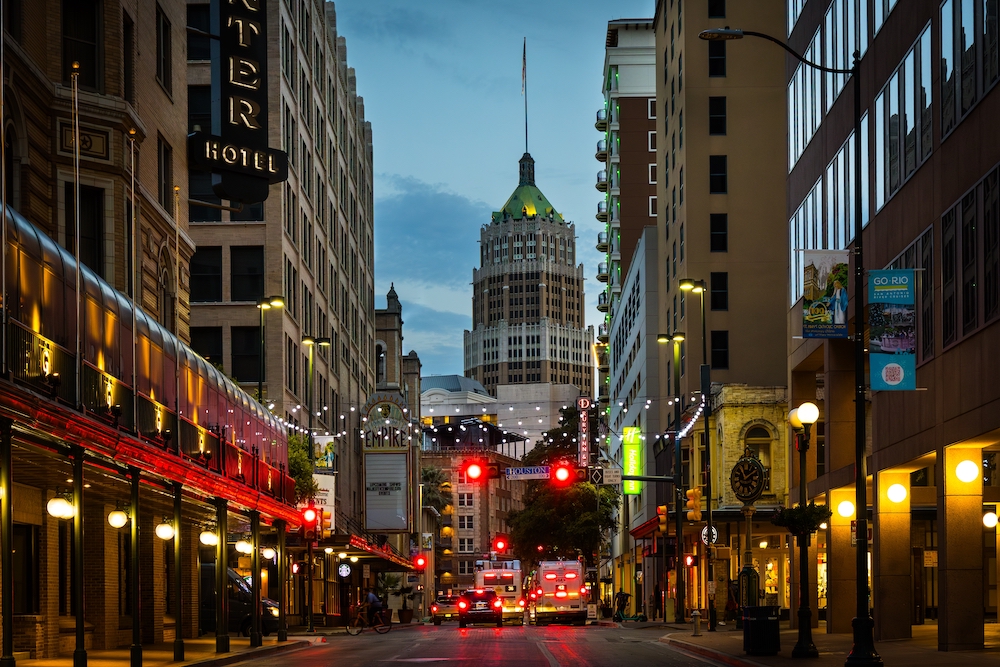
 The number of hotel room nights in San Antonio has plunged 12.1% since the city hit its 2019 tourism peak, according to data from consultancy Source Strategies. Credit: Shutterstock / NYCKellyWilliams
Last week, Designated Bidders LLC, the group which owns the San Antonio Missions minor league baseball team, unveiled renderings of its grand vision for its new downtown ballpark and surrounding economic development.
The publicly financed sports complex northwest of downtown will have capacity for 7,500 fans. The group also expects two apartment towers to be built nearby, along with an eight-story hotel with 160 rooms.
Just three miles southwest of the ballpark, another sports and entertainment district is taking shape at the same time.
Instead of a minor league baseball stadium, the publicly financed Project Marvel complex will be anchored by a new NBA arena for the Spurs. Hotels will feature prominently there too — at least one boutique property is planned, along with a possible new convention center hotel, although specifics remain murky.
And earlier this month, The Monarch, a 200-room luxury hotel managed by Hilton, opened at Hemisfair. That new development is located across the street from the Kimpton San Anto, a 347-room luxury property that opened in 2024.
To be sure, downtown San Antonio is awash in newly built luxury hotels.
There’s just one problem: demand is plummeting.
“We did expect the year [2025] to go better. It started off pretty strong in the first quarter, but a combination of things, and I think the Trump administration has done some things that have been harmful to our local hospitality industry,” Paul Vaughn, who heads data operations for hotel industry consultancy Source Strategies, told the Current.
“You’ve got Canadians actively boycotting the United States,” Vaughn elaborated. “You’ve got European countries who are issuing travel advisories not to come to the United States. That’s across-the-board bad for our hospitality industry, and it’s not just hotels. It carries on over to restaurants, bars, transportation services and entertainment services.”
The number of hotel room nights in San Antonio has plunged 12.1% since the city hit its 2019 tourism peak, according to Source Strategies’ numbers. Occupancies have dropped 14.4%, while room supply has increased.
That’s bad news for the Alamo City, where the tourism industry employs one in every eight people. Adding to the pain, the public financing for the competing downtown sports and entertainment districts — Project Marvel and the minor league ballpark — depends, in part, on hotels being full.
After all, Project Marvel “will be paid for primarily by visitors, not local residents,” city spokesperson Brian Chasnoff recently reiterated to the Current.
The question is: What if those visitors don’t come?
Breaking down the numbers
San Antonio’s economy has long been heavily dependent on tourism — more so than any other major Texas city.
Not only does our hospitality sector employ nearly 150,000 residents, it had a $21 billion economic impact on the city in 2023, generating nearly $300 million in taxes and fees, according to Visit San Antonio.
San Antonio missed out on industrialization in the late 19th century, in part because it was among the last U.S. cities to be connected to the national railroad system, but also because its risk-adverse business elite held a strong disdain for labor unions, according to Pomona College professor Char Miller.
“The entrepreneurial elite in San Antonio did not like labor unions; it didn’t particularly even like labor,” said Miller, whose focused his academic career on analyzing San Antonio’s history. “They needed it, but they liked it in a way that they could exploit.”
Some of that ambivalence came from local leaders’ unwillingness to spend money, some from an aversion to taking risks, but much stemmed from its eagerness to take advantage of a labor force that would work cheap.
“They effectively owned a city that was deeply segregated , and where labor could be exploited easily,” Miller added.
As a result, the business leadership of the era went all-in on tourism.
However, San Antonio’s cash cow is now in trouble.
Only 59% of the hotel rooms in downtown San Antonio were occupied in the final fiscal quarter of 2025, according to the most recent data available from Source Strategies. That’s a 17% drop since 2019.
Meanwhile, downtown Revenue Per Available Room, or RevPAR in the industry, for the final quarter of 2025 was down nearly 9% from a year prior.
Vaugn said the consistent post-pandemic decline in San Antonio hotel stays largely comes down to business and convention travel never recovering due to the rise of video conferencing, remote work and Zoom during the COVID era.
“There was a nice boom, especially with leisure travel,” Vaughn said of the post-pandemic world. “What we didn’t get back to that same degree was business travel and group convention travel. San Antonio had been a really good destination for conventions, big business meetings and that kind of stuff — especially in the wintertime. That stuff has not come back as strong now.”
Trump’s draconian immigration crackdowns, which have led to the high-profiled shooting deaths of at least three U.S. citizens, have also forced many international travelers, especially Europeans, Canadians and Mexican nationals, to reconsider travel to the U.S.
That’s rough news for a city which welcomed more than 2 million international visitors in 2023.
And, as mentioned earlier, it’s also a major speed bump for San Antonio’s ambitious sports-and-entertainment developments.
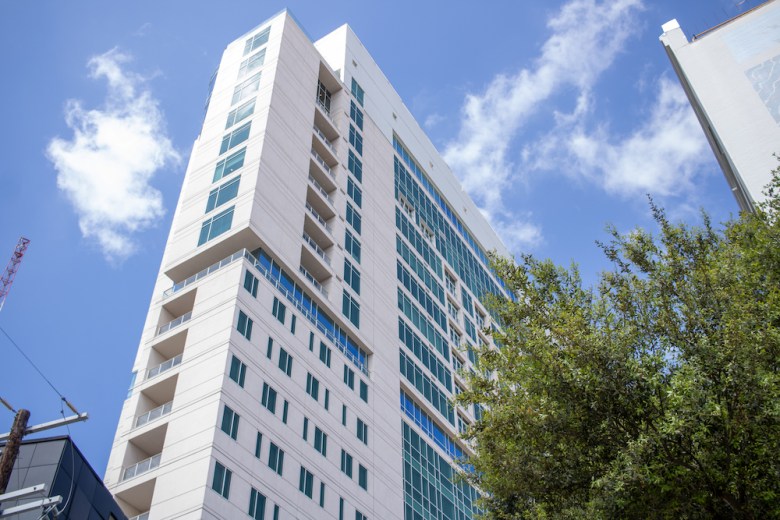 Lenders foreclosed on downtown San Antonio’s luxury Thompson Hotel last month. Credit: McKinley Thompson
Project Marvel
Endeavors such as Project Marvel – which city leaders hope will bring $4 billion into the downtown area around Hemisfair — could help boost downtown tourism, according to Vaughn.
“That’s a fantastic driver for stays in the downtown arena, which we need,” he said.
Even though the convention business has struggled nationally since the pandemic, Vaughn said San Antonio should expand the Henry B. González Convention Center as part of Project Marvel so it can “keep up” with other cities, including Dallas and Austin.
The new arena for the Spurs is projected to cost somewhere around $1.3 billion. About $311 million of the tax dollars funding it are coming from raising the county’s hotel occupancy tax by 0.25% and redirecting the existing 5% car rental tax.
However, with local tourism plunging and gas prices rising due to Trump’s war in Iran, some economists worry that projected tourism revenue will fall short, leaving the city and its taxpayers on the hook for the bonds.
“Almost always, the bonds that are issued to pay for these are backed by the full faith and credit of the municipality,” said Kennesaw State University’s economics professor J.C. Bradbury. “So, if there’s not enough money in tourism, well, then some money may come out of your property taxes [to make up the difference]. And they’ll say ‘Well, nobody could have foreseen this’ — even though it happens every single time.”
Bradbury also took issue with Vaughn’s argument that sports arena projects drive tourism.
“It’s been studied pretty extensively,” Bradbury said. “Most people who attend professional sports games are people who live locally in the community. There’s not a big boost in tourism at all.”
Neither outgoing Bexar County Judge Peter Sakai nor Spurs Sports & Entertainment officials responded to the Current’s request for comment on what San Antonio’s dwindling hotel taxes are likely to mean for Project Marvel.
A great destination?
With San Antonio missing out on the industrial revolution and unable to build any of its other industries into major contenders, it’s more or less stuck with tourism, according to economists.
Grand projects such as SeaWorld, Six Flags FiestaTexas and the Alamodome have extended visitor stays, but they have largely fallen short of promoters’ promises to transform the city into a next-level travel destination. Observers maintain new sports stadiums are likely to prove similarly disappointing.
If San Antonio is stuck with tourism as an economic driver, what can it do to get visitors coming back?
A new president — one that doesn’t make the nation an inhospitable place for travelers — would be a good starting point.
However, beyond the politics, the nature of travel has shifted, Andrea Baigorria, the CEO of the Tourism Lab, a Miami-based consulting firm, told the Current.
“What we’re seeing globally is that travel demand is still very strong – but the behavior has fundamentally shifted,” Baigorria said. “Travelers haven’t stopped prioritizing travel, but they’re approaching it much more intentionally and cautiously.”
In other words, the number of travelers hasn’t necessarily changed. Rather, the market has become hyper-competitive, leaving them with more options. Beyond that, people’s priorities have shifted.
“In 2026, people are looking for value-driven experiences. That doesn’t necessarily mean cheap – it means worth it,” Baigorria said.
Things like meaningful cultural experiences, walkable destinations that let travelers cut down on transportation costs while maximizing time to enjoy and explore, and “blesiure” — a blend of business and leisure travel — have all emerged as trends.
“This is not just about San Antonio,” Baigorria said. “Many destinations are seeing shifts in traveler behavior and stronger competition for discretionary travel spend. The issue is less about whether people are traveling and more about how destinations position themselves to meet changing expectations, preferences and value perceptions.”
Perhaps that means San Antonio should put a moratorium on luxury hotels until it figures out how they fit in with delivering on those new travel priorities.
Sign Up for SA Current newsletters.
Follow us: Apple News | Google News | NewsBreak | Reddit | Instagram | Facebook | Twitter | Or sign up for our RSS Feed
Related Stories
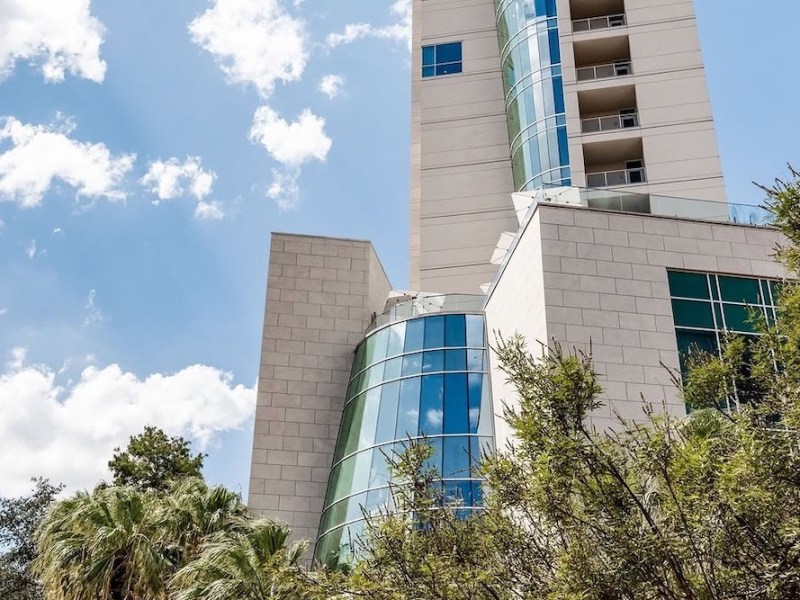
Houston-based DC Partners, which developed the luxury property said high interest rates and a flurry of downtown hotel openings cut into its earnings.
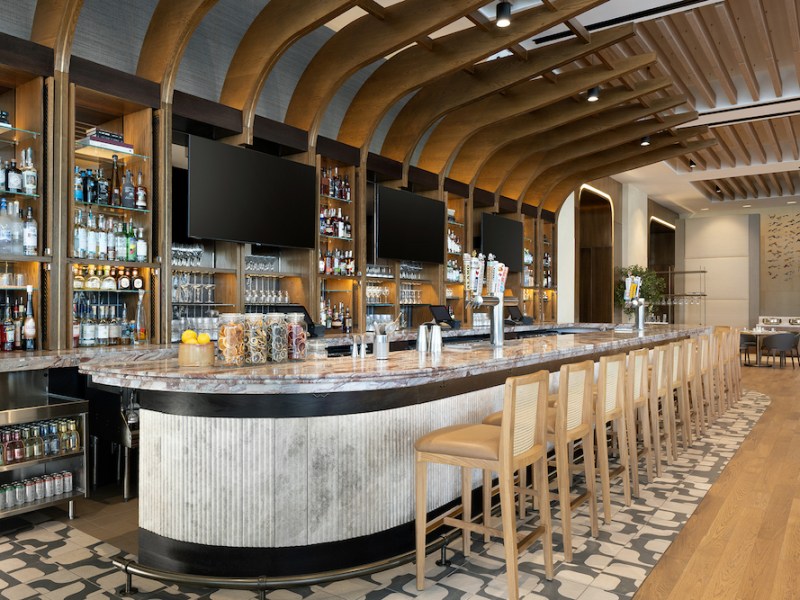
The new concepts include Italian eatery Moda Fare, the Texas-themed Tejas Lounge and an upscale coffee spot.