

Editor’s note: This story is part of a series that covers historical events, buildings and people that have made Arlington the place it is today while celebrating the city’s 150th anniversary.
Today, Arlington is a sprawling city that sits between Fort Worth and Dallas, but it was once a town of less than 10,000 people.
By the early 1930s, the city had somewhat of a wild side. With horses galloping along dirt tracks and men and women gambling underground, the Prohibition era was a stark difference from what the city is today.
Behind the gates of Arlington Baptist University lies the crumbling remnants of Top O’ Hill Terrace, once an infamous casino in the 1930s and 1940s, according to the Texas State Historical Association.
The original tearoom was opened in 1921 by Thomas and Beulah Marshall, as Mrs. Marshall’s business. As a restaurant in a prime location, the tearoom was particularly popular for ladies’ brunches, bridal showers and tea parties. The Marshalls owned the property until 1930, when Charles “Fred” Frederick Browning purchased the property from them.
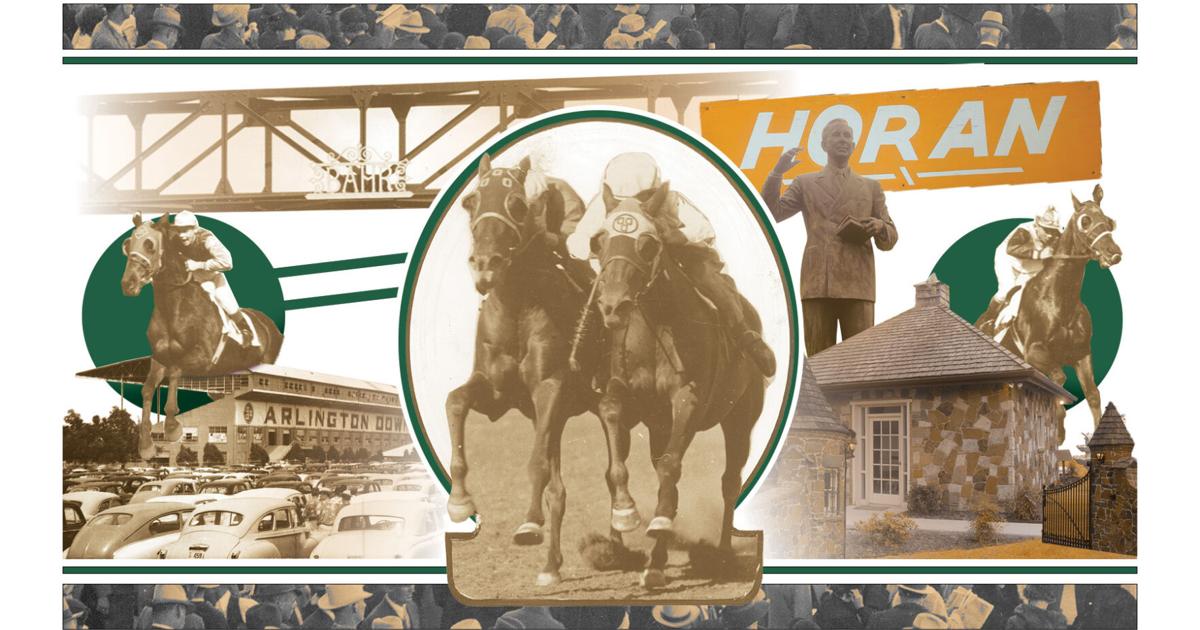
Browning bought the property due to its proximity to Arlington Downs, a horse racing track at the time, according to the historical association.
Arlington Downs was built in 1929 by William T. Waggoner, a wealthy oilman and rancher. The structure cost around $2 million at the time and was the first major recreation venue in Arlington, according to City of Arlington landmark signage.
At the time, Texas did not allow parimutuel betting, also known as pool betting. Erica Rousseau, UTA Libraries processing archivist, said Waggoner took a gamble building the venue. However, after campaigning for its legalization, the gamble paid off when the Texas Legislature legalized parimutuel betting in 1933.
Rousseau said Waggoner didn’t enjoy the success for very long, dying in 1934. Shortly after, in 1937, the law legalizing parimutual betting was repealed, she said.
“The downs went downhill after that,” Rousseau said.
The Arlington Downs’ horse racing era saw successful attendance from the opening until the end of gambling, she said.
“The venue was unique to the city,” she said. “It represents a bubble in time of people really seeking entertainment, whether it was through Depression era, or wartime, or postwar time.”
Rousseau said Arlington Downs was eventually sold to commercial developers, where it would be used for a multitude of events, like air shows, rodeos and a different kind of racing — one with cars.
“There were three years from 1947 and 1950 that Arlington Downs hosted AAA championship car racing, which is the foundation for modern IndyCar,” she said.
At the height of the racing, Clark Gable, a known visitor of Top O’Hill Terrace, filmed “To Please a Lady,” an action romance film, according to the historical association.
Joseph Carpenter, history and geography communications assistant, said with the initial success of Arlington Downs, Browning’s business took off at Top O’Hill Terrace. From 1933 to 1937, people would attend the horse races during the day, and then go to Top O’Hill Terrace at night, he said.
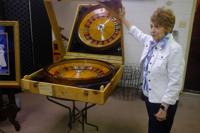
Vickie Bryant, Top O’Hill Terrace curator, stands next to an original Top O’Hill Terrace roulette table. Bryant collects artifacts from the former casino.
After purchasing Top O’Hill Terrace, Browning installed security measures to combat police raids, including sandstone walls along the driveway, guard towers, an iron gate and tunnels. Visitors were vetted by guards and had to pass security checkpoints before being allowed into the house.
It’s rumored that many famous and infamous people graced the doorstep and whispered passwords to enter the world below the restaurant. Bonnie and Clyde, Will Rogers, Ben Hogan, Duke Ellington, Frank Sinatra and more have been suspected of visiting the casino, said Vickie Bryant, Top O’Hill Terrace curator.
The opulent basement featured famous musicians, ample alcohol and prostitutes from the brothel.
“Some people reported that Fred Browning made up to 8 million in his lifetime,” Carpenter said. “What 8 million would be worth today [is] in the neighborhood of 200 million. And when he died, he left his wife 10,000 dollars, so that was how much he had fallen.”
One of the biggest obstacles in Browning’s career as a casino owner was J. Frank Norris, a Baptist pastor who was against gambling and drinking, Carpenter said. His mission was to shut down Top O’Hill Terrace.
“He was a real crusader for morality, and so he was involved in a raid at Top O’Hill House in 1933. He had convinced a grand jury to give him and some constables a warrant,” Carpenter said. “That was sort of successful, but Top O’Hill was back in business in no time.”
He said Norris was an early version of a “megachurch pastor,” having owned a newspaper and radio and traveled the country preaching. His nickname was the “Texas Tornado.”
“If you insulted him or embarrassed him, he was going to blow you away,” Carpenter said. “You were going to be crushed by him. All of that is because of his surety that he was called by God.”
Though he died in 1952, he imparted his knowledge to his church.
“In Frank Norris’ mind, I have no doubt that this was a prophecy that he saw in the future. This is going to happen,” Carpenter said.
“Speaking these things with conviction into belief is what J. Frank Norris believed he was doing, in my opinion.”
In 1947, Texas Rangers raided the property, signaling the beginning of the end, Carpenter said. It was the third raid by the Rangers in a 12-year time frame, and it caught everyone in the act.
“People were fighting the gambling crowd, the liquor crowd, trying to clean up Tarrant County, and our founder was leading the charge,” Bryant said.
Browning’s business was run into the ground when visitors became scarce. He sold the property in 1951, and it became the Arlington Club before he reacquired it before he died in 1953. Carpenter said Bible Baptist Seminary, now Arlington Baptist University, purchased the property in 1956.
Bryant has spent over two decades preserving and exploring the history of Top O’Hill Terrace, conducting tours and sharing the property’s history.
Top O’Hill Terrace has worn with time.
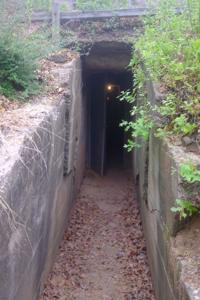
An exit lies at an underground tunnel at Top O’Hill Terrace. Multiple tunnels exist under the structure.
Many underground passages have been lost after the university filled them with dirt in the 1960s, Bryant said. Students were getting into the tunnels, which were unsafe.
However, half a century later, efforts are being made to locate those tunnels.
“We think we have a maze of tunnels and rooms,” Bryant said.
Parts of the tea garden are in danger of collapsing, she said. The retaining wall collapsed 10 years ago and was a pile of rubble for several years, Bryant said.
“The city had money set aside to do something before COVID, but when the pandemic hit, all that stuff went up in smoke,” Carpenter said. “As far as active plans go with the city, I’m not aware of any that are actively going on right now.”
The Arlington Downs was demolished in the late 1950s, according to UTA Libraries, with only a fountain etched with horses and their jockeys standing in what was the first whisper of an entertainment district.
But sometimes history repeats itself.
In mid-March, the city hosted the inaugural Java House Grand Prix of Arlington NTT IndyCar Series race, bringing back a tradition that was once long gone.
“The modern race track is less than half a mile away from the edge of the old racetrack,” Rousseau said.
While there is no more underground gambling at Top O’Hill Terrace and a parking lot now stands on the dirt where horses galloped and cars sped by at the Arlington Downs, some history remains, while some remains to be seen.
@wall035203 @atclements03