
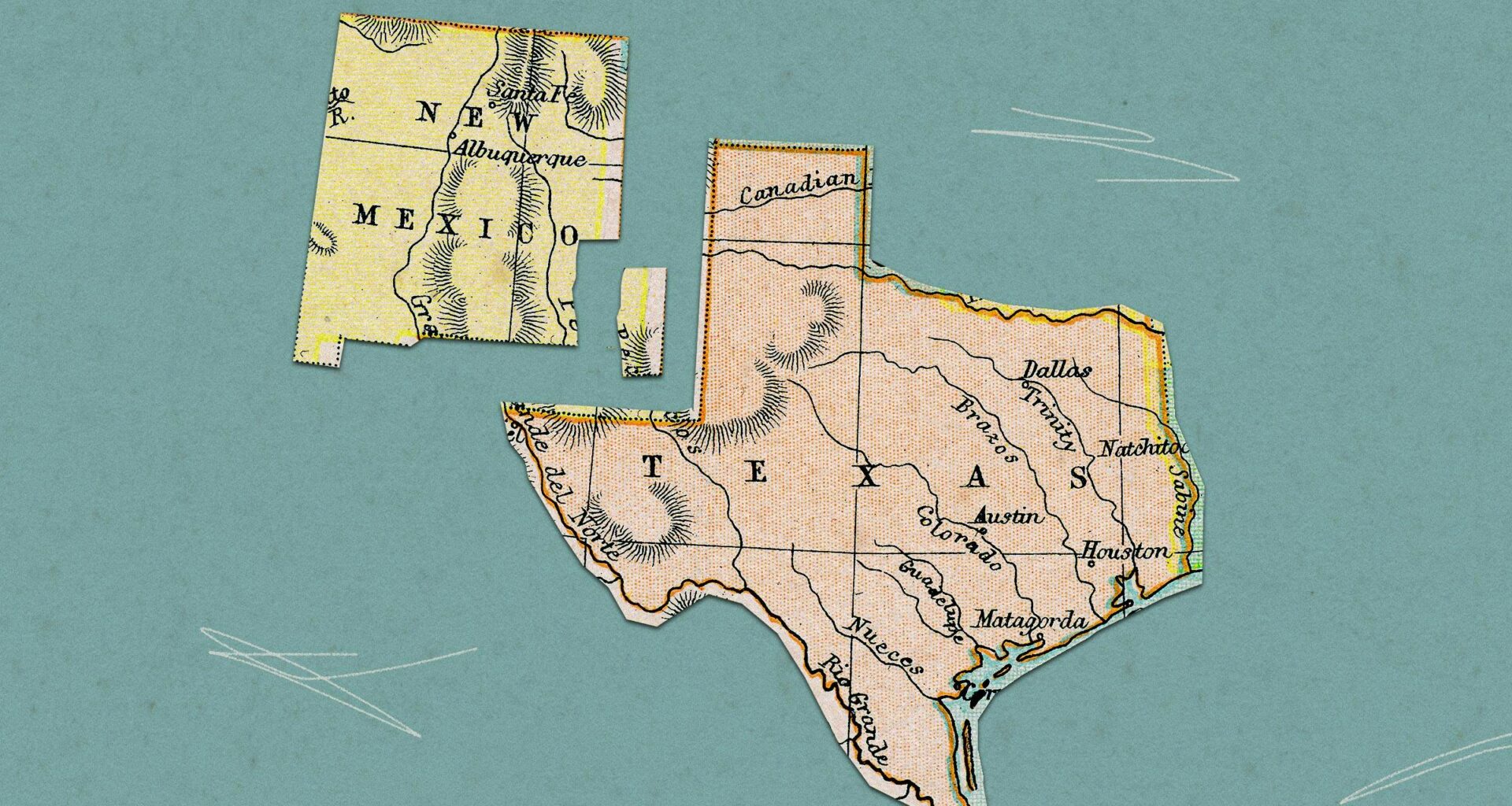
Last week, the Texas House of Representatives published the interim committee charges for the Eighty-Ninth Legislative Session, and there was a surprising item in the 53-page document: The Select Committee on Governmental Oversight would be exploring the impact and feasibility of adding one or more adjacent New Mexico counties to Texas.
This, understandably, was a bit of a head-scratcher for Lege observers, especially in a document mostly focused on less-novel issues such as teacher retention and data center construction. The question of whether Texas really planned to annex part of New Mexico quickly became international news; a spokesperson for New Mexico Governor Michelle Lujan Grisham told The Guardian the proposal was “not a serious” one. But we live in unserious times, so let’s do our best to understand what’s going on here.
Which part of New Mexico are we talking about here?
Southeastern New Mexico—most prominently Lea County, a 4,393-square-mile chunk of the state shaped like an upright rectangle with some protruding bits on its western edge. (It’s on the bottom right of the state, if you’re looking at a map, just below Roosevelt County, which is another one Texas might be interested in.) Lea County alone is not a small bit of property; it’s bigger than Delaware and Rhode Island put together.
Why do Texas lawmakers want it?
Partly because folks in that part of New Mexico seem to want to join Texas—according to local officials in the county, residents there feel a bit alienated from the rest of their state. The rectangle that is Lea County is about seventy miles west of Lubbock at its north end and about sixty miles from Odessa at its southeast tip. Many residents, their representatives say, feel they have more in common with their West Texas brethren than with the relatively progressive state legislature in Santa Fe.
Bringing these conservative New Mexicans into Texas would both increase the size of the GOP majority here (although not by a huge number—despite its size, Lea County only has about 75,000 people) and bring federal funding from New Mexico to Texas. The fact that Texas would add an additional large chunk of oil patch to the state isn’t unattractive to the Texas Republicans who put this on the list of charges, either. (Lea County was also part of the Republic of Texas during our brief but fondly remembered stint as our own nation, which has additional appeal to legislators susceptible to a certain strain of Texas pride; House Speaker Dustin Burrows said Lea County “rightfully belongs” in Texas.)
Can they just . . . do that?
Well, no, which is part of why Lujan Grisham’s spokesperson described the proposal as unserious. Other New Mexico lawmakers have been similarly dismissive—the Speaker of the state’s house, Javier Martínez, told Burrows to “get offline” and “touch some grass” in response. Changing the territorial boundaries of either state would require the approval of Congress, which can’t even agree on whether to pay TSA agents right now.
So is this a troll job?
Also no, or at least not entirely. In January, state representatives for Lea County proposed an amendment that would put the issue of secession on the ballot for residents. That proposal isn’t going anywhere—it’s been “postponed indefinitely,” which is legislature-ese for “dead”—but it indicates that as far as legislative trolling goes, this idea has support on both sides of the border.
Has anything like this been discussed anywhere else?
Oh, yeah. Indiana actually passed a law last year that would allow parts of southeastern Illinois to become Hoosiers (the companion bill in Illinois died in committee, which you’ll begin to see as part of a trend). Idaho and rural eastern Oregonians have enjoyed a similar flirtation in recent years. The reason in these cases is similar to the one here: Conservatives who feel trapped by their progressive state government want to join a more politically aligned neighbor, and leaders of that neighboring state would enjoy the benefits of adding a bunch of new land and residents for free.
How would this work, if it were to happen?
Both states would have to pass a law, which is unlikely, given that New Mexico’s government has plenty of reasons to oppose the measure and no real reason to favor it. But if that were to happen, then Congress could approve the transaction, and Texas would have a new shape.
Wait . . . a new shape?
Yep. Say goodbye to the distinct ninety-degree angle on the left side of Texas, in the Great Plains, and hello to a bubblier-looking new Texas. Please throw away your old waffle irons and replace them accordingly. (But hey, at least we all get a little more waffle!)
I don’t like that!
Of course you don’t. Literally one of the last things everyone in Texas can agree on is that we like the way it’s shaped.
When was the last time a state annexed part of another state?
Back in 1961, Minnesota gave a li’l twenty-acre sliver of itself to North Dakota in order to ease some flood-control decisions on the Red River (a Northern river by the same name, not the real one in Texas). North Dakota accepted, Congress assented, and the transaction was made. Bear in mind that that was a piece of land about 1/125,000th the size of Lea County. But even figuring out what to do with tiny bits of land between two states, if both aren’t in agreement, can be contentious. The “Delaware Wedge,” a single square mile at the intersection of Delaware, Maryland, and Pennsylvania, was under dispute by the three states from 1681 (!!) to 1921, when Delaware finally received it. Another jurisdictional issue involving Delaware came up a little less than twenty years ago, when the state was sued by New Jersey over who had control over certain portions of the Delaware River for purposes of a BP pipeline. (Delaware won that one too; don’t mess with Delaware!) All of which is to say that territorial integrity of states is a big deal, and there is a good reason these things haven’t changed much.
So we’re not about to welcome 75,000 new Texans?
It is deeply unlikely that we will do so via annexation, unless we want to go to war with New Mexico and perhaps the federal government. But don’t worry; that many people move here roughly every four months, so we’ll keep growing—just, you know, the normal way.
Read Next