
It’s not every day a space rock explodes over Houston in broad daylight. It’s even rarer when scientists can walk outside days later and pick up pieces of it.

That’s exactly what happened after a one-ton meteoroid broke apart about 29 miles above North Houston around 4:40 p.m. on March 21, triggering sonic booms and an airburst equal to about 26 tons of TNT, according to NASA.
Fragments from that explosion likely fell across a wide “strewn field” stretching from the Louetta area north toward Spring. Within days, scientists started finding them.
Article continues below this ad
One of those scientists, NASA planetary scientist Marc Fries, spent several days searching the predicted impact zone using weather radar, seismometers and eyewitness reports. By Tuesday evening, he found a piece right where he expected it—in a grassy strip along Cypresswood Drive near Barbara Bush Branch Library.
The spot along Cypresswood Drive in North Houston where NASA scientist Marc Fries recovered a meteorite from a rare daytime fireball.
Marc Fries
That fragment is among at least 13 meteorite stones found so far, and some are now being studied at Rice University.
What the meteorite looks like
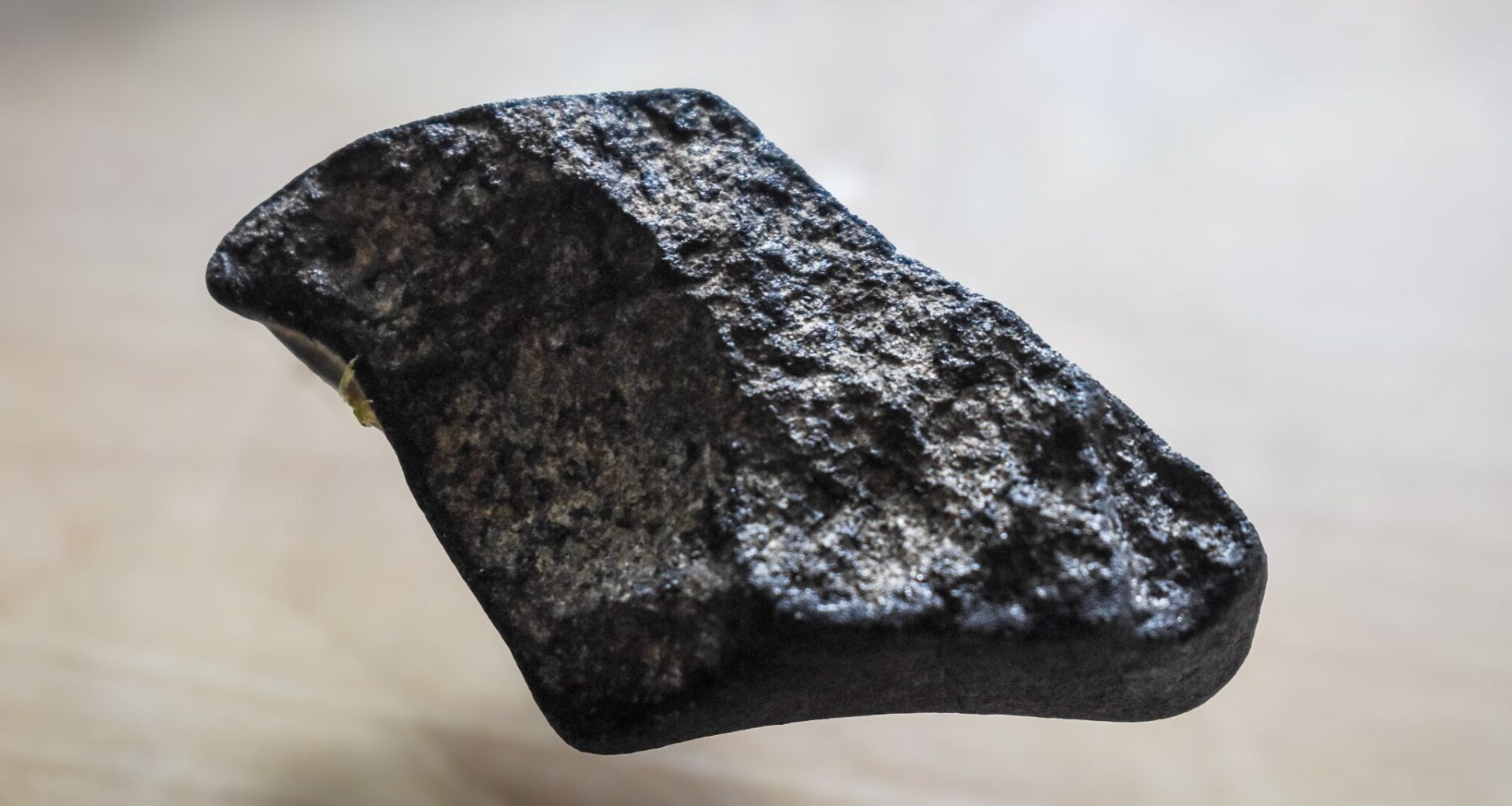
One fragment Marc recovered weighs about 46 grams and looks unassuming at first glance: dark gray on the outside, lighter inside.
Article continues below this ad
A meteorite fragment found along Cypresswood Drive in North Houston after a rare daytime fireball on March 21.
Linda Welzenbach, Rice University
“This one is actually covered with fusion crust,” said Linda Fries, a science writer at Rice University and Marc’s wife. “It broke up very high in the atmosphere while some of the melted material was still flowing around it, coating the surface.”
That thin black layer—essentially natural glass—forms as the rock tears through Earth’s atmosphere at extreme speeds. Friction heats the surface enough to melt it, and as the rock slows, that material cools into a crust.
Article continues below this ad
“The fractured face looks dark, but the inside is very bright, light gray,” she said. “It’s very fresh.”
How to tell it’s not just a rock
Meteorites can be easy to miss, especially in a place like the Gulf Coast, where most rocks are small, rounded or brought in for landscaping. But this one stood out.
“This clearly looks distinctly different,” Linda said.
Article continues below this ad
Linda Fries, a science writer at Rice University, holds a meteorite fragment recovered after a rare daytime fireball over North Houston.
Ariana Garcia
She said meteorites often have a noticeable contrast between their dark outer crust and lighter interior, along with a smoother, slightly melted shape from tumbling through the atmosphere.
Some are also magnetic due to iron content, though not all. This one contains very little metal.
Why scientists are excited
The Houston meteorite is classified as an “ordinary chondrite,” the most common type of meteorite—though the name is misleading.
Article continues below this ad
“We call them ordinary only because about 85 percent of meteorites fall into this category,” Linda said. “That doesn’t make them ordinary by any stretch.”
These rocks are especially valuable because they’ve remained largely unchanged since the earliest days of the solar system.
“They preserve material from when the sun and planets were first forming,” she said. “They tell us what the starting materials of planets may have been.”
This particular meteorite also has a more unusual feature. Linda said the meteorite is “brecciated,” meaning it shows signs of past impacts in space. It’s made up of broken fragments fused together with dark veins likely formed from melted rock early in the asteroid’s history.
Article continues below this ad
“It kind of falls apartvery easily,” she said, a sign it experienced significant shock from those collisions.
How scientists figure out where it came from
Now comes the detailed lab work.
At Rice’s Astromaterials and Exploration Laboratory, researchers are running tests to better understand the meteorite’s composition and origin.
Article continues below this ad
Tao Sun, an isotope geochemist at Rice University, studies a meteorite fragment in the Rice Astromaterials and Exploration Laboratory.
Ariana Garcia
Early measurements suggest it falls between two subtypes based on iron content. To narrow that down, scientists will analyze its chemistry and oxygen isotopes—essentially a fingerprint that can link it to its parent body in space.
“We don’t need a lot,” said Tao Sun, an isotope geochemist at Rice. “Just a few milligrams.”
Tao Sun works with a tiny meteorite sample, just a few milligrams, in a Rice University lab.
Ariana Garcia
His team will heat the sample to extract and measure oxygen from the rock, helping to determine where it came from.
Article continues below this ad
“The idea is quite simple,” Sun said. “We want to know what it’s made of and where it’s from. Those small differences in isotopes help us trace that origin.”
Gelu Costin analyzes a meteorite sample mounted in resin at Rice University using an electron microprobe.
Ariana Garcia
Gelu Costin, a research scientist and lab manager at Rice, said the team uses an electron microprobe to run “quantitative point analysis” on tiny spots within the rock, revealing its composition and texture. The sample is mounted, polished and coated, then placed in a vacuum and hit with a focused beam of electrons.
A race against time
More fragments are likely still out there, though most are expected to be small. The largest piece—estimated between 500 and 800 grams—crashed through the roof of a home in the Ponderosa Forest area. Another, weighing about 61 grams, was found by a family the following day.
Article continues below this ad
“Meteorites will float, so rain could carry them away,” Linda said. “And they can start to break down pretty quickly.”
The meteorite sample is secured inside a membrane box that forms a seal to keep humidity from reaching the rock.
Ariana Garcia
That’s because tiny bits of iron inside the rock can rust when exposed to moisture, causing the meteorite to crack apart. Even handling them with bare hands can speed up that process.
Article continues below this ad
Just how rare is this?
Events like this are extraordinarily uncommon, especially in a major city. Earth is constantly bombarded by material from space—about 50 metric tons a year—but most of it is dust. Larger objects, especially ones big enough to drop recoverable pieces, are rare.
“We might see something this size about once a year, if we’re lucky,” Linda said.
Finding pieces is even harder. Most fall into oceans, forests or unpopulated areas. That’s part of what makes this event stand out.
Article continues below this ad
“It is now a piece of Houston history,” she said. “Meteorites that fall in a large metropolitan area are incredibly rare.”
Scientists plan to preserve part of the sample at Rice, with the possibility of putting it on display.