
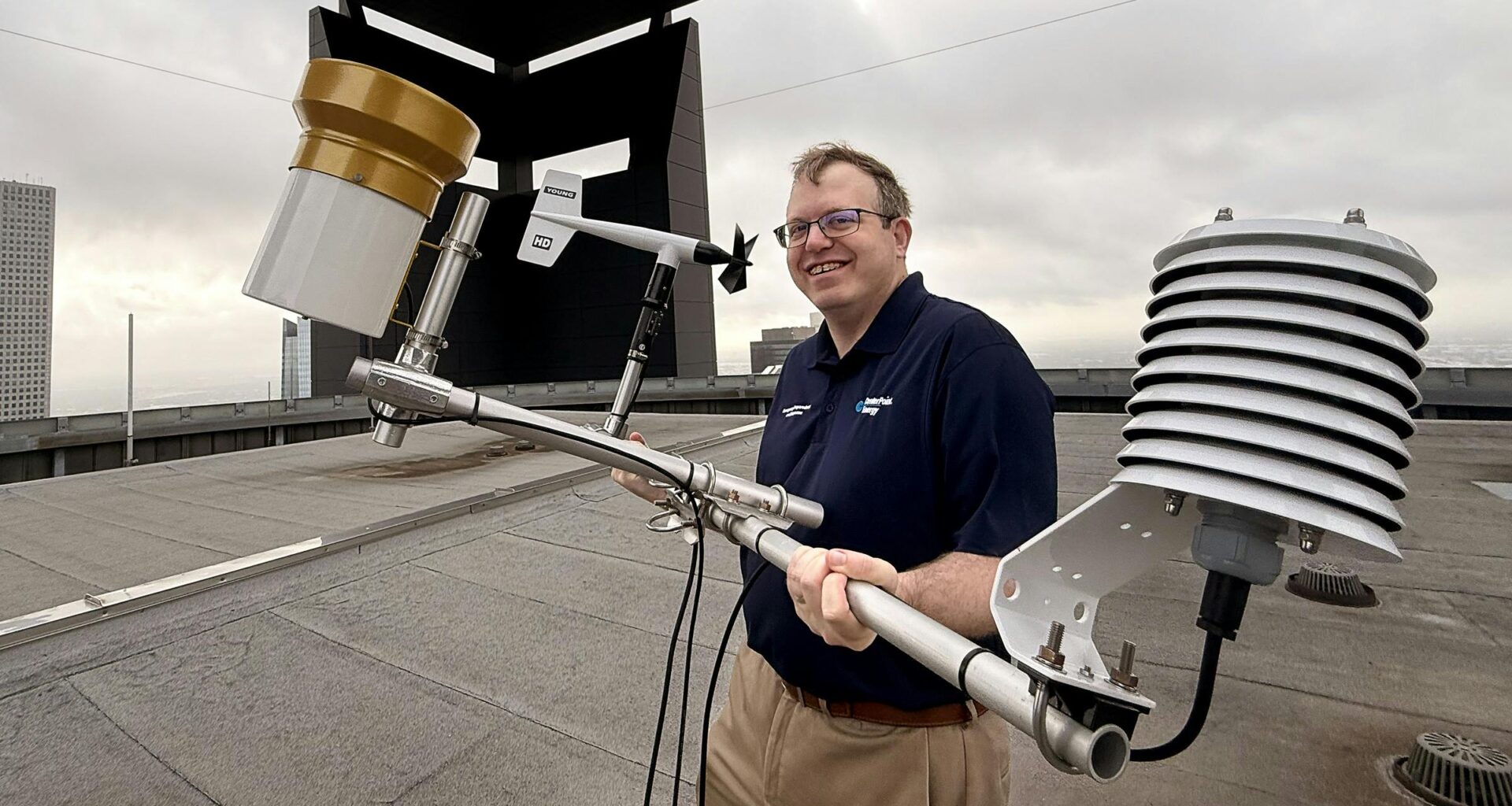
Since moving to Houston in 2012, meteorologist Matt Lanza has seen it all. Freak windstorms. Record-setting freezes and droughts. Hurricane Harvey (2017), Tropical Storm Nicholas (2021), and Hurricane Beryl (2024). For the past eleven years, Lanza has shared his “hype-free” forecasts on Space City Weather, a bare-bones blog that he runs with fellow meteorologist Eric Berger. The website enjoyed a modest following until Harvey dumped some 27 trillion gallons of rain over southeast Texas and Louisiana, sending Houstonians scrambling for a reliable forecast. The site received around four million page views over the course of the disaster. Now it’s the first place many people turn when the forecast darkens.
Last week, Lanza announced that his family was moving to Connecticut, partly to be closer to his elderly parents and partly because Houston’s extreme weather had become a little too extreme, even for a professional. “I do worry about our vulnerability here to hurricanes, and not just Beryl-type storms—much bigger storms,” he explained. He’s leaving his day job at CenterPoint Energy, the Houston utility where he serves as chief meteorologist, but will continue contributing to Space City Weather and its sister site, The Eyewall, which focuses on Atlantic hurricanes.
Texas Monthly conducted an exit interview to find out why Lanza is so spooked and whether the rest of us need to be equally alarmed. This interview has been lightly edited for length and clarity.
Texas Monthly: Tell me about your decision to leave Houston.
Matt Lanza: My parents are getting older. We’ve got two kids, and my parents only get to see them once a year. That started stirring up thoughts of moving. It was that combined with just being done with hurricane stuff for a while. It’s a different world now than it was five or ten years ago in terms of how we forecast and cover hurricanes. We have to constantly talk people off the ledge.
TM: What do you mean by that?
ML: It used to be that if there was a storm in the Atlantic, seven or eight days out, people might not give much thought to it. Now people see something like that on social media and panic, no matter how much you educate them. There are people on social media trying to score engagement points. We have to constantly battle people that are scaring people for engagement. It gets tiring.
TM: Then again, there’s always the possibility of Houston getting hit by the big one. How much did that factor into your decision to move?
ML: We’ve dealt with everything in Houston during my time here. It’s been incredible to see the variety of extreme weather we get—cold, hot, drought, flood, hurricane. As a meteorologist I’m fascinated and intrigued by that. But at a certain point I was like, is it better for me to be doing this job from somewhere else rather than constantly having to juggle both informing people and worrying about my family?
The primary reason for moving is definitely my parents. But I’m not going to lie—I don’t want to go through another summer 2023 [the hottest Houston summer on record]. I don’t want to see another Winter Storm Uri [which led to the failure of the Texas electric grid in 2021]. We had a newborn at the time. We only lost power for 36 hours, but it was scary.
TM: A lot of people will see your decision to leave Houston as the canary in the coal mine. If a meteorologist as knowledgeable as you is worried enough to move away—even though you have family reasons as well—how should other Houstonians be thinking about the risks?
ML: The housing market is already responding to that concern through all the building that’s going on to the northwest of Houston—in Fulshear, Magnolia, Waller counties. Our whole center of gravity is shifting inland. I’ve seen some comments on my post that are like, “A meteorologist is leaving; what does that say about the rest of us?” I’m concerned, but do I think Houston is going to become uninhabitable? No, I don’t.
TM: What’s the worst-case scenario for a direct hurricane hit on Houston?
ML: The worst case is a category 4 or 5 hurricane that makes landfall near Galveston and goes up the Houston Ship Channel. You would have massive flooding in the Bay Area and the ship channel. There are things that we know will happen if there’s a large-enough hurricane. We know how bad it will be.
TM: It’s been nearly twenty years since Hurricane Ike, and the Ike Dike—a proposed coastal barrier to protect the Ship Channel from hurricane storm surge—remains basically a plan on paper. Is the project necessary?
ML: The Ike Dike is not some pet project that we build to let people live near the coast in big houses. It’s a national-security project. The economic ramifications of a category 4 or 5 hitting the ship channel directly would be really bad for everyone in the country. The social toll, the economic toll, the environmental toll would be unspeakably bad. I don’t think anyone in the country fully appreciates that risk. That’s why we need to continue to invest in these mitigation projects, because that’s what ensures Houston’s survival into the next century.
TM: You’ve noted that nine of the fifteen hottest summers in Houston’s recorded history have occurred since 2009. What role does global warming play in that and in the intensity of recent storms?
ML: The reality is that climate change is happening. There’s no refuting that. It acts as a kind of force multiplier, which is to say that if you have an extreme event, climate change makes it a little bit worse. The best analogy I’ve heard is, you’ve got a baseball player that is taking performance-enhancing drugs, and maybe they hit 68 home runs. Without the drugs, maybe they would have hit 55. Climate change is the performance-enhancing drug of weather.
TM: You became CenterPoint Energy’s chief meteorologist in 2024. Why did you go to work there, and what does your job involve?
ML: They decided that they really needed to build up their weather-intelligence operation. Basically I got free rein to build a weather platform. We installed a hundred weather stations across the area. I was thinking about the 2024 derecho [the sudden windstorm that killed eight Houstonians and knocked out power for one million customers]. I wanted to build something so you could see that coming and prepare for it. What would give the company the extra hours of lead time they needed to prepare a response?
TM: CenterPoint received a ton of criticism for its failure to adequately plan for Hurricane Beryl, in 2024. Was any of that deserved? And do you think they’ve learned from that disaster?
ML: Space City Weather was very critical of them as well, which is why I give them a lot of credit for hiring me. They could have said, “This guy threw us under the bus like everyone else, so the hell with him.” I think they recognized that they needed better forecasting.
TM: Then there’s a separate issue with ERCOT and the reliability of our state electrical grid. Is the grid more resilient now?
ML: I definitely think we’ve done a lot of good things in the wake of 2021. If you had a similar type of freeze, the end result would be a little bit different than what we saw then. I’m not going to say it would be perfect or it would be fun, but it would hopefully not be as horrific. There’s been a lot done to mitigate against that.
TM: Tell me a little about your new job. You wrote that you’ll be “helping commodities traders with weather intelligence.”
ML: There are different companies across the country—hedge funds, commodity houses, banks that trade commodities—that need to understand how weather’s going to impact prices, demand, all these different things. It helps if a shop has the expertise to understand that. I can’t say where I’m going, but it’s that type of environment. It’s still forecasting, but it’s more big picture: how everything connects to impact energy demand.
TM: What are you going to miss the most about Houston?
ML: The food. Every time I’ve gone somewhere else, either for a conference or a vacation, I’ve found good food. But it’s not the same. The average restaurant in Houston is so much better than the average restaurant almost anywhere else.
Read Next