
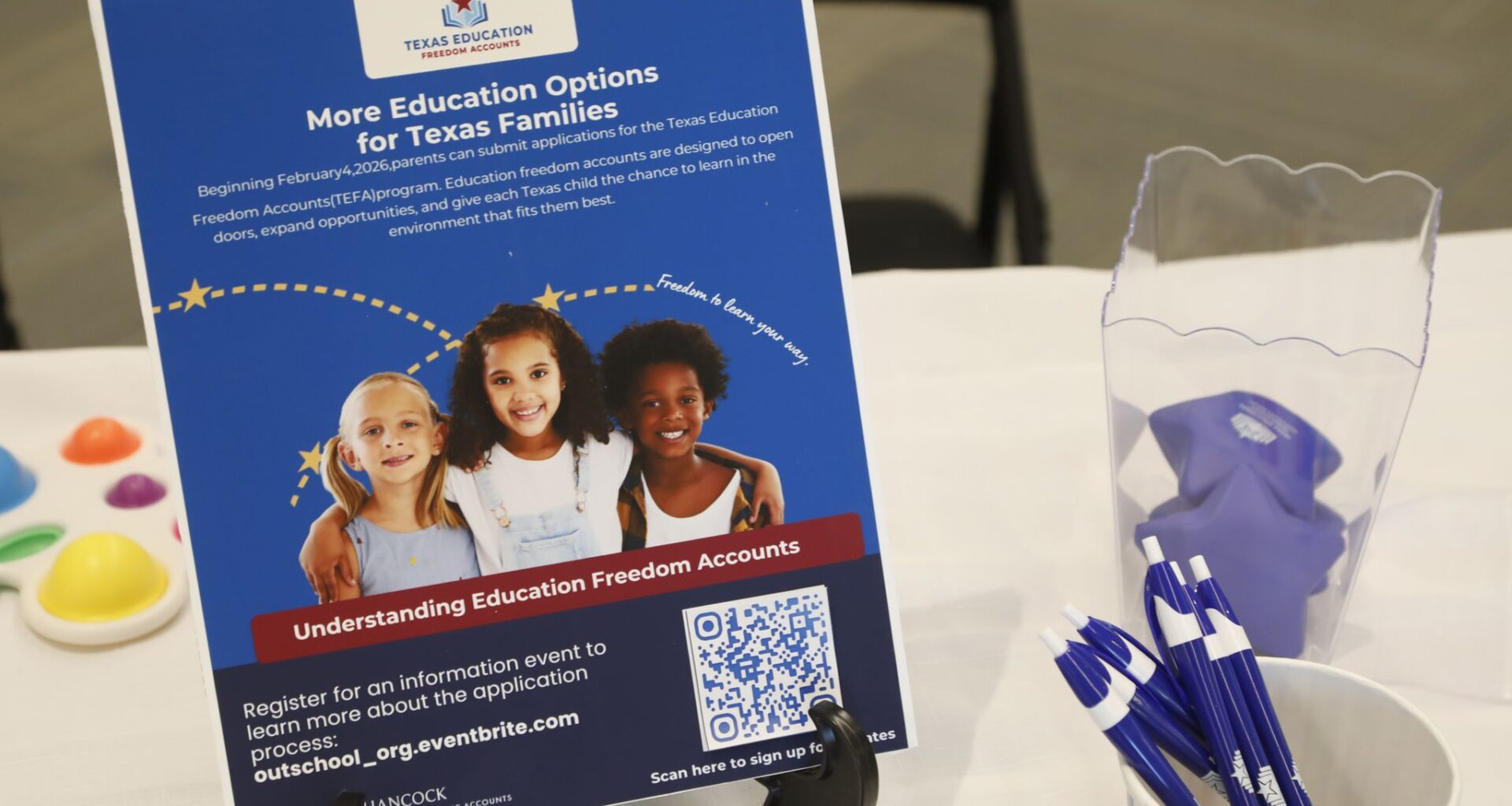
The Texas Education Freedom Account program is expected to run out of first-year funding before it reaches all students in its first two priority categories, the Texas Comptroller’s Office reported Thursday.
The voucher-like program’s application period closed Wednesday night after the deadline was extended by two weeks by a federal judge in a lawsuit filed over the exclusion of Islamic schools from the program. Nearly a quarter million students applied for funding for the program’s inaugural year.
The $1 billion program, approved in the last legislative session, gives students access to public money to pay for education expenses like private school tuition and homeschooling costs. The program awards students money based on a prioritization system. Low- to middle-income students with disabilities receive top priority, followed by students whose families earn twice the federal poverty level or less. Other student groups, including those whose families earn between 200% and 500% of the federal poverty level and those who earn more than 500% of the federal poverty level, come further down the list.
The Texas Comptroller’s Office reported Thursday that the program received nearly 30,000 applications from low- to middle-income students with disabilities and another 79,000 from students whose family income puts them in the second priority tier. State officials expect the program to have enough money for 100,000 students. That means the program’s funding won’t be enough to cover all applicants in the second priority category.
State law dictates in such circumstances that the comptroller’s office awards money to all eligible applicants in the first priority tier, then uses a lottery system to determine which students in the second tier get funding. All second-tier applicants who aren’t selected will go on a waiting list.
In a statement, acting Texas Comptroller Kelly Hancock said the program set a national record for first-year demand for a school choice program.
“Families across Texas made it clear they want a greater role in their child’s education, and they showed up in record numbers,” he said.
Students zoned to Dallas ISD made up the second largest group of applicants, with 8,617. A breakdown of the top application totals by school district largely corresponded with the size of the districts overall — Houston, Dallas, Fort Bend, North Side and Cypress-Fairbanks ISDs rounded out the top five districts in terms of applications submitted. All five are also among the largest districts in the state.
Numbers from last month suggest that most applications didn’t come from families looking to leave public schools. The Texas Center for Voucher Transparency reported that of the roughly 152,000 applications submitted in the first month of the application period, 76% came from students who were already in private school or homeschooling, or hadn’t started school yet.
The state comptroller’s office is expected to begin notifying families of their awards later this month.
The DMN Education Lab deepens the coverage and conversation about urgent education issues critical to the future of North Texas.
The DMN Education Lab is a community-funded journalism initiative, with support from Bobby and Lottye Lyle, Communities Foundation of Texas, The Dallas Foundation, Dallas Regional Chamber, Deedie Rose, Garrett and Cecilia Boone, Judy and Jim Gibbs, The Meadows Foundation, The Murrell Foundation, Ron and Phyllis Steinhart, Solutions Journalism Network, Southern Methodist University, Sydney Smith Hicks, and the University of Texas at Dallas. The Dallas Morning News retains full editorial control of the Education Lab’s journalism.