
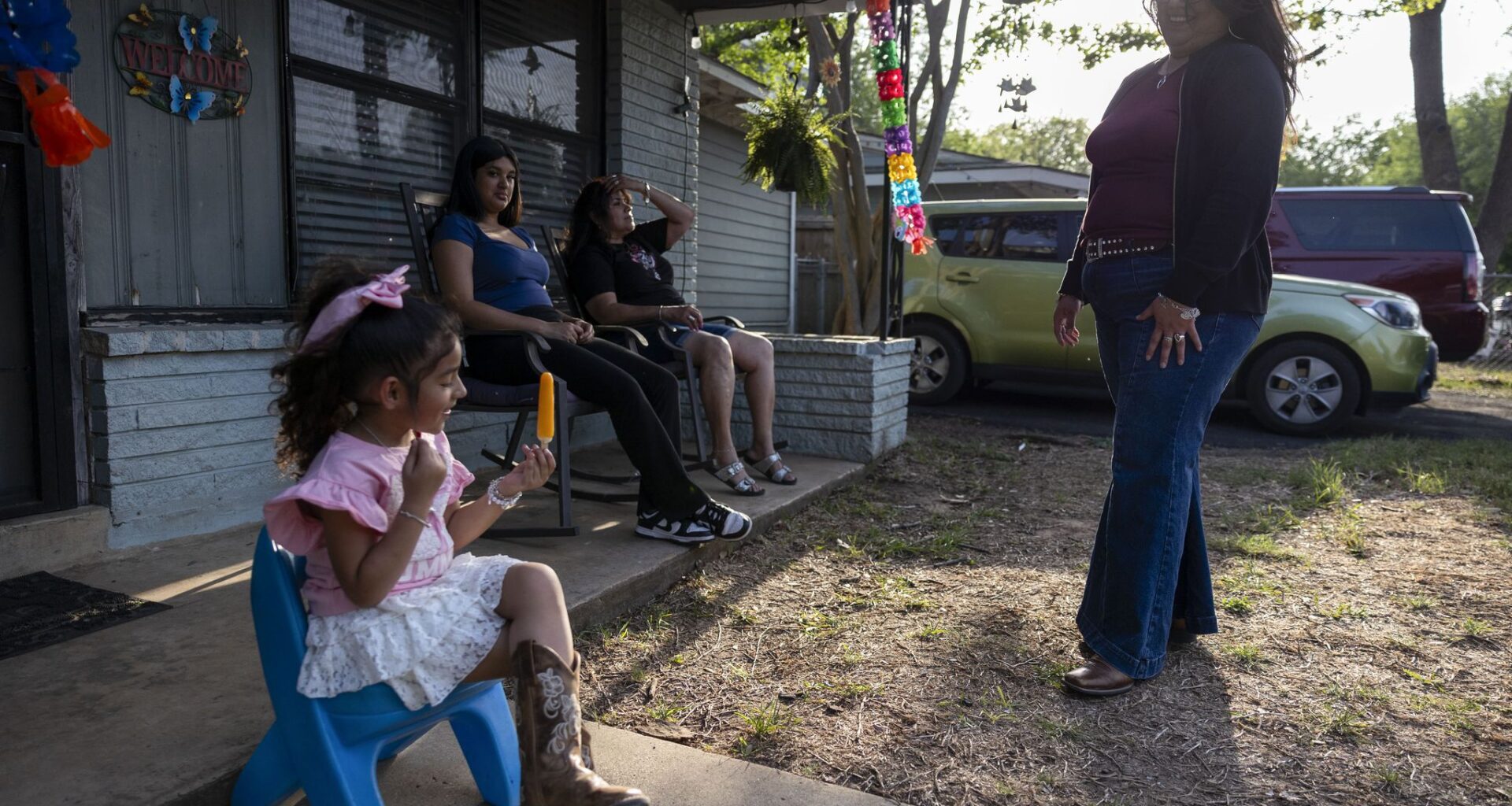
Darlene Sanchez, right, and her daughters Donnalyse Rodriguez, left, 5, and Danae Rodriguez, 15, spend time with Debby Sanchez, Darlene’s mother, at Debby’s home in San Antonio on Wednesday, April 1, 2026. Darlene is a graduate of the South San Antonio ISD and her daughters, Donnalyse and Danae, both attend schools in the district. Darlene’s mother is also a former employee of the school district and worked there for 17 years.
Katina Zentz/San Antonio Express-News
When Darlene Sanchez was a student at South San Antonio High School in the 2000s, she watched as the district continually made local headlines for the way its elected leaders conducted themselves. Looking back on her time as a South San Bobcat, she remembers constant issues with the South San board and a consistent turnover of its superintendents.

Even after Sanchez graduated in 2008, infighting on the South San Antonio Independent School District board continued. For decades, allegations of and investigations into misuse of authority, nepotism and financial mismanagement have plagued trustees. In recent years, those tensions have boiled over, leading to turnover on the school board and in the superintendent’s office, as well as highly publicized boardroom stunts, including one incident involving protesters dressed as clowns that ended with district officers arresting a trustee.
Article continues below this ad
Since the 1980s, the Texas Education Agency kept a watchful eye on the South Bexar County school system, at times sending representatives to intervene. In the early 2000s, TEA twice investigated the school board for mismanagement before clearing trustees. After a San Antonio mayor and city councilman called for state intervention in 2013, TEA appointed a conservator.
But it wasn’t until one year ago when the state imposed the harshest consequence available: replacing locally elected trustees with state-appointed managers and eliminating local control from the district.
Unlike the seven other school districts taken over by the TEA for failing academic performance in recent years, South San attracted state oversight because of its long history of dysfunction among the adults leading the 7,400-student school system.
After TEA opened its latest investigation into the district in 2021, the agency issued a 47-page special report finding the district’s board could not serve its students properly because of elected officials’ inappropriate behavior. They failed to maintain a relationship with district leadership and mismanaged public funds. In a 15-year period, trustees appointed, hired or fired nine superintendents.
Article continues below this ad
TEA’s investigation culminated in February 2025 when the agency announced the installation of seven appointees to govern the district and Saul Hinojosa as superintendent in place of leader Henry Yzaguirre.
“For far too long, the best interests of students and teachers in South San Antonio ISD were cast aside by many of the very adults elected to serve them, who instead worked in favor of their own self-interests,” Texas Education Commissioner Mike Morath said in a statement at the time.
Texas Education Commissioner Mike Morath sits in on a fourth-grade class at Heritage Elementary School while on a visit to the Southside ISD school on April 30, 2024.
Jessica Phelps
While the state intervened over dysfunction at the elected board, many have argued that the incessant fighting held students back academically.
Article continues below this ad
Data from the 2024-25 academic year showed that only 34% of South San students were reading at grade level and 25% were on level in math. TEA had rated South San Antonio ISD a D in its A-F letter grade scale, the lowest score of any Bexar County school district.
Hinojosa, a longtime superintendent in nearby Somerset ISD, came out of retirement to lead South San with a simple goal: boost the district to an A-rated school system.
Dr. Saul Hinojosa, Somerset ISD Superintendent at the time, at a Parent Symposium on January 28, 2023.
Kaylee Greenlee Beal
In the year since he’s been in office, Hinojosa has changed the way teachers are expected to command classrooms, and the appointed board has avoided negative headlines. But many teachers report heavier workloads, demanding hours and, in some cases, a growing desire to leave the profession.
Article continues below this ad
Still, initial results reported by the district shows improvement. Student testing data provided by the district show growth in all subject areas when comparing 2024 and 2025 outcomes.
Sanchez never felt the “negative impact” of the board fighting accurately represented her community’s teachers or staff, including her mother, who worked for the district for more than a decade. As a proud product of the South Side district who stayed in the community to raise her own kids, Sanchez said she feels the schools are headed in a positive direction for her two daughters, Danae, 15, and Donnalyse, 5. Both are South San students.
Danae Rodriguez, 15, smiles at her mother Darlene Sanchez while helping her sister Donnalyse Rodriguez, 5, color at her grandparents’ home in San Antonio on Wednesday, April 1, 2026.
Katina Zentz/San Antonio Express-News
Donnalyse Rodriguez, 5, left, and Danae Rodriguez, 15, spend time with their grandmother Debby Sanchez outside Debby’s home in San Antonio on April 1, 2026.
Katina Zentz/San Antonio Express-News
TEA officials have echoed Sanchez’s positivity.
Article continues below this ad
Steve Lecholop, the deputy commissioner of governance for TEA, said Hinojosa and the board have been “laser focused” on stabilizing district leadership and focusing district priorities on best serving students. In an email, he praised the district for embracing the Teacher Incentive Allotment initiative — a pay-for-performance program that rewards high performing teachers with boosted salaries — and for creating learning environments where students “can achieve at high levels.”
“To make that a reality, it requires leaders that are aligned and rowing in the same direction. Over the past 12 months, evidence shows that is exactly what is happening in South San,” Lecholop said. “It’s what the students deserve, it’s what the community deserves and, frankly, what the community was asking for for quite some time.”
Pursuit of academic excellence
In Hinojosa’s final year leading nearby Somerset ISD, 54% of Somerset students read at grade level, and 52% performed on level in math.
Article continues below this ad
Student demographics in South San and Somerset are relatively similar — in both school systems, the majority of students are Latino and low-income. Students’ academic performance often mirrors the socio-economic adversity they and their families face. But Hinojosa, who bucked the trend at Somerset, hopes to do the same in South San. He said he doesn’t believe a zip code or neighborhood should define the quality of education a student receives.
Prior to his tenure, he promised to grow performance-based compensation, implement new recruitment strategies and begin restructuring the district. Since he started, the district has emphasized the need for quality instruction to be the priority throughout the school year.
“I feel that we built a good foundation of really putting plans and protocols in place to really improve student outcomes,” Hinojosa said in a February interview.
To improve academic results and test scores, Hinojosa embraced the pay-for-performance system, modeled on one that worked for him at Somerset ISD. The system, called the Teacher Incentive Allotment (TIA), is a merit-based program that allows educators to earn bonuses through state funding. South San bases its rating system on metrics like student testing data and formal observations along with more informal information, like conversations with students, according to a rubric available on the district website.
Article continues below this ad
The district first launched the program in South San in 2022, but Hinojosa, credited with implementing the system successfully at Somerset, said the expansion of it since the takeover has driven higher academic performance. Under the program, “master teachers” — some of the district’s highest rated educators — monitor classrooms and evaluate teachers’ work. They give their colleagues feedback and coach them on how to improve their classroom instruction.
Hinojosa also visits classrooms, having promised to personally observe each teacher in the district. After the visits, he sends the instructors feedback and encouragement.
Students walk by during passing time at Robert C. Zamora Middle School in San Antonio on Feb. 26, 2026.
Katina Zentz/San Antonio Express-News
First-grade student Kimberly Guerrero participates in a class activity at Price Elementary School on Feb. 26, 2026.
Katina Zentz/San Antonio Express-News
In the year since TEA stepped in and as Hinojosa and the appointed board of managers near the end of their first full academic calendar, the district has witnessed test scores improve. Students who originally failed their end-of-course exams in 2024 and retook them in 2025 posted sharp gains in pass rates on English and U.S. history tests at South San High School. These students also improved in Algebra and Biology, according to data provided by the district.
Article continues below this ad
Hinojosa pointed to this data as a sign of initial improvements as the district awaits the results of the State of Texas Assessments of Academic Readiness or STAAR tests, the most consequential factor in TEA’s A-F district ratings. Results typically come out in June each year.
Investing in the South San community
While Hinojosa leads the academic improvement plans for the district, Ray Tijerina oversees the school board governing South San Antonio ISD from its board room dais. The president of the board of managers, Tijerina is a familiar figure in the local charter school community as an advocate for parent choice.
To accept his appointment from the state, Tijerina had to resign from the boards he served on for Legacy Traditional School, which has three campuses across Bexar County, and Royal Public Schools, which has a campus in the southeast part of the city.
Article continues below this ad
“It was a no-brainer,” Tijerina, a district alumnus who served in the Navy for nine years before taking a job as a teacher.
“I love being in the classroom. I love being with kids,” he said. “Teaching is my jam.”
After years of teaching, he eventually got involved in the charter community and co-founded an education company called Verdant EDU, which helps school districts in the area recruit talent. But even as he became involved in the education world, he worried about what he saw from the elected leaders of the district he graduated from.
Knowing the community opposition and outcry that can follow a district takeover, Tijerina recalls being nervous there would be backlash against state intervention. In the years since the state announced a board of managers in Houston ISD, protests against the TEA-approved leadership have been a near-constant presence.
Article continues below this ad
Tijerina acknowledged that takeovers have “a negative connotation,” but said he believes district residents were ready for change.
“I think the community just kind of got to a point where the community was like, ‘Okay, we got to try something different here,” Tijerina said. “I think staff — some staff — felt that way.”
Now, Tijerina’s main goals are academic gains, partnerships with organizations who can support students, limiting conflict with fellow appointees and supporting the superintendent and district administration.
He works alongside six other appointees. Four, including Karla Gomez Sanchez, Darrell Balderrama, Jesus Rendon III and Adrian Guerra, attended South San schools. The two other appointees, Kelly Murguia and Aurelina Prado, also have ties to the South Side.
Article continues below this ad
Connecting with the community may be a vital part of making changes from an appointed board and superintendent stick long term. In other Texas school district takeovers, critics often describe the board of managers and installed superintendent as outsiders.
Aurelina Prado, center, board member for South San Antonio ISD, speaks with Saul Hinojosa, the district’s superintendent, as Prado’s uncle Joaquin Prado, left, stands with Aurelina Prado’s daughter Amelia, 8, during the South San Community Block Party on March 28, 2026.
Katina Zentz/San Antonio Express-News
Cory Nichols spins around his granddaughter Layla Nichols, 4, during the South San Community Block Party on March 28, 2026.
Katina Zentz/San Antonio Express-News
That’s one reason it means a lot that Javier Chavez Jr. has seen Hinojosa at community events like football games and band competitions. Chavez Jr. is an alumnus and former truck driver who returned to South San Antonio ISD to drive school buses.
Article continues below this ad
“His presence was there, and I love that, because when I was in school here back in the 90s, I can’t tell you who my principal was,” he said. “I sure as hell didn’t know who my superintendent was. All I remember hearing was about corruption.”
With a son in the district, Chavez Jr. said he was impressed by Hinojosa’s decision to come out of retirement to support the district. He also appreciated that all employees received a raise when the new administration took over. And while he doesn’t know everything leadership does behind closed doors, the power of Hinojosa’s presence goes a long way.
“He will stop for anyone — whether you’re a custodian, a parent, on the school board, whatever your title is,” Chavez Jr. said.
While many community members might see him as the new superintendent, Hinojosa has ties to the district. Early in his education career, from 1995 to 1998, he was a history teacher and track and football coach at South San Antonio High School.
“As a spiritual person, I feel God has put me here for a reason, and that’s to make a difference in this community, and I’m committed to putting in the work to make sure that this is carried out and our kids achieve the best,” he said.
Article continues below this ad
He made it a goal to attend a Sunday service at every church in the district boundaries. Though he’s been in South San’s top job for more than 52 Sundays, he said there are still some churches he’s yet to get around to. The weekend routine is something he started doing at Somerset as a way to integrate himself into the community and show families he was more than just a district leader.
“I want them to see the human side of me, right?” Hinojosa said. “So I feel that going to different churches, different denominations, is just a way for me to go out and show that human side and get to see parents and students in a type of just different atmosphere.”
Sanchez, the 2008 graduate of South San Antonio High School and mother of two current students, said she sees Hinojosa as a humble and approachable superintendent who is ready to connect with the community.
When her eldest daughter got injured during volleyball season, he helped Sanchez locate the athletic trainer. He later checked to ask how Danae, a high school freshman, was doing.
Article continues below this ad
“He makes his presence known,” she said. “That’s nice to see that he’s out and about everywhere. Very involved.”
But even as Hinojosa attempts to connect with the South San community, the takeover hasn’t come without resistance and some new challenges.
Heightened demands on teachers
After two years as a teaching assistant in Medina Valley ISD, Ayah Ayad came to South San in hopes of giving children a quality education.
Article continues below this ad
The sixth-grade English teacher at Zamora Middle School joined the district three years ago and recalls paying little attention to board politics, even as the elected officials for the district she worked in stayed in the news.
But when the district was taken over and, subsequently, the curriculum and teaching structure changed, she welcomed it. Ayad has benefited from boosted pay initiatives and also enjoys “cluster” time, a recurring professional development meeting in which she and other teachers in the same subject come together to identify ways to improve.
“The curriculum has changed. I think our role and responsibilities as educators here, too, have changed,” Ayad said. “Our vision has changed, and when it comes to the classroom level, I think we are — I can speak for myself as a teacher — I think I teach efficiently now. More purposeful.”
Sixth-grade student Kelis Villalon, left, listens as Ayah Ayad, an English teacher, answers a question at Robert C. Zamora Middle School on Feb. 26, 2026.
Katina Zentz/San Antonio Express-News
Fifth-grade math teacher Katie Hellum during a class at Price Elementary School on Feb. 26, 2026.
Katina Zentz/San Antonio Express-News
The higher demand on teachers, which came with a TEA takeover, was also welcomed by Gwendell Gravitt Jr., an eighth-grade science teacher at Zamora.
Article continues below this ad
He also thinks his students noticed a difference.
“The message to them was very clear: ‘We’re not playing here,’” Gravitt Jr. said. “No, we’re not doing parties two days before Christmas. We are doing instruction, bell to bell. And they’re like, ‘Why won’t you give us 10 minutes? ’ Because we’re going to learn for 10 minutes. So they know it’s different.”
But with rising expectations for students, some teachers have lamented the increased pressure and more demanding expectations.
South San Antonio AFT, the district teachers’ union, surveyed 325 of the district’s 450 teachers to understand how educators felt in the midst of the state takeover.
Article continues below this ad
Among the 125 who responded, 71% said they were considering leaving the profession, and the same number said they feared retaliation from district administration when they voiced concerns. Sixty percent said they didn’t feel their work was valued by district administration.
Anonymous teacher comments gathered by the survey highlight concerns over the extra work without enough time to complete existing tasks.
Cecilia “Ceci” Gonzalez, a dual language kindergarten teacher and former union representative, described a culture of fear, confusion and “impossible expectations” during the transition to TEA control.
A veteran educator, Gonzalez spent the bulk of her 18 years in the classroom at San Antonio ISD. When she began working at South San the year before the takeover, Gonzalez said there was a “lax” attitude from administrators. Rules and guidelines were based on the whims of the person in charge, she said. When the state took control, the new administration began to implement fresh directives at a pace that felt like a “top-down fire hose.”
Article continues below this ad
“When we started our school year, all these initiatives came out that were quite hefty demands on teachers’ time and an absolutely zero tolerance for questioning the reason for these,” she said.
While she wasn’t employed by the district for the bulk of the board’s dysfunction, Gonzalez said her colleagues at South San hoped that things would get better. Referencing the union survey, Gonzalez said the new administration may be successfully raising test scores, but the improvement is at the cost of the teachers’ well-being.
“Even if it was a fire hose of wonderful ideas, you can’t make it all happen all at once,” said Gonzalez, who ultimately left her post and moved out of state. “You’re going to break the system by putting the load on. This is the first year and you’re breaking it. Is it long-lasting? Is it sustainable? If you’re getting your scores up, at what price?”
Teacher morale is the lowest Tom Cummins, who has represented South San’s teachers union for 25 years, said he has ever seen in the district. He attributed the tension to the transition and new policies implemented under TEA’s chosen administration.
Article continues below this ad
“The administration has gone ahead and made up the rules that it wants to implement, and they haven’t been good,” Cummins said. “ There are teachers who are just walking out the door.”
Hinojosa acknowledged the extra pressure teachers are under to perform. He notes that the biggest issues he’s faced so far have been clashes with the union and teacher retention, with around 10 teachers having left since the takeover.
“My previous district had really little or no pushback, but the unions maybe were not as present as they are here,” Hinojosa said.
‘It is way different today’
When he was elected to the district’s board of trustees in 2022, Abel ‘Chili Dog’ Martinez was warned that TEA could take over the district. Now, he’s glad they did.
Article continues below this ad
“I don’t think the state should ever let South San go,” Martinez said. “TEA should never let go of South San, because it is way different today.”
Stacey Alderte and Irma Vigil, dressed as clowns in support of friend and South San ISD board member, Abel Martinez, left, argue with Officer Serrata after Alderte and Vigil were escorted from the building at a school board meeting.
Jessica Phelps
Under the new leadership, Martinez said he sees an increased focus on student performance, less conflict between board members and Hinojosa’s extensive involvement in the community. He supports Hinojosa based on conversations they’ve had and what he’s heard from relatives who work in district schools.
“I have plenty of family members that continue working for the district, so I hear that he’s helped. He walks the property every day, like, every day,” Martinez said. “He’s literally in the trenches with the teachers.”
Article continues below this ad
Martinez said that during his first few months as a board member, fellow trustees and district administration often invoked the looming threat of a state takeover, and the damage it could do to the community early on scared him.
Now, a year after the takeover started, he said of South San constituents, “nobody cares” about the takeover. He added that community members have long been apathetic to the issues the district faced for a long time.
Angelina Osteguin, a lifelong South San resident and trustee nearly a decade before Martinez, recalls many of the same issues during her time on the board.
“We made headlines every week because of the drama we were doing my first two years,” said Osteguin, who served on the board from 2014-2018.
Article continues below this ad
During her tenure, one trustee accused another of being involved in a shooting at her home, and TEA opened an investigation into a football coach misusing funds. In 2016, Morath appointed a conservator to oversee the district because of trustees’ poor working relationship with administration. The agency ended the appointment two years later, calling their oversight of the district “no longer necessary.”
But in the years that followed, infighting continued and new allegations of inappropriate trustee behavior emerged, highlighting one of the key challenges districts face after state oversight ends — making any reforms endure.
Takeovers last a minimum of two years and can be extended if the education commissioner deems it necessary. Once Morath approves elected board members to take back power leading their district, they will transition back onto the dais, three at a time, in subsequent election cycles.
Article continues below this ad
Tijerina hopes that his time in power — however long that may be — means the district he graduated from and now represents can change its future.
“One of the main goals is to make sure that when you leave, it doesn’t go back to the way it was before” he said.
Danae Rodriguez, 15, and her sister Donnalyse Rodriguez, 5, walk out the door with their grandfather, Daniel Sanchez, in San Antonio on April 1, 2026.
Katina Zentz/San Antonio Express-News