
Driving his truck along a stretch of eastern El Paso County just outside the Horizon City limits, Walter Miller slowed in front of a small church set back a few dozen yards from a bumpy dirt road.
“We’re losing the battle,” he said, looking at the building – a simple structure of white aluminum siding erected on a concrete slab.
Although it’s well-built, the makeshift Baptist church, set amid thousands of acres of undeveloped county land, represents a broader dilemma: a growing number of residents living in communities that lack basic services deemed too expensive for public or private development.
“Don’t get me wrong, these folks living out here are doing what they can, and I admire that,” Miller said.

A Baptist church sits amid thousands of acres of undeveloped county land.
Ruben R. Ramirez
Now, El Paso County may have a path forward utilizing a 2021 state law that allows counties to reclaim long-abandoned land – a move leaders say could lead to a surge of new development.
For now, though, the challenges remain visible across the landscape.
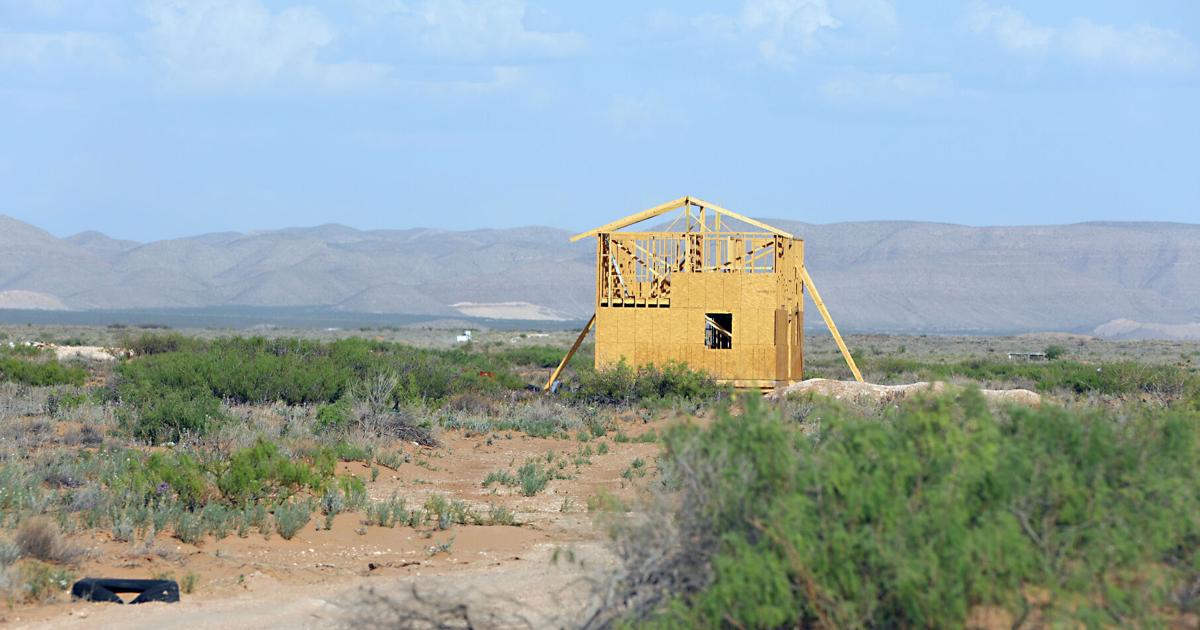
As Miller continued driving along unpaved back roads, he pointed to homes in various stages of construction with no water or sewage access, and to businesses scattered across these county areas that have no zoning laws.
“From a planning viewpoint, this is not going to be attractive for development because they’ve got to deal with all this,” he said.
Miller has served in a variety of roles in Horizon City government – from council member to mayor – since 1998 and was a founding member of the Horizon City Economic Development Corporation. He also served on the El Paso Central Appraisal District board and chaired the El Paso Metropolitan Planning Organization.
Walter Miller
Ruben R. Ramirez
Without much infrastructure in the unincorporated areas around Horizon City, the region’s surging eastward growth slowed significantly. With stricter infrastructure laws around new county subdivisions, developers are steering clear of these properties. And El Paso County doesn’t have the financial resources for the multimillion-dollar installation of water, sewage and powerlines to these far-flung houses and businesses.
The result is a swath of 54,000 acres of eastern El Paso County land in prime locations for development, languishing without utility service. Added to that is the confounding problem of identifying who exactly owns each property, which has derailed both public and private attempts to acquire and improve the land.
Origin of the problems
From the 1950s through the 1970s, developers were free to sell unregulated plots in most unincorporated areas of Texas. This became big business in El Paso with companies buying large tracts, platting and registering them, then selling them as individual lots for a quick profit.
One such company was Horizon Corporation of Tucson, Ariz., which is not affiliated with Horizon City.
In the early 1960s, the company bought about 63,000 acres near Horizon and kicked off a massive marketing campaign, highlighting the area as a premier location for land investment. It began selling individual lots to people from all over the world.
At the time, Horizon City was not incorporated and had about 650 homes and a population of about 1,800. But it had an 18-hole golf course surrounded by picturesque desert and plenty of undeveloped land. Aggressive salesmen used a variety of maneuvers to lock in contracts.
“I’ve heard stories from the old timers about meeting prospective buyers at the airport, and they would have curtains on the car windows so they didn’t see El Paso,” Miller said, surmising that the salespeople were leery of turning off buyers with scenes of dusty El Paso. “And they would ply them with refreshment all the way to the golf course. They needed to see that green golf course first.”
Horizon Corporation, which was also selling property in New Mexico and Arizona, helped build much of early Horizon City, investing about $30 million in construction and public facilities.
But its sales practices drew scrutiny from the Federal Trade Commission, which determined the company used false and misleading advertising. The FTC ordered Horizon Corp. to create a $14.5 million fund to repay 40,000 consumers who bought land that the commission deemed to have no resale value.
The company closed in 1984, but not after selling thousands of lots around Horizon City, leaving behind stalled development and a patchwork of parcels that has contributed to the growing problem of unregulated colonias.
“I think it was a scam from the word go,” Miller said. “They sold these under the full knowledge that they would probably never have service. And people would buy them thinking they’re going to get service, and they never did.”
Even after Horizon Corp.’s closure, other developers continued selling land without water, sewer or paved roads – a practice that was still legal at the time.
An image from Google Maps shows some of the undeveloped lots east of Horizon City.
County steps in
Erich Morales, an assistant county attorney and the division chief of El Paso County’s public works and projects division, has spent most of his career trying to solve the infrastructure problems in unincorporated areas.
“They hired me to start figuring out what to do about the colonias,” he said, referring to county neighborhoods that lack basic utilities.
When Morales began in 1987, the solution seemed straightforward: If the problem was land developers not installing utilities before selling land, then the solution would be a clearly mandated set of policies requiring exactly that.
“I thought, initially, we’re going to pass some laws. We’re going to adopt some regulations. We’re going to stop some of these developers, and we’ll have this thing cleaned up in a year or two. I had the blessed ignorance of the youth,” he said.
His first tour of neighborhoods outside El Paso’s city limits brought him the sobering reality of colonia life. Dilapidated homes without stable electricity and “no water, no sewer, no roads,” he recalled.
“I saw this stuff, and I didn’t sleep for about three nights,” Morales said. “I thought, ‘Oh my God, how are we going to address how widespread this problem is?’”
Ruben R. Ramirez
Most of the lots were purchased by people who either tried to find inexpensive water, sewage and electricity connections or held on to the land, hoping development would eventually reach them. Others abandoned their properties.
State laws enacted in the 1990s now require developers to install utilities before selling properties, which has allowed some expansion of modern neighborhoods and businesses in eastern El Paso County. But about 91,000 plots of undeveloped or unattended land are blocking further modern expansion.
With the government and land developers now largely on the same page about providing infrastructure to new subdivisions, a critical hurdle remains – contacting owners of the vacant or neglected plots of land.
‘Fractional’ lot ownership
In the decades since Horizon Corporation closed, many unserviced and neglected properties have been passed down through generations. The deeds have become increasingly divided as landowners have died, leaving properties shared among their children and grandchildren. Divorces and other legal complications have further clouded land ownership.
“A plot might have 16 owners. It’s really crazy. Altogether, there could be hundreds of thousands of owners,” said Michael McElroy, director of planning and development for El Paso County.
“People from all over the country, and in fact, all over the world, purchased land. In the decades since, that ownership has just expanded. So a lot might be owned by someone in El Paso, and the lot next door might have ownership in Switzerland. It really is that diverse,” McElroy said, describing it by the industry term of “fractional ownership.”
Because of these deed ownership questions and lack of basic public services, many of these plots have very low tax assessments – sometimes as low as a few hundred dollars. Many owners have lost contact with the tax office because it costs more for the office to mail them a bill than the amount of taxes due, McElroy said.
“They just don’t send that notice, so people might not even know they own the land because they’re so far removed from the person who originally purchased it,” he said.
Ruben R. Ramirez
What’s the fix?
One potential solution is a 2021 Texas law that allows El Paso County Commissioners Court to declare a property abandoned if the owners cannot be located.
H.B. 1564, known as the “fractionalized lots bill,” is a legal way for these abandoned lots to be transferred to a trustee who oversees the redevelopment of the land and brings it back to the market.
“We think the solution is to vacate many of these lots, erase the subdivision lines that were put in in the ’50s, ’60s and ’70s, return them to effectively raw land, and then come up with a plan that would ideally require the land to be developed in a way that has more modern amenities to it,” Morales said.
This would only be an option for land that has been abandoned for 25 years, and a percentage of the money from the sale would go to the landowners, based on the percentage of land they owned.
If no landowner can be located, the funds would go into a registry of the court and would be “held until we can find somebody who can lawfully claim it,” Morales said.
The initial implementation of the law in El Paso will be a partnership with the Horizon Communities Improvement Association for a parcel of land north of the Eastlake Mission Ridge area near Horizon City.
“This is going to be our first attempt to see how this legislation is going to work, and to see if it really does help us address this issue of fractionalized lots so that these areas can be developed properly,” said El Paso County Commissioner Iliana Holguin, whose district includes many of the problematic lots.
If successful, the effort could mean a new surge of development and the creation of a hub of commerce in Far East El Paso, said Eduardo Garcia, executive director of the Horizon City Economic Development Corporation.
Eduardo Garcia
Ruben R. Ramirez
“It would help out economically for this entire area,” he said. “We do have a lot of retail already, but we do need more in this area so that people who live around here don’t have to travel all the way to Central El Paso.”
Miller said he envisions a fully developed Horizon region as another downtown, capturing the flow of growing traffic that is already circulating and expected to increase. With the progress being made within the city limits of Horizon City, he said the addition of new communities in nearby El Paso County land would establish this region as a major economic corridor.
“We don’t need to go to Downtown (El Paso),” he said. “We’re creating our own downtown.”