
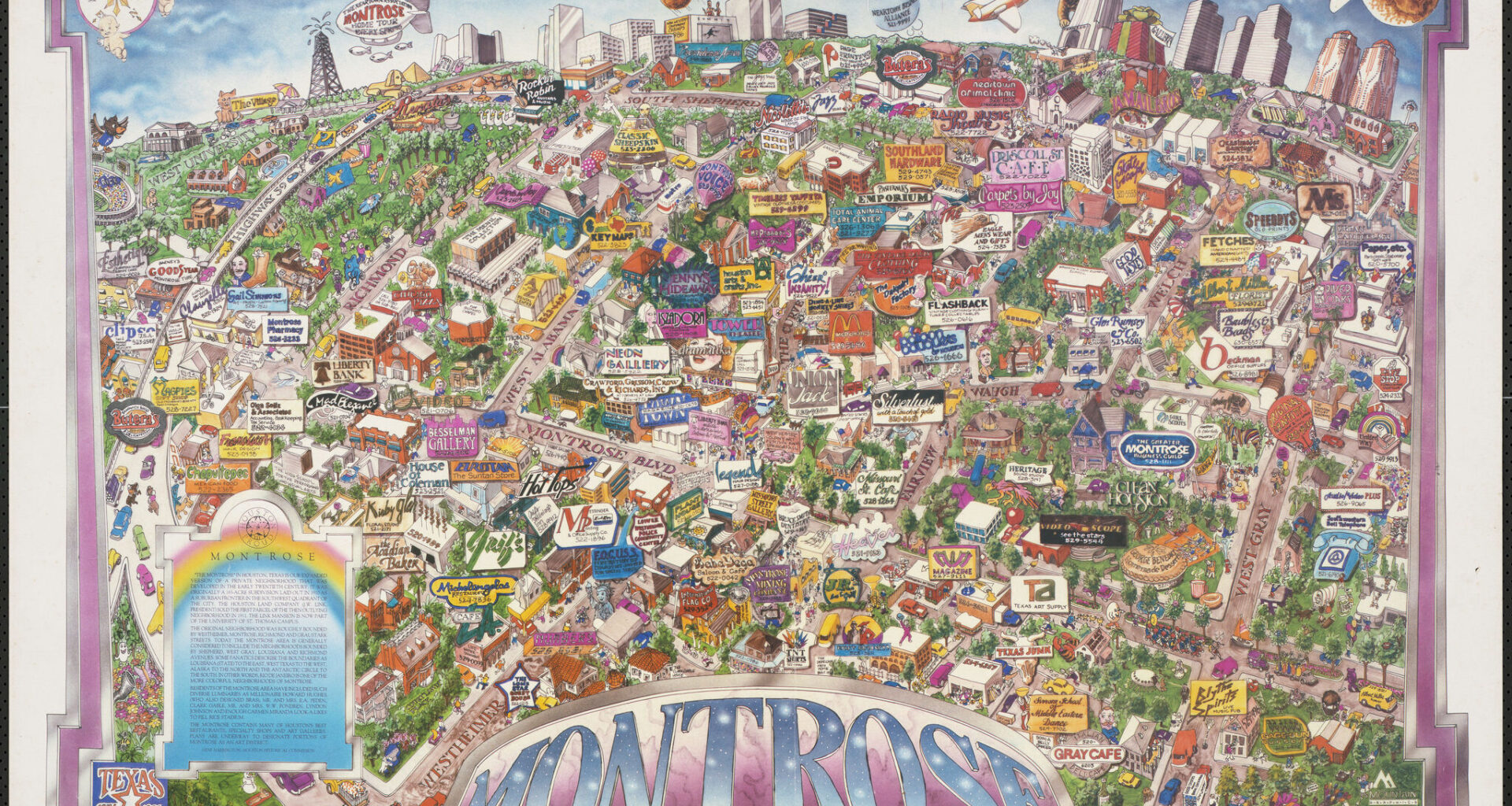
This weekend, my girlfriend had a request for me. She had found a TikTok where a lucky Round Top traveler found a vintage framed poster of Houston’s Montrose neighborhood from 1986. Was there any way I could track it down and get us one, too?
Indeed, I was able to find the original in high-resolution glory online (though actually getting one for our home is a quest for another day, so if you have a copy please email me!). But the two of us ended up gazing at the poster, and a few other old Houston maps like it, for over an hour. As Zoomers, we marveled at the businesses we recognized and the ones that have since shuttered. Most notably, the map shows legendary Montrose haunts that I’ve only heard by name. My heart sank at the amount of queer bars that no longer exist.
I’m not the first person to take an interest in this illustration. Google “Montrose map” and tons of Reddit posts about the map pop up over the years, with many Houstonians expressing similar feelings. Most posts, however, contain little to no information about the map’s history. So I did a little digging.
According to the University of Houston Libraries and LGBTQ+ Houston historian JD Doyle, both of whom have digitized and shared copies of the Montrose map, the 1986 illustration my girlfriend and I became obsessed with was done by Houston artist Randy Ruhlman. A Conroe native and graduate of Texas Tech, Ruhlman moved to Houston in the late 1970s and became a commercial artist, running his own design firm, Ruhlman Design.
Ruhlman became enmeshed in the city’s LGBTQ+ community, working with local nonprofits and designing some of the first logos for the Houston Pride Parade. He also made cover art for This Week in Texas, an LGBTQ+ newspaper that chronicled Texas AIDS deaths during the height of the epidemic. Ruhlman himself sadly died of AIDS in 1987, according to his obituary. He was 31.
One of the many parts of his legacy he leaves behind is the 1986 Montrose Commemorative Map, which he illustrated just a year before his death. The map now serves as a cute, quirky Montrose time capsule. Done for Houston-based graphics company Mountain Graphics to celebrate Texas’ sesquicentennial (that’s the 150th anniversary of something for you non-nerds), the map shows local businesses in Houston’s quirkiest neighborhood in 1986.
Gay bars, restaurants and businesses of bygone years are all represented: Montrose Mining Company, Heaven, Baba Yega, the Daiquiri Factory, Union Jack. Many of these closed in the 2010s or earlier. Radio Music Theatre, featured prominently on the map, closed in 2011. Others, like the former spot of Jenny’s Hideaway, have been dubbed as cursed locations unable to sustain local businesses. There’s Mary’s, the iconic and oldest Houston gay bar that closed in 2009. The office of the Montrose Voice, a long-shuttered Houston LGBTQ+ newspaper, can be seen, too. (Mary’s and many other queer hangouts are also represented on a 1990s version of the map by local artist David Walton). Montrose Skate Shop is there, too. I was lucky enough to visit the roller-skating emporium before it shuttered and owner John McKay died.
Taken together, Ruhlman’s map is a “Where’s Waldo” game of Montrose that evoked a sort of sadness in me at first. Seeing all of the cool spots that no longer exist gave me the same feeling that Tony Soprano talks about when he says that he feels like he got in at the end of something. As some gay haunts close and many lots in the area feel emptier than ever, is Montrose finally and truly dead?
But look harder, and gazing into the Ruhlman and Walton maps become exercises in optimism. The Tower Theater is now a jazz club, but it’s still there. Ripcord and JR’s are still kicking. The Texas Art Supply is around. The familiar landmarks, from institutions like the Rothko Chapel and Menil Collection to Rockin’ Robin Guitars & Music and Numbers, are alive and well. That McDonald’s on Westheimer refuses to die. And old favorites like Griff’s Irish Pub are coming back from the dead.
Nothing good lasts forever. Things change, people pass on, your favorite bar closes, rainbow crosswalks are erased. But the fabric of a place like Montrose can’t truly be torn apart as long as the dream remains. Ruhlman’s map is a time capsule of a Houston we can’t ever go back to. But it’s also a reminder that a place isn’t just the bars and restaurants we go to. It’s the memories we make there and how we decide to remember it.
In other words: Montrose is still alive and well. But you need to have more wild nights out to make sure it stays that way.