
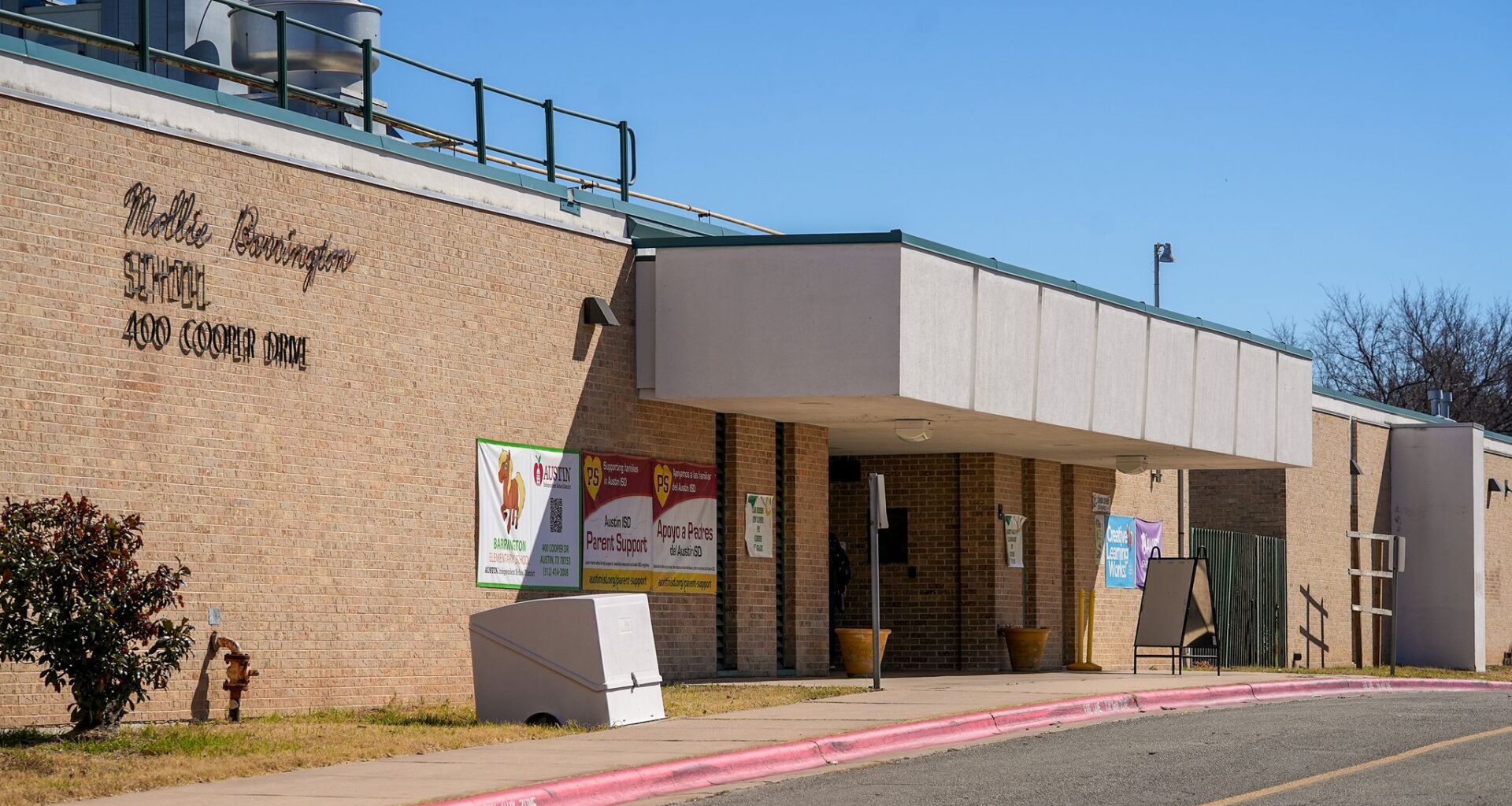
Barrington Elementary School in Austin on Thursday, Feb. 5, 2026.
Jay Janner/Austin American-Statesman
Austin city council leaders want more say in the future of parks and public spaces at the campuses Austin Independent School District plans to close this year.

Two resolutions that Austin City Council approved in March seek to shore up a consistent parkland condemnation process and to start discussions on partnership or acquisition opportunities to find new use for closed school campuses.
Article continues below this ad
The city and Austin ISD have jointly owned several parcels of land on campuses for decades. The partnership formally allows the public to use the park space outside school hours and splits maintenance costs between the two entities.
The imminent closure this summer of 10 Austin ISD campuses — and the district’s ongoing efforts to find new uses for the properties — prompted city council’s interest in creating more defined rules for city and school district joint property agreements.
Superintendent Matias Segura said Friday he welcomed a more defined process for working with the city but AISD needs to take the lead in determining how closed district properties will be used in the future.
“Which property lends itself to community hub, which lends itself to a repurpose for early childhood center, which lends itself to workforce housing — that’s the process that we need to own,” Segura said.
Article continues below this ad
One city council resolution directed the city manager to develop a standard process for when the city would give up its rights to property it jointly owns with other public entities, like AISD, and how the city would be compensated. In the past, council members haven’t always been made aware of when the city was being asked to give up its stake in a park that it jointly owned with Austin ISD, said Councilman Ryan Alter.
This is important to Alter who hopes to increase the number of Austinites with a park in walking distance. About 70% of city residents can walk to a park, but Alter hopes 100% of residents eventually will be able to. Austin ISD parks play a role in that number, but there’s a not a defined process for what factors the city should consider during condemnation procedures, he said.
“If this is an area where that’s the only park in the neighborhood and that park is being taken away, then what steps should the city be taking?” Alter said. “What can we do to protect the public’s interest when it comes to parkland, which is so precious and there’s never enough around here?”
The city and schools have partnered on facility space for decades.
Article continues below this ad
In 1955, Austin ISD replaced Austin Public Schools, which had been run by the city since 1881. After that transition, the city and the newly formed district created agreements for joint facility and land use. The agreements allow residents to use the green space on campuses outside of school hours. But even on campuses that don’t carry these agreements, residents often view school parks as community assets and gathering places where neighbors walk their dogs or families bring their kids to play on the weekends.
Last month, Councilwoman Vanessa Fuentes proposed an agreement that asked the city manager to explore partnering with public entities on how to use closed school campuses and other unused public properties. She also asked for more information on when the city could move to acquire those properties.
Fuentes felt moved to maintain public access to closed schools watching the closure of Widén Elementary, which is in the city council district she represents.
“People are just heartbroken oven it,” Fuentes said. “Having a process in which we leverage the city and what it brings to the table and work together where we can is really the goal here.”
Article continues below this ad
The city and AISD have joint agreements for park space on 21 campuses: Andrews, Barrington, Barton Hills, Cook, Cunningham, Doss, Gullett, Hill, Houston, Kealing, Norman-Sims, Oak Springs, Odom, Ortega, Pecan Springs, Pillow, Reilly, Sánchez, St. Elmo, Williams and Wooldridge.
However, with voter approval of the 2022 $2.4 billion bond, Austin ISD sought to take 100% ownership in joint-interest land areas on six elementary campuses: Andrews, Barrington, Houston, Oak Springs, Pecan Springs and Wooldridge.
Obtaining full ownership was a necessary part of the city permitting process to build the 2022 bond projects, so the district sought to condemn the city’s share of ownership, Segura said. AISD has the majority ownership share for the six school parks, he said.
Barrington is slated for closure this summer. Oak Springs won’t house students next year, but students will move into a brand new facility at that site in 2028.
Article continues below this ad
Both Alter and Fuentes brought the resolutions forward because Austin ISD is exploring what to do with the 10 campuses that will close this summer.
Alter wants to make sure the public’s interest is maintained as AISD closes schools because of the district’s financial situation, he said.
“They’re closing them because they can’t afford it, and they have a fiduciary duty to also utilize the value of those spaces, to the benefit of their students, not just to the good will and benefit of the broader city needs,” Alter said.
Article continues below this ad
Austin ISD has a handful of former school properties already up for sale or redevelopment. Crews began work at the former Anita Ferrales Coy site this spring on a 675-unit workforce housing project, a largely celebrated development that will open its first units next year. An early childhood center is planned at the Pease Elementary building through a partnership with United Way. Construction likely won’t begin there until at least the fall.
Alter asked for an update on condemnation proceedings by May 28, and Fuentes asked for more information on city partnerships by the end of August.