
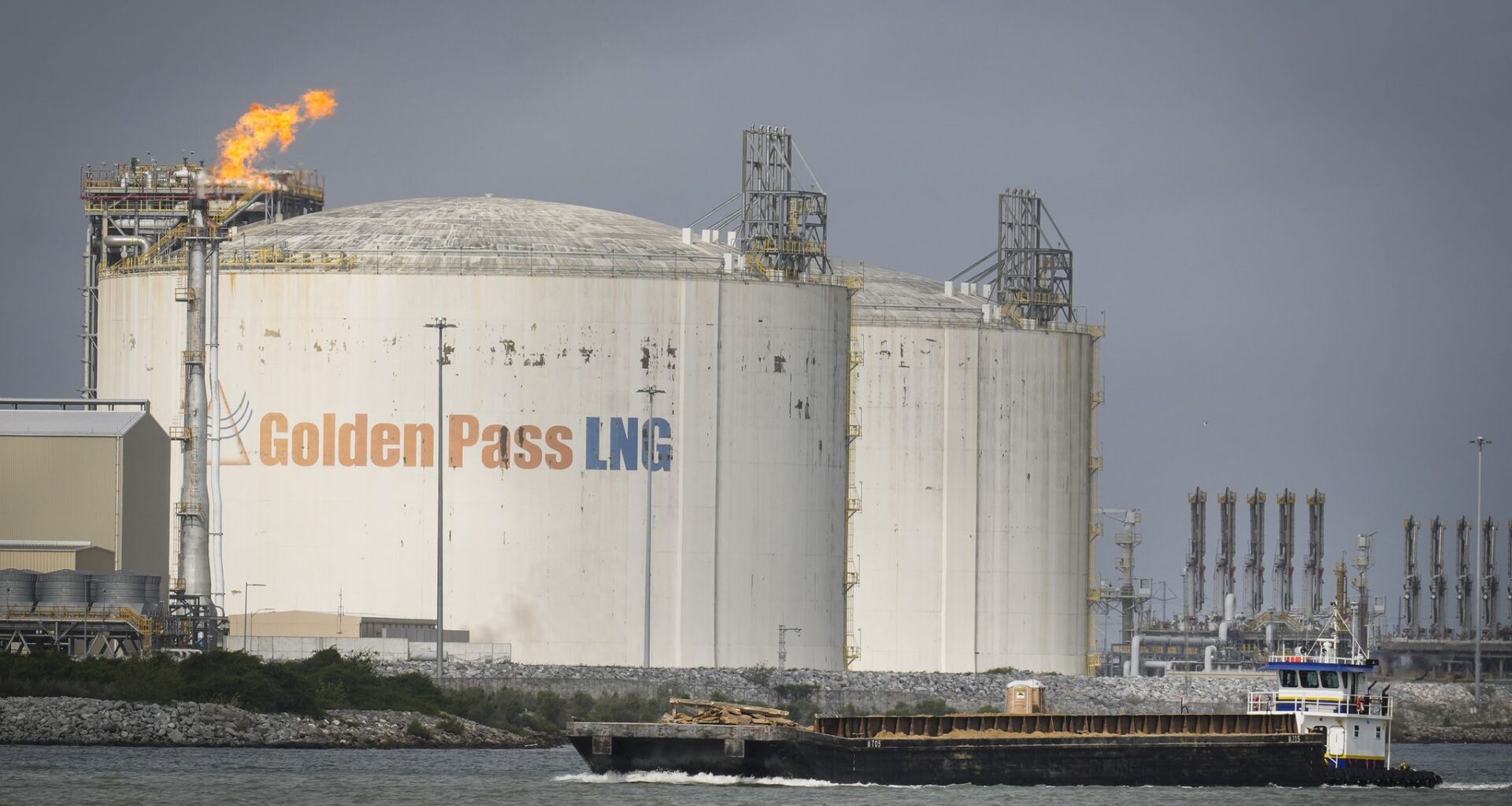
A barge moves along the water past Exxon and QatarEnergy’s new Golden Pass LNG facility in Port Arthur, Thursday, April 2, 2026.
Brett Coomer/Houston Chronicle
Exxon and QatarEnergy’s new Golden Pass LNG facility is shown behind a house in Sabine Pass, Thursday, April 2, 2026.
Brett Coomer/Houston Chronicle
Terry Fritz bought her light blue lakefront house more than two years ago, as the now-hulking liquefied natural gas facility took shape across the street.
Golden Pass LNG, owned by QatarEnergy and Houston oil behemoth Exxon Mobil, started commercial production last week and expects to ship its first cargo in the coming months. The water that laps against it is the same that added real estate appeal to the line of neighboring pillar-raised homes and vacation rentals.
Fritz, 70, said she didn’t mind Golden Pass. The gas processing and export facility was relatively quiet, she said. Unlike the refineries down the road in Port Arthur, she couldn’t smell the gas being piped in and, at night, the flares and lights made it look like she lived near a little city.
Article continues below this ad
“They do what they need to do,” Fritz said of companies operating nearby, like Exxon. “And if it keeps the gas lower than it is in California, then it’s nice.”
The facility’s launch, under construction since 2019, marks a critical moment for both the U.S. and global industry. It is the latest project along the Gulf Coast to come online and strengthen America’s role as lead exporter while natural gas markets elsewhere reel from the Iran war.
“Golden Pass is hitting the market at the right time,” said James West, head of energy and power at Melius Research.
INDUSTRY STANDARDS: Trump promised an energy boom in his second term. Texas shows who actually got one
Article continues below this ad
Demand for U.S. LNG has skyrocketed as a result of the war in Iran. An Iranian airstrike to a QatarEnergy LNG facility at the Ras Laffan industrial hub in Qatar in March knocked out as much as 17% of the country’s current supply for the next five years, according to the company.
LNG is considered one of the cleanest fuel sources on the market. It is the supercooled liquid form of natural gas, which makes it easier to pipe into ships to send to gas-favoring markets in Europe and Asia.
The U.S. is the world’s largest exporter of LNG, and a favorite of the Trump administration, which restarted export permitting after a yearlong pause to the process during the Biden administration.
The war in Iran showed that U.S. LNG is safe from a vulnerable choke point — the Strait of Hormuz — that cargoes from Qatar LNG are not, West said.
Between the war, the artificial intelligence boom and the popular use of natural gas to power data centers, demand for LNG is primed to increase faster than demand for crude, he said.
Article continues below this ad
BOOM OR BUST: Oil prices surged past $100 this week. Why is Texas oil still on the sidelines?
Until the war, Qatar was producing around 20% of the world’s LNG supply. It’s left a hole that customers in Asia and Europe are hoping to fill elsewhere – like from the Gulf Coast’s expanding industry.
Houston’s Cheniere Energy CEO Jack Fusco said his company and its facilities in Louisiana and Corpus Christi were trying to meet the demand influx.
“We are trying to do whatever we can do,” Fusco said at CERAWeek by S&P Global, the international energy conference that annually brings the biggest names in tech, oil and gas to Houston.
“We’re looking at our maintenance schedules really hard, but at the end of the day, we have to be safe and we have to be reliable. We don’t want to sacrifice anything to get that last drop out,” Fusco said.
Article continues below this ad
Exports from Golden Pass are set to start in the second quarter. A Thursday report from Reuters said Italy was expected to receive Golden Pass imports starting in June.
A tanker sails past Exxon and QatarEnergy’s new Golden Pass LNG facility in Port Arthur, Thursday, April 2, 2026.
Brett Coomer/Houston Chronicle
According to the company, the facility’s export capacity is expected to be 18.1 million tons per year through the use of three trains, the individual units responsible for turning the natural gas into LNG. Train 1 came online last week week; Trains 2 and 3 have yet to start producing.
“We’re excited to go to work delivering Texas LNG to power the world,” said Jeremy Horn, vice president of operations for Golden Pass, in a statement.
DATA RACE: Texas could soon have more data centers than anywhere in the world: What residents should know
Article continues below this ad
John Beard, founder of the Port Arthur Community Action Network, said he was less than thrilled about another oil and gas facility coming online in his community.
“It’s not about what you see or don’t see,” Beard said. “The problem is about what you don’t.”
LNG facilities have been shown to release methane gas, which can be odorless and colorless. Methane is a climate-warming greenhouse gas that can cause respiratory problems and is emitted throughout the production, processing, and shipping cycle.
Beard also said he would be happier if the facility had hired more members of the Port Arthur community. Port Arthur has an unemployment rate of 8.5%, according to the Texas Workforce Commission in December.
The national unemployment average is around 4.3%, as of March, according to the Bureau of Labor Statistics.
Golden Pass provided roughly 2,600 on-site jobs through the third quarter of 2025, as the company put the finishing touches on its first train, according to the company’s website.
Golden Pass did not provide updated employment figures and did not respond to requests for comment. It was unclear how many permanent jobs were created by the facility, and how many of them went to nearby residents in Port Arthur or Sabine Pass.