
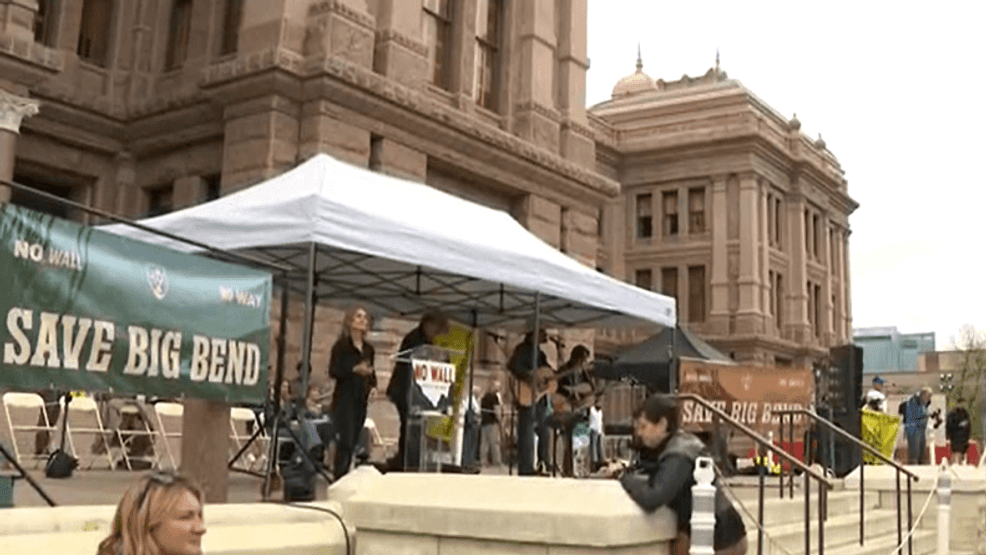
AUSTIN, Texas — Hundreds of Texans rallied at the state Capitol on Tuesday to oppose federal border protection plans in the Big Bend region, warning that new infrastructure could damage the area’s ecosystem and change one of Texas’ most iconic landscapes.
The rally filled the south steps of the Capitol with chants, signs and speakers calling for “no walls in Big Bend.” Participants also raised concerns about what they described as a lack of transparency and communication from the federal government about what could come next.
Incoming federal border protection plans could reshape more than 150 miles of land in the region. Ramon Rodriguez, who lives near Big Bend National Park, called the park “the gem of that area of West Texas.”
River guides who work in the area said a wall would fundamentally alter the experience for visitors and wildlife. Laura Stinger, a river guide at Big Bend National Park, said, “No, not at all. Couldn’t imagine a wall being there. It would ruin the experience for everybody and the animals.” Stinger said she had been on that section of river earlier in the day and traveled to Austin for the rally.
ALSO:Round Rock PD arrests alleged child predator in investigation involving multiple victims
In February, the Trump administration removed multiple environmental laws that would allow for a new border wall to be built within the Big Bend region. The wall would have stretched 150 miles through the area, prompting bipartisan pushback.
State Rep. Sarah Eckhardt, D-Austin, said, “Our land, our rivers are our public and our Texans’ vitality and our heritage, and we’re going to keep it. Come and try and take it.”
Brandon Herrera, a Republican U.S. Congress candidate, said, “I’ve never found a single person who thinks this is a good idea…Nobody wants the wall in Big Bend.”
Although the federal government did not announce it publicly, the plans appear to have changed. U.S. Customs and Border Protection’s website now maps out a “Smart Wall” instead of a physical wall. The agency says the smart wall would use lights, cameras and other detective technology across more than 530 miles of the U.S.-Mexico border.
Even that approach drew criticism from some Texans at the Capitol. Molly Farrell, a river guide at Big Bend National Park, said, “We want to protect, our land, our economy, our people, our water, and the wildlife too.”
According to a Texas Tribune report, only 1.3% of border crossings in 2025 happened in the Big Bend region.
U.S. Customs and Border Protection did not respond to a request for comment.