
TEXAS — City and state governments across the country are making final adjustments to their websites before a new rule from the U.S. Department of Justice (DOJ) will be enforced later this month.
The DOJ published a rule in early 2024 that requires local and state municipalities to update their websites to be accessible to those with disabilities, like visual impairments.
The first deadline is April 24 for cities and states with a population of more than 50,000 people. Other municipalities where the population is under 50,000 have until next year to comply with the rule.
“Websites, it isn’t obvious unless you’re testing it,” said Brian East, an attorney for Disability Rights Texas.
East has worked on cases where certain websites were not made accessible for users, saying the cases either end in the issue getting resolved or sometimes leading to litigation if required.
“[People] may be contacting city council members, the mayor, to get this work done,” he said. “It is complaint-driven to get this work done.”
In Alvin, one man working with the National Federation of the Blind of Texas has been helping people navigate visual impairments to perform everyday tasks, from walking with a cane to using the computer and internet.
“We try to find all kinds of techniques,” said Raul Gallegos, the first vice president of the organization.
Gallegos completely lost his vision when he was 17 years old.
“Some of them are a little creative and some of them, we try to think outside the box. People generally feel good when they can do something,” he said.
When it comes to local and state governments, techniques for making their sites accessible could be the inclusion of alternative text for pictures, having high-contrast colors and having clear audio in videos.
The City of Austin recently launched the new version of its website on March 19.
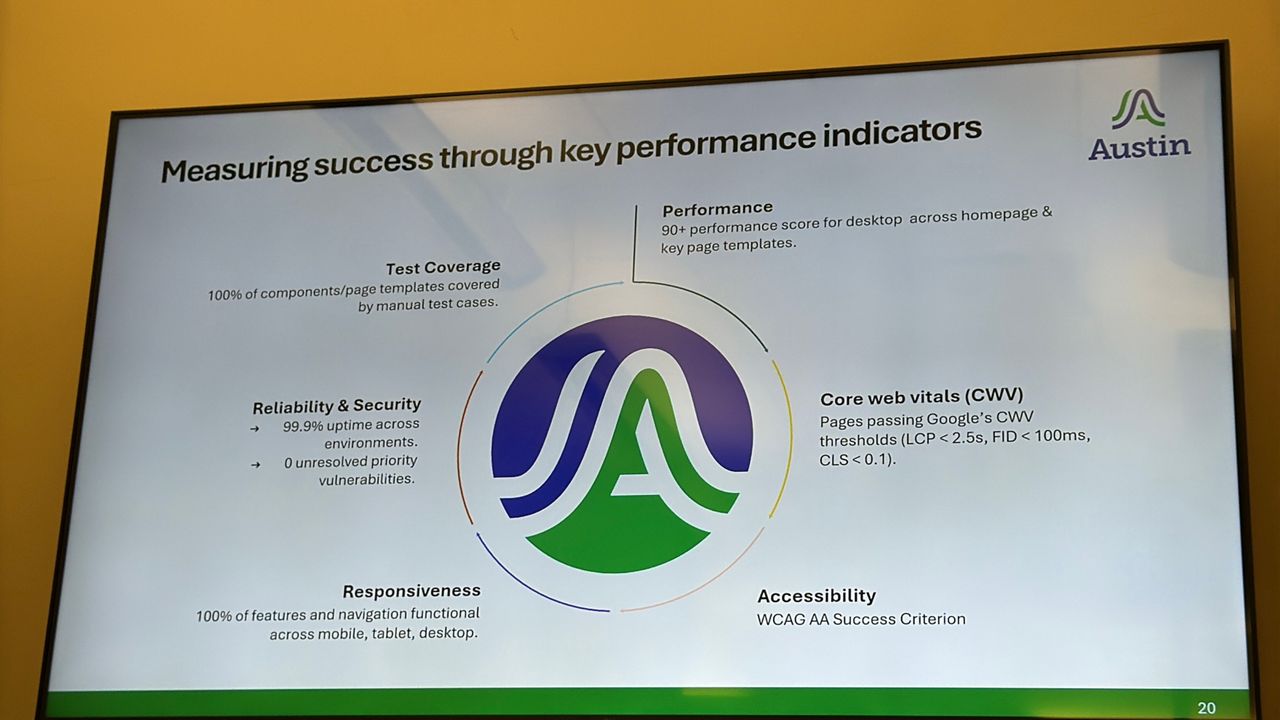
For two years, members in the city’s communications team and information technology team have implemented the Web Content Accessibility Guidelines laid out by the World Wide Web Consortium.
“We also reduced their pages significantly; that is a best practice for making sure the site is really focused,” said Yasmin Wagner from the city’s digital and creative services team.
The City of Austin said they reviewed other city websites like Boston, New York, San Francisco and Philadelphia for inspiration and ideas.
Wagner said another key to making things accessible was having consistent designs across platforms.
“Always going to be consistency in the font, in the colors, the layout design so that everything is very clear in that it’s coming from the same place,” said Wagner.
Gallegos tested the City of Austin’s website for himself and found that some of their headline sizes may not be as accessible as he would have preferred.
He also tested the City of Houston’s website and said that for sites like Houston’s, the developers may include a hidden accessibility button.
Gallegos says he is doubtful that every city and state will comply with the new rule but continues to push for accessibility on every platform possible.
“When these standards are developed or websites are made accessible, they need to be accessible on all aspects, no matter what device or screen size you’re using them,” said Gallegos.