
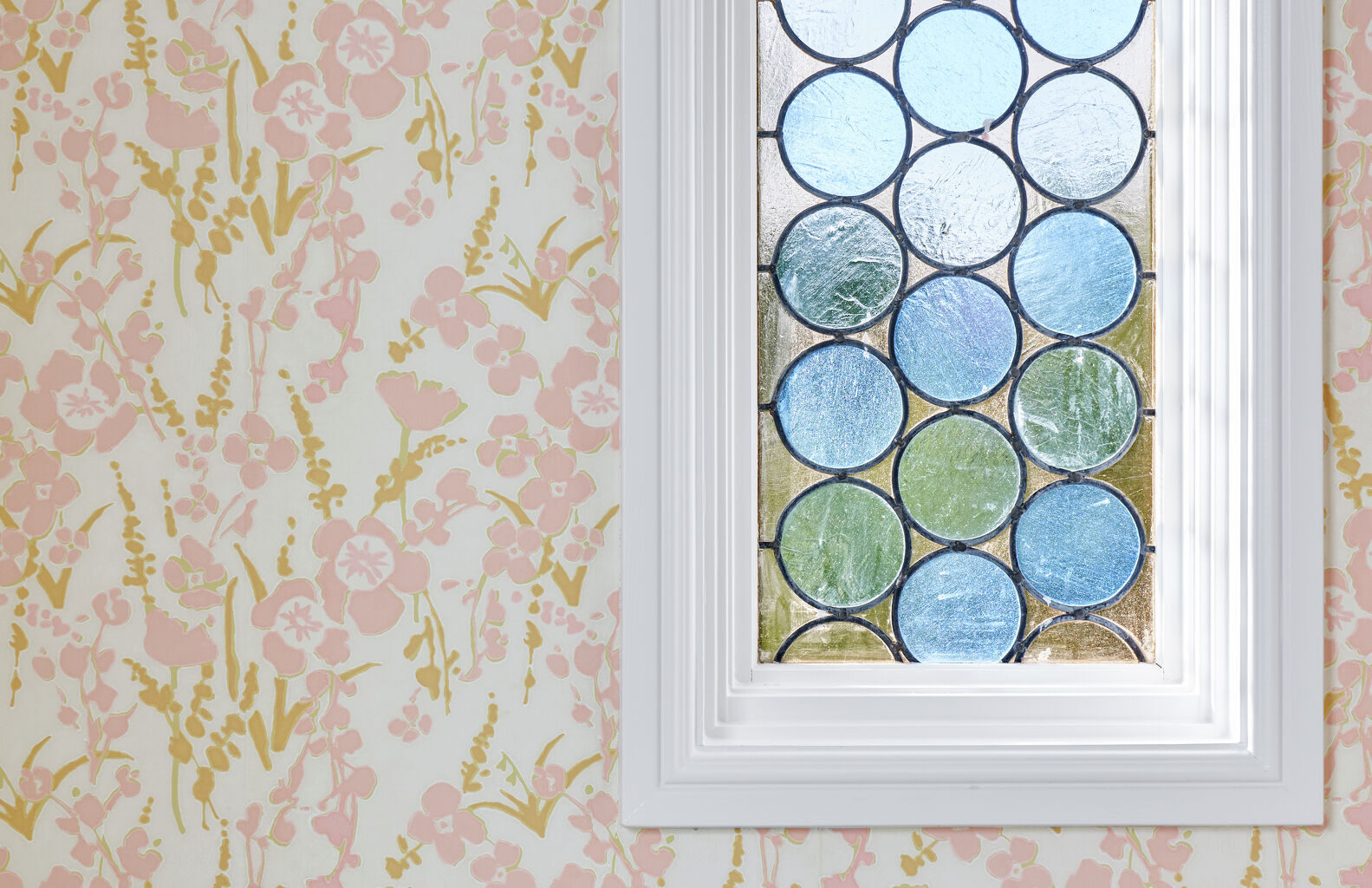
Simple patterns like grids and diamonds are frequently requested glass designs. These windows are by Glasshouse.
Dan Piassick/Courtesy Glasshouse
In Lakewood, there’s a Hutsell house for sale. The front elevation showcases one of the more magnificent stained-glass windows of any home in Dallas.
Expansive stained glass faces the street in this 1936 Lakewood home designed by architect Clifford Hutsell.
Courtesy David Bush Realtors
It’s likely not something an architect would spec today, but to some, it’s the envy of the neighborhood. The leaded-glass windows of Dilbeck homes in the Park Cities carry that same weight. Slightly imperfect, deeply specific, the windows are both signature and signal: of old-world craftsmanship and a time when eclectic ways and funky features were treasured.
Article continues below this ad
We lost that for a while, as new homes and even renovations became brighter, cleaner, flatter. But everything old becomes new again, and there’s a movement brewing. After years of minimalism, architects, designers and homeowners are returning to more layered and detailed spaces.
Arched, leaded-glass windows add texture and character to a stone-lined wine room Morgan Farrow created.
Nathan Schroder
“I definitely think there is that shift back to the more-is-more maximalism. … It will be different from how we knew it in the ’90s — and I think that’s a good thing,” says interior designer Morgan Farrow. “But there’s a warmth and character that was missed for many years as we cleaned everything up.” Younger generations have also embraced heirloom design. They want pieces that feel made to last — not easily cast off, not meant to be temporary.
What Farrow calls “window moments” are part of the shift.
Article continues below this ad
When her clients want something special, Farrow works with Glasshouse, a Dallas company specializing in luxury residential glass. Tim King founded the company 25 years ago and has seen demand for decorative glass windows rise and fall and rise again.
Today’s decorative glass tends to favor texture and pattern over bold color. This is the work of Glasshouse.
Dan Piassick/Courtesy Glasshouse
“The trend over the last year and a half to two years has definitely shifted toward more period-driven, more nostalgic design — richer colors, darker woods — just more luxury overall. I pray that leaded glass and stained glass come back with a vengeance, and it does seem to be heading that way,” he says.
Article continues below this ad
It doesn’t necessarily mean heavily ornamental work, however. Today’s stained glass may not be what you expect. It may not even be “stained” at all.
“Some people react strongly to the term ‘stained glass,’” King says, “because they think of very colorful church windows.” Instead, he uses the term “leaded glass” to describe a broader range of treatments, often colorless or subtly tinted — but he notes it’s “really just semantics.” The point is, modern decorative windows are more restrained, more architectural than pictorial.
In a bathroom designed by Farrow, softly colored glass designed in circles diffuses the light and maintains privacy.
Nathan Schroder
“There are so many iterations of what it can be,” Farrow says, echoing King. “It doesn’t always have to be that traditional, swirly thing you think about when you’re at church.” What it might look like instead are new panes designed to mimic the distortions of older, hand-blown glass or slightly playful geometric designs with a hint of color. Diamonds, grids and divided panes: They feel timeless, as if they’ve always belonged to the house and always will.
Article continues below this ad
While that distinguished Hutsell home makes a statement as obvious as a peacock on a rooftop, today’s window moments tend to be far more understated. And though a thoughtful decorative window in a bathroom, stairwell or laundry room looks lovely when you’re standing inside the space, taking it in like a work of art, “location is really driven by architecture, not necessarily by interior function,” Farrow says — meaning these windows are typically placed where the structure allows, often within fixed openings on exterior walls. Though that could be changing too. Decorative glass sometimes appears on an interior wall, say, in a wine room or bar alcove, strictly for the pleasure of the room’s occupants.
What seems certain is that leaded glass and stained glass are back in the conversation. “This is a resurgence,” King says.
Consideration to the balance of a home’s exterior is usually how windows are placed, but a beautiful leaded-glass window in a bathroom or laundry room can be a joyful surprise to the occupants. Morgan Farrow designed this bathroom.
Nathan Schroder
Another view of the windows shows their decorative appeal.
Nathan Schroder
Leaded-glass cabinet doors — these are by Glasshouse — add vintage character to even a new home.
Dan Piassick/Courtesy Glasshouse
Love homes, gardens and design? Get more good stuff from Abode by following us on Instagram, Facebook and LinkedIn.