
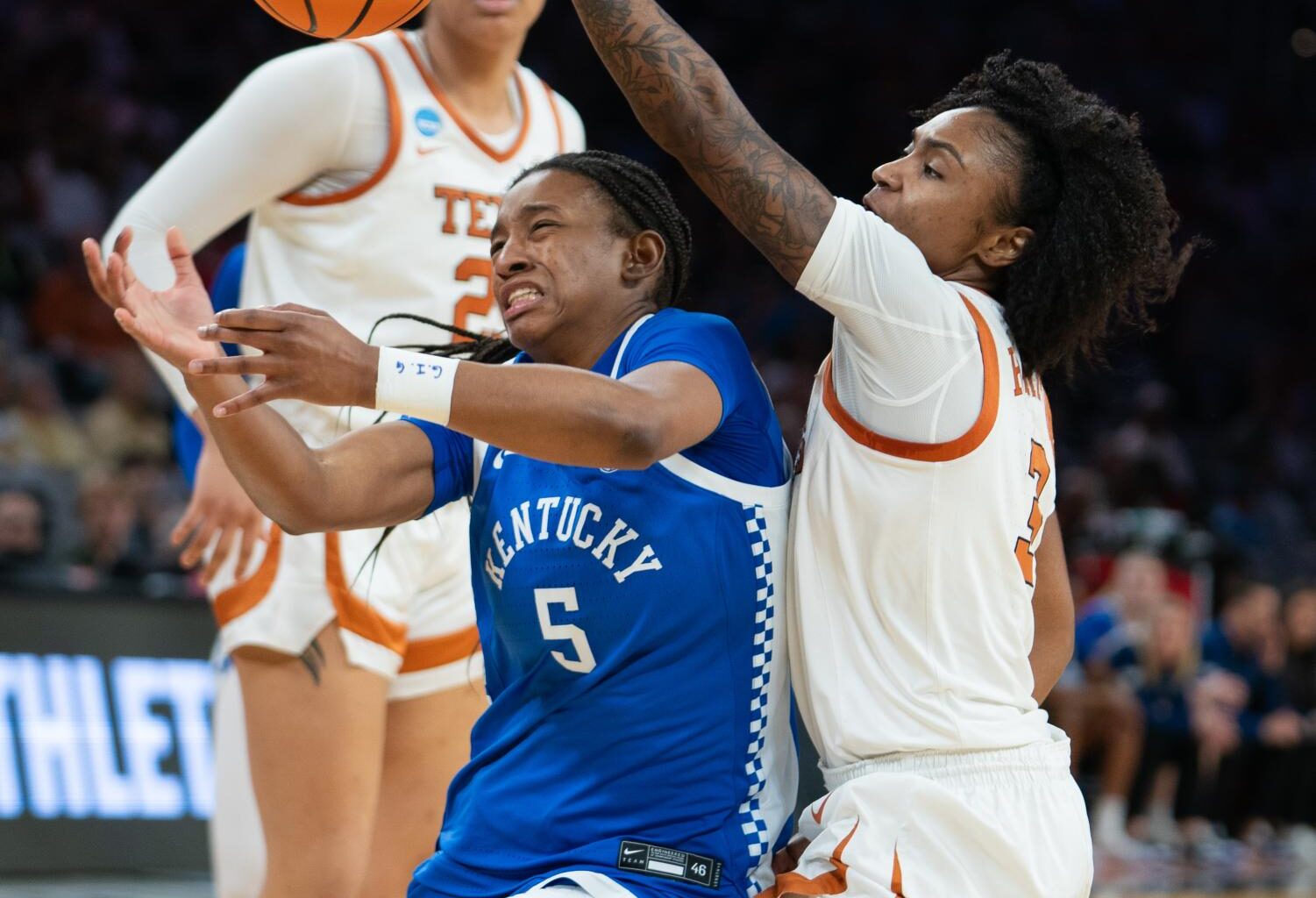
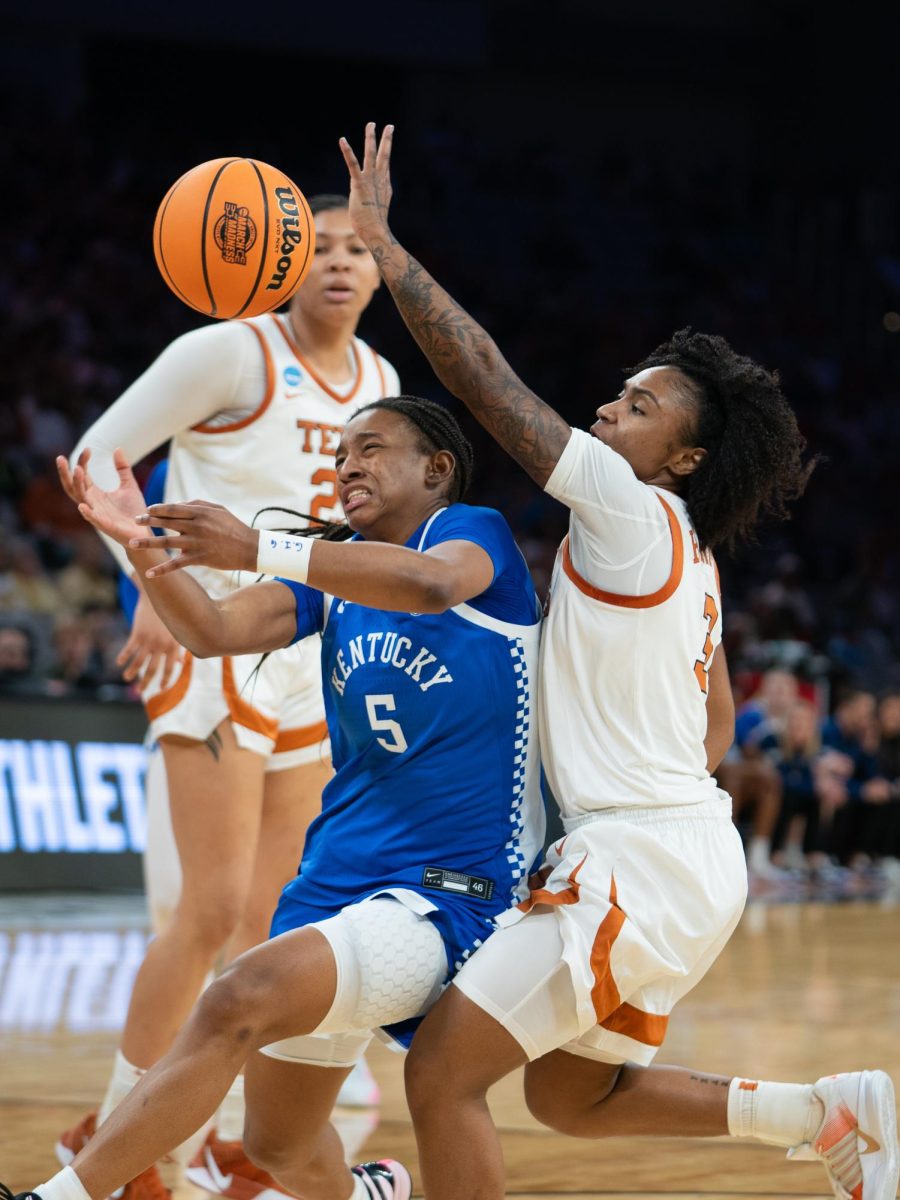
Senior Rori Harmon deflects the ball away from Wildcat senior Tonie Morgan during the Sweet 16 against the Kentucky Wildcats on March 28.
Texas women’s basketball suffered a frustrating, season-ending defeat at the hands of eventual champion UCLA in the Final Four. But even on the brightest stage, amidst difficulty adding points to the scoreboard, the Longhorns never lost sight of what got them to Phoenix.
On Friday night, head coach Vic Schaefer vocalized how proud he was of his team’s determination to maintain its defensive identity until the final buzzer sounded.
“You ain’t (ever) seen a team at the Final Four play defense like that group did tonight, guarding people, denying handoffs, all that. They played their hearts out,” Schaefer said.
Texas’ defensive acumen was near and dear to its successes all season long, which has become accustomed for the Schaefer style. Among Southeastern Conference programs, the Longhorns allowed the fewest points and field goals per game, forced the most turnovers per game and secured the most steals per game.
At the nucleus of defensive effectiveness was graduate point guard Rori Harmon, who became the program’s steals leader in the home victory over LSU on Feb. 5. Harmon led Schaefer’s ruthless full-court press plans, pestering ball-handlers and never giving up on a play.
“(Harmon will) guard your ass at the city limit and show you the door when she’s done with you,” Schaefer said after the Final Four game. “You want to talk about somebody that’s hard to replace. We may never replace her (and) the impact she has on our team.”
Unsurprisingly, when Schaefer didn’t find satisfaction in the defensive effort, Harmon didn’t either. A paramount example came after Texas conceded a season-high 86 points to Vanderbilt, when Schaefer claimed Harmon reinvigorated the defensive cause of his team.
“Rori got up and said, ‘Hey, guys, I’ve been here five years. The standard here is 60 points,’” Schaefer said. “In our last five games, we’ve given up 67 points a game, which was something that I had pointed out to them. She said, ‘That ain’t it. That’s not the standard.’ Ever since then, we’ve been pretty good defensively, locked in.”
In the 13 games after its loss in Nashville, Texas only gave up 55.4 points per game. Time and time again, Texas would take over a game or control it by blitzing an offense anywhere on the court.
Then, after falling into an early deficit against UCLA, pressure instigated by Harmon and company helped keep the Longhorns in the game and increase the late-game tension.
Through its indispensable full-court press, with under three minutes remaining and down seven points, Schaefer’s team caused two UCLA timeouts and a turnover off of consecutive inbounding situations. As the Longhorns looked to rally a final comeback effort, they forced UCLA to barely prevent five-second calls.
“They put so much pressure on us,” UCLA head coach Cori Close said. “It definitely was not a pretty game. … But I think credit to them, that they played that hard to force that kind of game. They have some excellent players on their team. Lots of respect for the year that they had and how much challenge they provided.”
The two games between Texas and UCLA were the two lowest point performances of the Bruins’ season.
And while there are no moral victories in the NCAA Tournament, and while the post-Harmon era of Texas defense now leaves plenty uncertain, the level of defensive success accomplished this season should not be downplayed.
It sustained and even elevated the standard set in Schaefer’s program.