
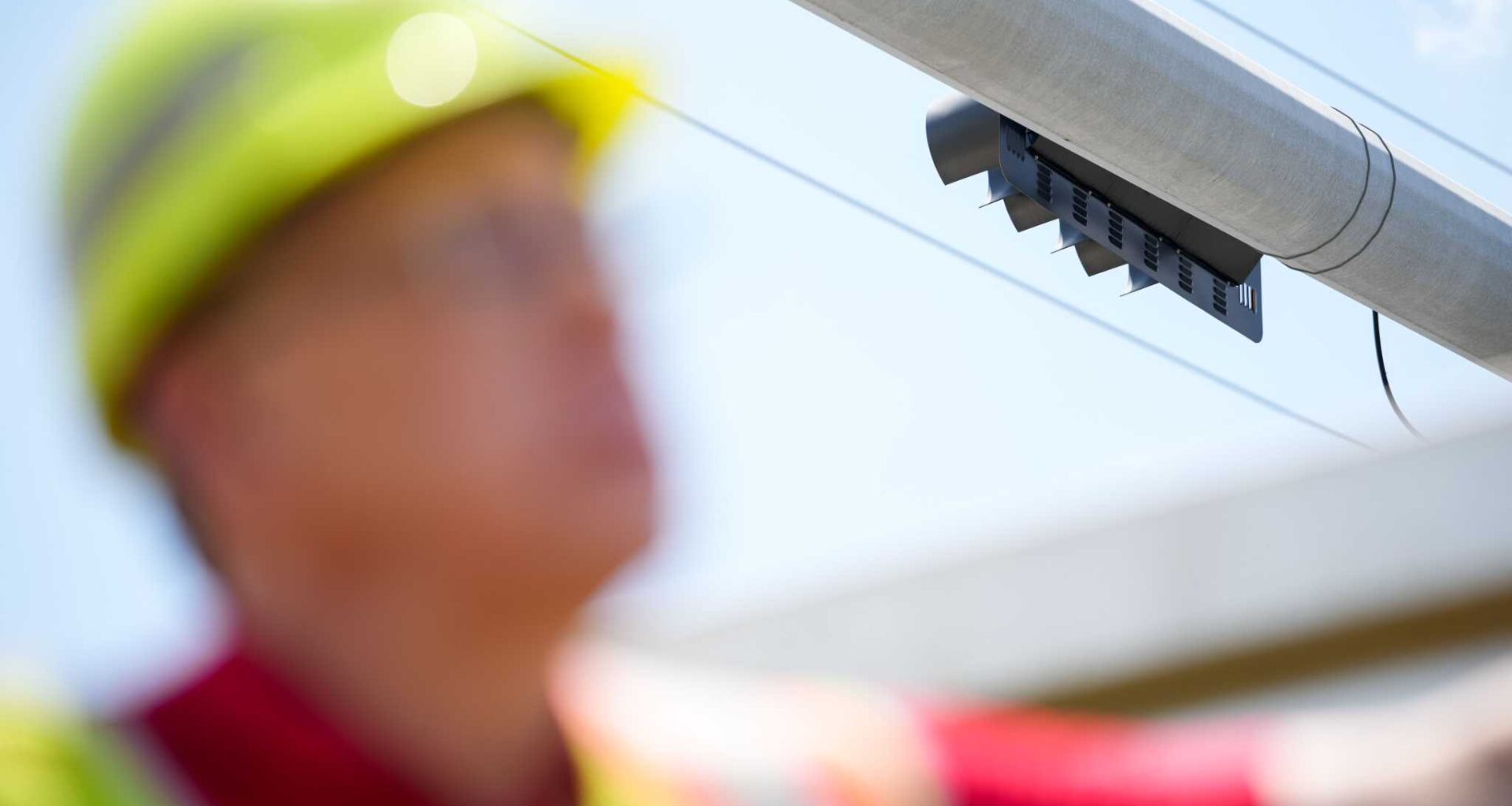
A traffic light is seen behind Robert Brydia, right, a senior research scientist and head of the Texas A&M Transportation Institute’s system reliability division, as he talks about the features of a new system of integrated sensors Wednesday, Aug. 7, 2024, at the corner of Voss Road and Texas 6 in Sugar Land.
Jon Shapley/Staff photographer
Houston City Council on Wednesday may expand the use of artificial intelligence-powered traffic signals designed to reduce delays and improve safety at busy intersections.
Houston has already tested the system at 10 intersections along a stretch of Old Spanish Trail near NRG Stadium, according to NoTraffic, the company that developed the technology. Wednesday’s $715,970 proposal would authorize Houston Public Works to contract with Texas Highway Products to install and support the NoTraffic “autonomous traffic management platform” at designated intersections.
More: Houston water bills are rising again, continuing annual hikes.
Article continues below this ad
Houston Public Works did not respond to a list of questions, including which intersections would be included and when the technology would be implemented. Tom Cooper, a NoTraffic vice president, said the cost can vary depending on the intersection, but estimated that a project of this size could cover 15 to 20 intersections.
The system uses a combination of cameras and radar to detect vehicles, pedestrians and cyclists and adjust signal timing based on real-time conditions. It can also collect detailed traffic data and be configured to prioritize certain movements — such as increasing green-light time along heavily traveled corridors during peak periods.
Cooper said the system reduced overall delays along the OST corridor by about 15% in congested conditions.
“That’s the equivalent of moving five or six thousand cars,” Cooper said.
Article continues below this ad
Cooper said the system was designed around goals set by city officials: reducing delays and managing traffic during large events near NRG Stadium, while limiting the need for staff or law enforcement to manually adjust signals or direct traffic.
Cooper also said implementing the system required coordinating with Metro’s light rail line along the corridor and accounting for train movements while still optimizing traffic flow.
“We had to make sure that we weren’t impacting Metro operations and priority for the rail, while optimizing the traffic around it,” Cooper said. “Instead of looking at a single intersection, it looks at an entire corridor.”
More: As Acres Homes celebrates ’44 Day’, residents confront their rapidly changing community
Can AI improve traffic?
Traffic signals are more complex than simple timers.
Article continues below this ad
They are typically controlled by a central system that follows timing plans based on expected traffic patterns at different times of day and uses cameras, radar or devices embedded in the pavement to detect when vehicles or pedestrians are present. That allows signals to extend or shorten lights based on demand, though they still operate within pre-programmed rules.
Artificial intelligence aims to build on that approach by using more detailed data and adjusting signals continuously in real time. The systems can also be programmed to meet specific goals based on recurring traffic patterns.
“For example, if there’s a church on Sunday and traffic lets out at a certain intersection, then we might see more people turning left at that time,” said Yolci Ramirez, traffic engineer for the City of Pearland, which began using AI signals in 2023.
Ramirez said the system could be configured to prioritize that movement during those periods, helping traffic move more efficiently.
While artificial intelligence can help make traffic signals more responsive, experts said its impact is often incremental rather than transformative.
Article continues below this ad
Kailai Wang, an assistant professor of industrial and systems engineering at the University of Houston, said AI-driven systems can improve how intersections respond to real-time conditions and reduce unnecessary delays. However, Wang cautioned that the technology does not address the root causes of congestion, such as population growth.
“AI cannot fully solve congestion itself,” Wang said.
Instead, he described it as an added layer that helps cities manage traffic more efficiently, particularly during peak periods or large events.
Wang also noted potential challenges, including cybersecurity risks — as systems rely on more data and connectivity — as well as the cost and complexity of implementation.
In Pearland, traffic engineers have installed AI-enabled detection systems at about 30 intersections, with plans to expand further. But officials there say the most advanced features, including fully automated signal optimization, are not yet widely in use.
Article continues below this ad
“It’s not going to be the fix-all,” Ramirez said. “But it’s going to make things run more efficiently.”
Ramirez said the system can eventually allow signals to adjust timing dynamically throughout the day based on changing traffic conditions, rather than relying on preset schedules. But implementing those features requires additional funding that experts say underscores that challenges of AI traffic systems and how they are ongoing investments instead of one-time upgrades.