
By Shelby Shank
Field Editor
A shift in weather patterns could take shape later this year as La Niña weakens and El Niño develops.
The National Weather Service Climate Prediction Center (CPC) reported below-average sea surface temperatures lingering across the east-central equatorial Pacific through February. Rising subsurface ocean temperatures and weakening trade winds are now signaling a transition toward El Niño.
The CPC predicts a 62% chance El Niño will form between June and August and last through the end of the year. However, the timing and intensity are still uncertain, and some early predictions may be overstated.
“It’s not a slam dunk, but there is a decent amount of confidence that we’ll see an El Niño signal,” Tom Bradshaw, meteorologist-in-charge at the National Weather Service told the Texas Farm Bureau Radio Network. “What becomes more difficult is determining what those impacts actually look like.”
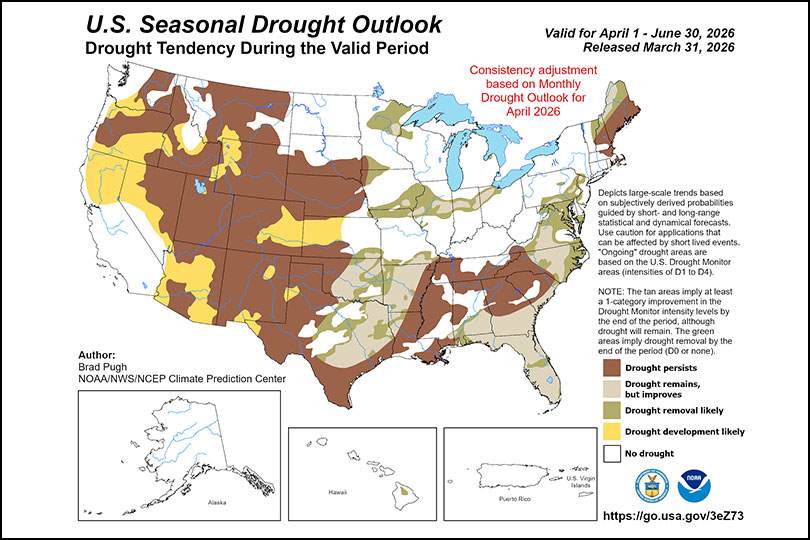
The transition to El Niño could bring challenges to farmers. A quick shift from La Niña to El Niño can lead to early season dryness in growing regions like the Midwest and Plains.
In Texas, La Niña conditions will likely continue into spring and bring temperature swings and uneven rainfall. Moisture is expected to start east of I-35 and slowly move west as the season progresses.
“How we start the year is not likely how we’ll finish it,” Matt Makens, meteorologist for CattleFax, told the Texas Farm Bureau Radio Network. “We’ll see that moisture patten slowly shift across the state as we move into the summer months.”
But El Niño doesn’t guarantee rain for everyone. Parts of West Texas could remain dry due to other weather factors.
“Just because you hear El Niño doesn’t mean water for everybody,” Makens said. “The farther west you go, the higher the chance you may stay dry.”
Questions remain about whether increased rainfall could help recharge Texas’ depleted aquifers. The Ogallala Aquifer in the High Plains and the Edwards Aquifer across Central Texas and the Hill Country have both seen declining water levels in recent years.
While rainfall could offer some relief, experts say recovery will take time.
“El Niño would certainly help the odds of that, but these aquifers are so dry. Lake levels are poor, too. It would take back-to-back, multiple years of this kind of pattern to really have a lasting effect,” Makens said. “We can’t say it’s going to be a three-year El Niño, but just having it reemerge will help. We need years’ worth of water to catch up, and we’re not getting the river levels up either. It’s a twofold issue, but at least El Niño helps our odds.”
Farmers are concerned about the potential strength of this El Niño, given its impact on rainfall, drought risk and crop yields.
Spring rainfall is expected to be near normal but may not provide much relief, according to meteorologists.
“If the soil moisture is quite dry, we may see temperatures that are substantially warmer than normal. That’s why what happens this spring is so important for how the summer sets up,” Bradshaw said. “As we move into late spring and summer, there’s less correlation between El Niño and what we actually see. That makes it harder to pin down exactly how conditions will play out.”