
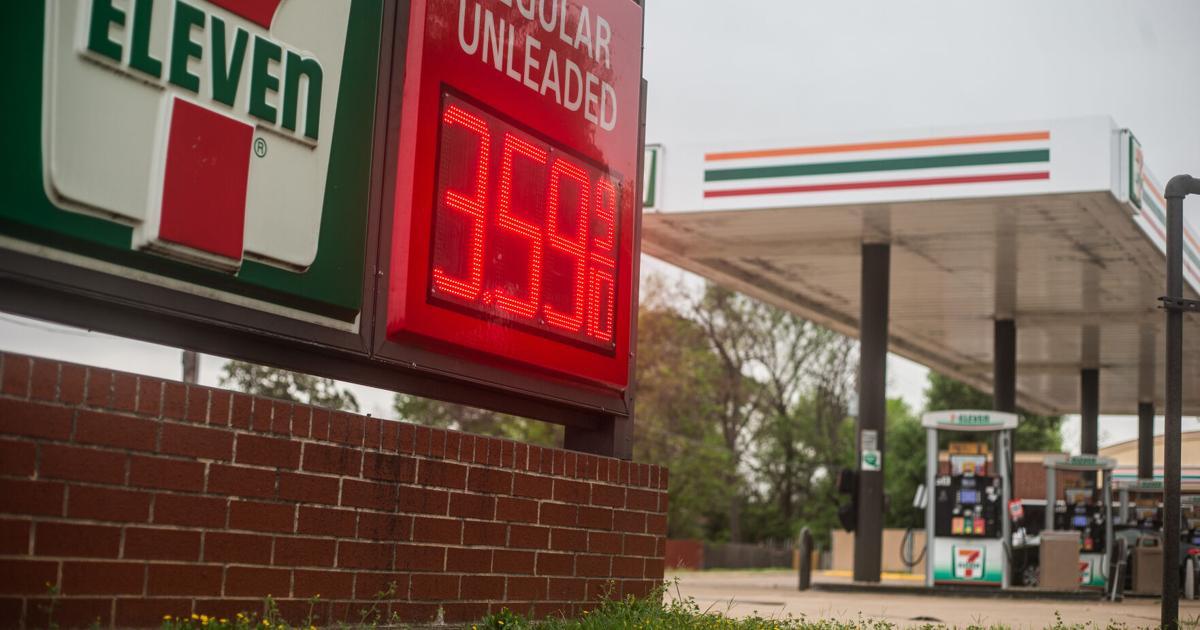

7-Eleven sits on South Collins Street on March 28 in Arlington. The national average gas prices rose about $1 since February, according to the American Automobile Association.
Gas prices across the country are rising as the U.S. continues its war with Iran, leaving students — many of whom already pay an abundance of collegiate fees — with more financial pressure amid an uncertain economy.
In February, the U.S. and Israel coordinated a series of strikes across Iran, killing the nation’s supreme leader, Ayatollah Ali Khamenei, and prompting retaliatory attacks against U.S. bases in the Middle East, according to the Associated Press.
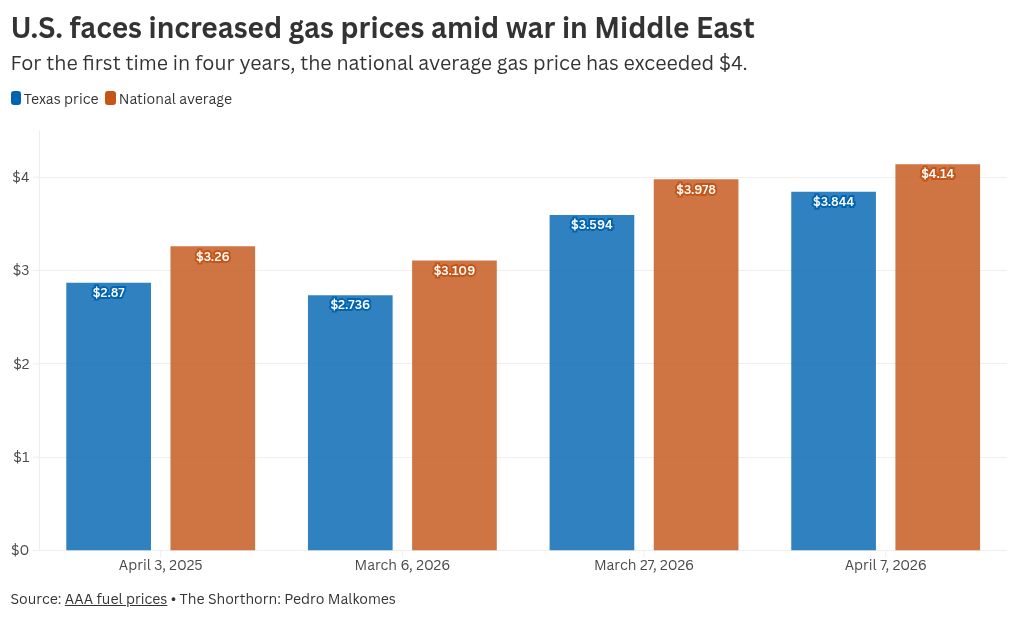
The ensuing war has limited oil production, hiking gasoline prices across the country. The national average gasoline price has spiked by about $1 since last month, reaching $4.140 as of April 7, with Texas sitting at $3.844, according to AAA motor club. The increase marked the first time in four years that the national average exceeded $4.
UTA has a large body of commuting students, many of whom have been impacted by the price hikes.
“These gas prices are just insane,” said Abimelec Sanchez, a supply chain management junior who commutes from Carrollton, Texas, in a Ford F-150.
Sanchez, who has to drive to Mesquite, Texas, when visiting his girlfriend, said he realized how bad the prices were getting when it cost him around $82 to fill up his truck.
Sanchez said he is trying to pay off school, and the heightened fuel prices are only making it harder to manage his finances.
“It’s hard to drive less,” he said. “Eventually, we have to just suck it up, and yeah, I guess keep on with our routines.”
Mathematics doctoral student David Cruz wasn’t happy when he saw the prices climb, but said he is not making a conscious effort to drive less. Cruz said the impact will likely weigh the most on first-generation students.
“It’s going to hurt for a little bit, but hopefully they [gasoline prices] go back down,” Cruz said.
Prices at the pump are made up of several variables, which interact in a cause-and-effect manner. The biggest factor is crude oil, which accounts for at least half of gas pricing, AAA Texas spokesperson Daniel Armbruster said. Other contributors include refining, processing, distribution and marketing prices.
As the global economy faces repercussions amid tensions in the Middle East, many analysts fear that the saying that gas prices rise fast and fall slow will prove true.
While the U.S. doesn’t directly purchase crude oil from the Middle East, Armbruster said it is a globally traded commodity, so supply disruptions can impact international markets — causing U.S. gas prices to fluctuate.
In an interview with Politico, Mike Sommers, American Petroleum Institute CEO, said the only way to improve oil prices is to reopen the Strait of Hormuz, a chokepoint at the Persian Gulf which accounts for roughly 20% of global petroleum liquid flow, according to the U.S. Energy Information Administration.
The strait has faced closures since February, when the war in Iran began.
“Otherwise [if the strait remains closed], you’re going to continue to see rising prices across the country,” Sommers said, “not just here in the United States, but the real effect you’re really seeing is in both Europe and Asia, where a lot of this oil is flowing.”
On Tuesday, the U.S. struck military targets on Kharg Island, an Iranian oil hub, after President Donald Trump made threats contingent on the nation reopening the strait, according to the Associated Press. Trump set an April 6 deadline for the reopening on Truth Social in late March.
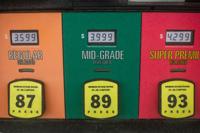
Pumps for regular, mid-grade and super premium unleaded gas display prices March 28 on South Collins Street in Arlington. The prices remain high due to the Iran conflict.
Following Tuesday’s strikes, Trump pulled back threats of further attacks, subject to Iran agreeing to a two-week ceasefire and reopening the strait.
Trump also told reporters in March that when the war is over, oil prices will go down “very rapidly.” The president said preventing Iran from developing nuclear weapons is more important than short- or long-term oil prices.
“It’s horrible how stuff in office and governance is really affecting us,” said nursing freshman Dasia Barefield.
Barefield, who drives a Chevy Malibu and lives on campus, said while finances aren’t an issue for her, she is still mindful of gas conservation. Barfield likes going out with her friends and driving to Dallas, and she needs a full tank to make it to where her family lives four hours away, she said.
“My parents, they have diesel. They had to rent out a car because it was just too expensive,” Barefield said. “They were dropping $200, $300 on a full tank of gas.”
Music composition sophomore Aaron Casterline said he feels sorry for people who drive diesel trucks, motorcycles or any high-octane vehicles.
“We’re lucky to be in Texas, where it’s $3.60,” Casterline said. “Heaven forbid you live on the West Coast.”
“It [the gasoline prices] just makes everything worse,” Casterline said. “It’s another thing on everyone’s plate.”
Beyond driving less, there are steps people can take to conserve gas. Armbuster said to avoid quick accelerations, drive at a steady speed and ensure vehicles are properly maintained.
“All of those little things, you know, habits and steps you can take, can add up to savings as well,” Armbuster said.
@PMalkomes