
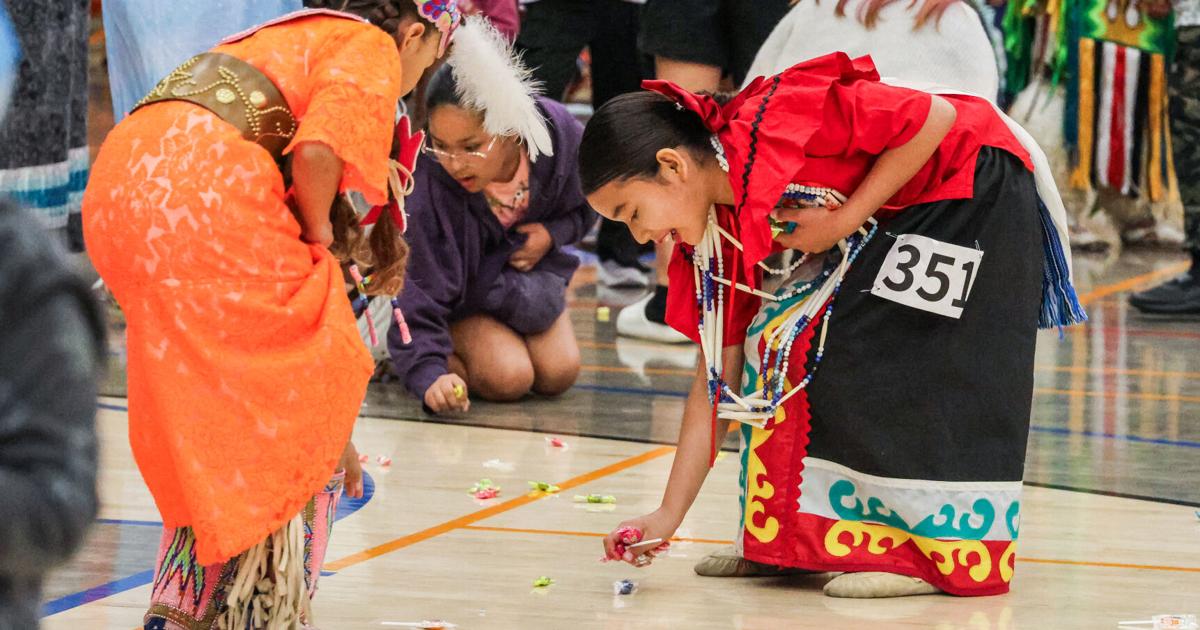

Contestant Amara Iron Shield, 9, picks up candy from the floor during the 30th annual Benefit Powwow on April 4 at the Maverick Activities Center. Iron Shield’s family traveled from Kansas for the event.
A drumbeat fills a hollowed gymnasium as footsteps rattle on the waxed wooden floor. Suddenly, more percussion begins. A rattle starts slowly and then picks up.
Finally, a chorus of voices fills the room. Pitches rise and drop with pinpoint accuracy. Singers harmonize and play drums. Dancers perform to the melody with soft, slow movements. They honor not only their families and ancestors, but warriors and the people who might not be here today.
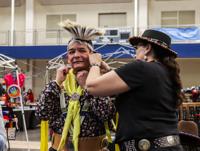
Scott Riding-In gets help securing his head piece during the Native American Student Association’s 30th annual Benefit Powwow on April 4 at the Maverick Activities Center. Scott Riding-In is brother of Les Riding-In, who was honored during the powwow.
The Native American Student Association’s 30th annual Benefit Powwow took over the Maverick Activities Center on Saturday, bridging vendors and traditional dancing and singing. The event also honored the legacy of Les Riding-In, a Native American Student Association primary adviser who died in August.
The event began with gourd dancing, which is considered one of the most respected traditions in the powwow circle and is a ceremonial dance of honor, discipline and community, according to a Native American Student Association Facebook post.
Sampson Dewey, former Native American Student Association president, said gourd dancing originated from southern Native tribes.
Dewey said the dance is like a prayer.
The dance descends from the Kiowa Tribe and spread to other Plains Indigenous communities, according to The Wandering Bull LLC, a Native American craft supply business. The dance commemorates the Kiowa victory against the Arapaho and other foes in a major battle along the Missouri River in Montana, according to EBSCO, a research database.
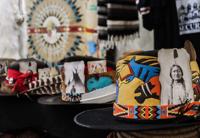
Native American beaded hats lay lined up on a table during the Native American Student Association’s 30th annual Benefit Powwow on April 4 at the Maverick Activities Center. Beads are a staple in Native American art.
Clifton Queton, a member of the Kiowa tribe, said he’s been told the dance originated over a battle between the Cheyennes. He said neither tribe won, and both lost many warriors. After a few days, they gave up.
Later, Queton said, both tribes formed an alliance through which the gourd dance was born.
Dewey said the dance is very choreographed and has lot of passion behind it.
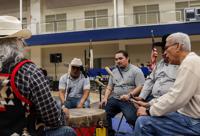
Drum circle members play the drums during the Native American Student Association’s 30th annual Benefit Powwow on April 4 at the Maverick Activities Center. The event included a gourd dance and grand entries.
The dance has been adopted by other Indigenous American tribes and non-Indigenous people, according to EBSCO.
Each dancer holds a gourd rattle in one hand and, usually, a fan or bird replica in the other, Queton said. They take small steps with the rhythm of the song played by the singers, who sit in a circle around a drum in the middle of the performance area.
“The songs depict everything,” he said.
Embedded Instagram video post from The Shorthorn.
Queton said each song tells a story and that they belong to their people.
“We’re familiar with it, so we understand it,” he said.
Jodi Yellowfish, a member of the Lakota, Creek and Cherokee tribes, danced because her husband, Ricki Yellowfish, was the head gourd dancer at the powwow. Jodi Yellowfish said she would not usually dance because gourd dancing is not a dance of her tribe.
She said the women’s role in gourd dancing is to dance on the side. Jodi Yellowfish said women don’t dance with the gourds or blankets the men wear and use, but they are very much a part of the tradition.
In the late 1800s through most of the 1970s, the United States made many parts of Native American culture illegal, and things like the gourd dance disappeared, according to the Native American Rights Fund.
“It’s an honor to do this, an honor to keep continuing this because we had ancestors that could not do it,” Jodi Yellowfish said.
Fort Worth resident Matthew Odell, 48, said he and his wife have attended the powwow every year for about four or five years.
Odell said his wife is Native American and Mexican and said they enjoy the cultural celebration .
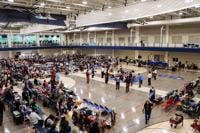
The community celebrates the Native American Student Association’s 30th annual Benefit Powwow on April 4 at the Maverick Activities Center. The powwow honored Les Riding-In, who died in August
“We just enjoy the whole atmosphere of everything that’s going on, everybody celebrating their roots and their background,” Odell said.
Arlington resident Sherrill Johnston, 73, said she was honored to be at the event.
“The tradition, the sacredness of every move is so deeply meaningful,” Johnston said.
@_.lexlie_ @wall0352