
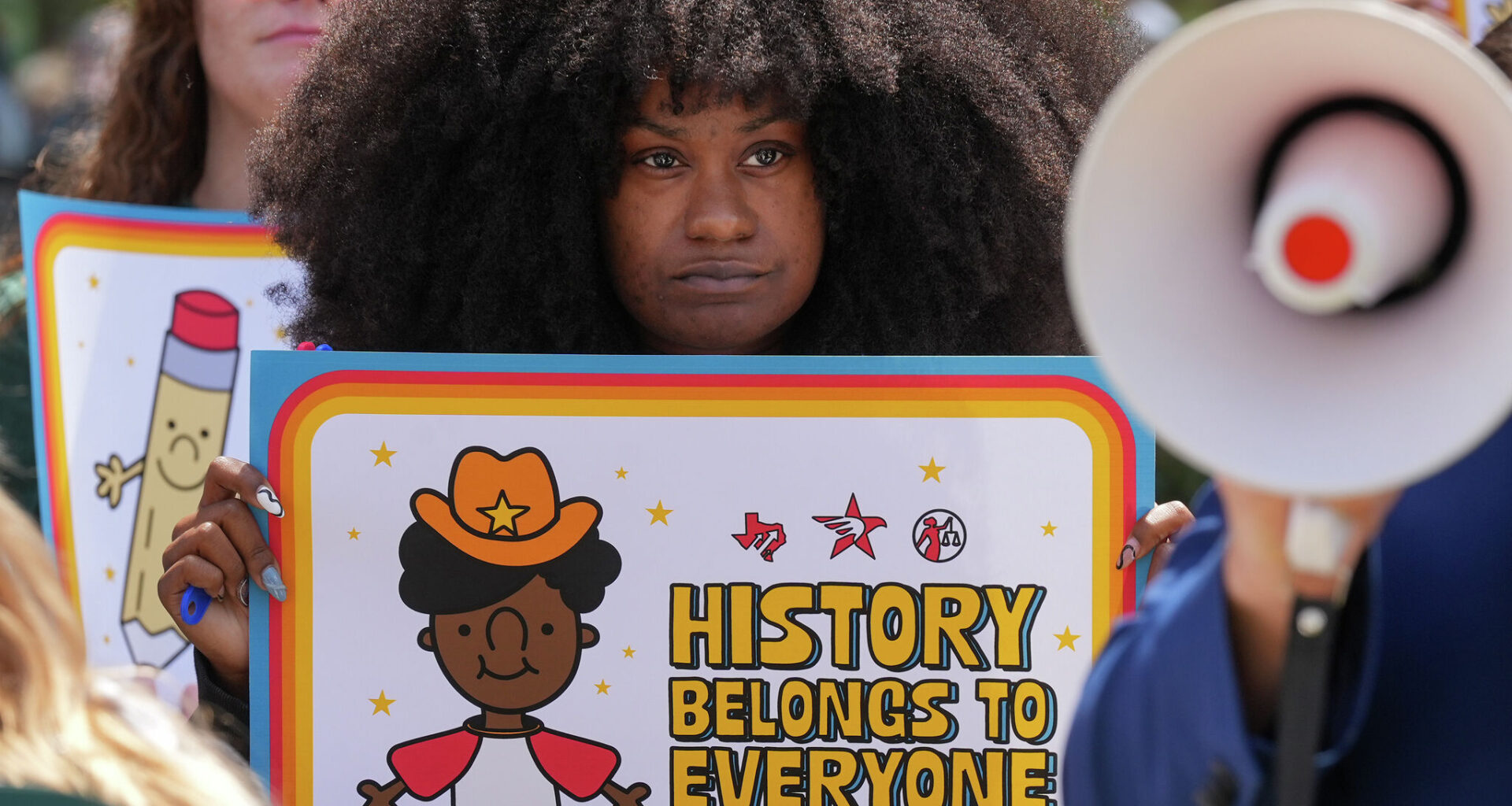
Taylor Crawford of Houston holds a sign reading “History belongs to everyone” during a rally on the Capitol Mall outside the Barbara Jordan State Office Building, where the State Board of Education meets, Tuesday, April 7, 2026, in Austin, Texas. (Jay Janner/Austin American-Statesman via AP)
Jay Janner/AP
Dozens of parents, students and teachers asked the State Board of Education to pause its process for overhauling the state’s standards for social studies ahead of a vote on proposed revisions that have been months in the making.

The meeting began at 8 a.m. Tuesday with discussion of a proposed required reading list that includes Bible stories, and didn’t wrap up until about 1:30 a.m. Wednesday. The board is expected to vote Wednesday on a revised set of Texas Essential Knowledge and Skills for social studies, which dictate what students learn at each grade level. The board is expected to hold a final vote on the proposed standards at its June meeting. If approved, the standards will go into effect in 2030.
Article continues below this ad
The State Board of Education meeting room is pictured inside the William B Travis Building (which houses the Texas Education Agency) in downtown Austin, Texas, Thursday, December 9, 2021. (Tom Fox/The Dallas Morning News)
Tom Fox
For months, social studies educators, parents and members of the working groups tasked with revising the standards have called on the board to slow the process down to allow more time for deliberation. Before public testimony began Tuesday, the progressive advocacy group Texas Freedom Network held a rally to call for more transparency and community input in the revision process.
Related: Texas Board of Education takes up reading list with Bible stories. Here’s how the public responded
Ellen Alexandrakis, a Richardson ISD parent and former teacher and school administrator, was among the participants at the rally. Alexandrakis told The Dallas Morning News that she wants to see the board start the revision process over, with a more diverse set of content advisers.
Article continues below this ad
Make Dallas News a preferred source so your search results prioritize writing by actual people, not AI.
Add Preferred Source
Alexandrakis, who is now pursuing a Master of Divinity degree at Southern Methodist University’s Perkins School of Theology, said the proposed standards prioritize Christian ideology at the expense of other world religions. For example, in one of the few cases in which Islam is mentioned in the proposed standards, it’s in reference to the Islamic slave trade as a part of a larger section on the fall of the Byzantine Empire and the rise of the Ottoman Empire. But the proposed standards make no mention of positive legacies of Islam, including Moorish influence on the architecture of Spanish Colonial buildings such as the Alamo.
People hold signs reading “Teach the Truth” during a rally on the Capitol Mall outside the Barbara Jordan State Office Building, where the State Board of Education meets, in Austin, Texas, Tuesday, April 7, 2026. (Jay Janner/Austin American-Statesman via AP)
Jay Janner/AP
Alexandrakis also takes issue with the inclusion of biblical texts in the proposed standards. Placing Christian stories in state history standards sends a message to non-Christian students that they don’t belong, she said. It’s important that students learn about world religions at school as a way of understanding cultures and historical events, she said. But she argued that the inclusion of sections on Abraham and Moses cross the line between teaching religion and teaching a specific religion itself.
Article continues below this ad
“Those are important things in Sunday school, but they don’t belong at public school,” she said.
Related: Texas mandated displaying the Ten Commandments in classrooms. What legal battles ensued?
Standards include parallels between Texas and Ancient Rome
Many of the proposed standards include the expectation that students be able to explain how people, events and ideas that originated centuries ago have influenced the United States and Texas. For example, in a section on the Roman Republic, students are asked to explain how the republican form of government developed in Ancient Rome influenced the United States and Texas, why George Washington is sometimes referred to as the American Cincinnatus — a reference to the Roman leader who voluntarily relinquished power and returned to his farm — and why Sam Houston compared himself to the Roman general Gaius Marius.
Article continues below this ad
People hold signs reading “Teach the Truth” during a rally on the Capitol Mall outside the Barbara Jordan State Office Building, where the State Board of Education meets, Tuesday, April 7, 2026, in Austin, Texas. (Jay Janner/Austin American-Statesman via AP)
Jay Janner/AP
Meghan Dougherty, a social studies teacher and a member of the first working group, told The News she worries that framing will confuse students by jumping from one era to another within a single lesson. She also worries that it will lead to instruction that frames history as a series of purposeful events marching to a predetermined outcome, an educational philosophy called teleological history.
Related: Revising Texas social studies: Public urges education board toward cultural inclusion
The problem with that idea is that it isn’t how history works, Dougherty said. Ancient Romans didn’t develop a republican form of government in the hopes that thousands of years later, another group of people would put that idea into practice on a continent they didn’t know existed, she said. They came up with that concept in their own time for their own reasons.
Article continues below this ad
“They were just trying to figure out their own lives in their own moments,” she said. “A true study of history avoids that kind of presentism and thinks about the past on the past’s terms.”
Debate over Islam in history
During the public testimony section of Tuesday’s meeting, a number of speakers called on the board to adopt the proposed standards as written, saying doing so would keep Islam out of Texas classrooms. Jolyn Potenza of Southlake called on the board to reject “any history that diminishes our exceptionalism in favor of race-based narratives or foreign ideologies” and push back against groups demanding “Islamist slants.”
At times, Tuesday’s meeting devolved into arguments about the role of Islam in American society. Board member Brandon Hall, R-Aledo, grilled Shaimaa Zayan, operations manager of CAIR-Austin, on whether the organization has connections to terrorism, noting that Gov. Greg Abbott has designated CAIR a foreign terrorist organization. Zayan said CAIR is a domestic organization that advocates for civil rights for Muslims. She pushed back on the idea that the organization bears responsibility for acts of violence committed by Muslims.
Article continues below this ad

By signing up, you agree to our Terms Of Use and acknowledge that your information will be used as described in our Privacy Policy.
The State Board of Education is expected to vote on the revised standards Wednesday afternoon.
The DMN Education Lab deepens the coverage and conversation about urgent education issues critical to the future of North Texas.
The DMN Education Lab is a community-funded journalism initiative, with support from Bobby and Lottye Lyle, Communities Foundation of Texas, The Dallas Foundation, Dallas Regional Chamber, Deedie Rose, Garrett and Cecilia Boone, Judy and Jim Gibbs, The Meadows Foundation, The Murrell Foundation, Ron and Phyllis Steinhart, Solutions Journalism Network, Southern Methodist University, Sydney Smith Hicks, and the University of Texas at Dallas. The Dallas Morning News retains full editorial control of the Education Lab’s journalism.