
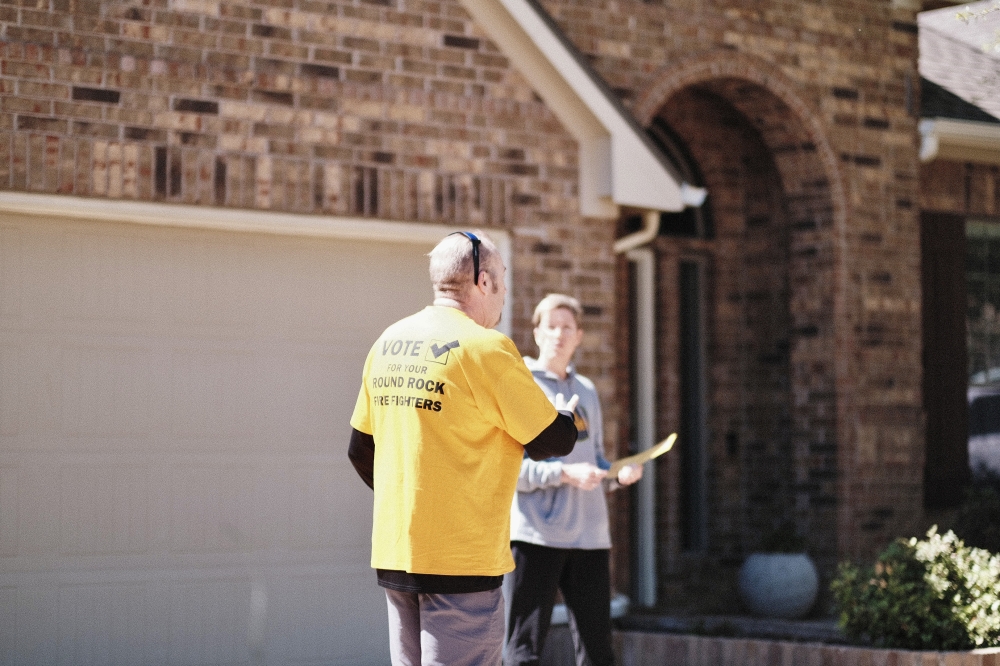
Round Rock voters will decide on two proposed amendments to the city charter addressing digital billboards and fire department staffing standards in the May 2 election.
Proposition A would allow electronic billboards in limited areas of the city, primarily along I-35 and SH 45. The current city charter prohibits digital billboards, and a similar petition effort in the past did not gather enough signatures to reach the ballot.
Proposition B would require the Round Rock Fire Department to meet national staffing and emergency response benchmarks and incorporate those requirements into the city charter.
The measures address different issues, but both were circulated through a campaign by the Round Rock Professional Firefighters Association.
City leaders have raised concerns about Proposition A, arguing electronic billboards are being promoted as emergency messaging tools despite existing highway alert systems.
The firefighters association said the proposals are intended to address long-standing concerns about staffing levels and public safety.
With both propositions now on the ballot, the firefighters association is entering the second phase of its campaign: educating residents about the measures.
Bill Clifton, secretary of the firefighters association, said the group primarily focused its outreach on Proposition B’s staffing proposal rather than Proposition A’s billboard proposal.
Proposition A
The proposed amendment under Proposition A would allow up to 12 new privately owned, operated and funded electronic message center billboards, each designed as double-sided digital signs, in designated highway corridors such as I-35 and SH 45.
Under the proposal, companies seeking to install a billboard would first be required to obtain approval from the Texas Department of Transportation, which regulates commercial signage along state highways.
The amendment states that electronic billboards would follow the location, size and spacing standards set by TxDOT, rather than additional city-specific rules. However, the city could charge fees for each billboard equal to the fee assessed by TxDOT. If voters reject the proposition, the current charter prohibition on billboards would remain in place.
Proposition A details
A maximum of 12 electronic billboards would be allowed.Billboard lighting must be shielded to prevent glare or interference with drivers and traffic signals.Signs cannot be located within 250 feet of public spaces, such as parks or recreation areas.Billboards must be at least 1,000 feet apart along the highway right of way.Billboards will only be allowed along I-35 and SH 45.The discussion
The proposition was placed on the ballot after a petition effort led by the Round Rock Professional Firefighters Association.
The firefighters association said the signs could serve as more than an advertisement by displaying emergency messages to drivers, warning of crashes, lane closures, severe weather or other urgent conditions along busy highways.
“Is this going to stop accidents? We can’t say it won’t,” Clifton said. “But what it can do is alert drivers to slow down, move to the side of the road and create that extra filter for us.”
City officials question how that system would work in practice. City Manager Brooks Bennett said Round Rock already invests in equipment and procedures designed to protect first responders during highway incidents.
“We definitely take the safety of both police and fire very seriously, especially when they’re on our highways,” Bennett said, noting the city uses specialized vehicles that shield crews at crash scenes.
Bennett also said it is unclear whether emergency information could be transmitted quickly enough to privately operated billboards, adding the city relies on systems such as Warn Central Texas and other official emergency alert channels to communicate urgent information.
The firefighters association explained that while the city charter allows for coordination between emergency messaging and private billboard companies, it is not mandatory. However, the companies have been receptive to cooperate, said Billy Colburn, former president of RRPFA.
“There are companies who have already vested in our community and are more than willing to participate in order to keep our first responders safe,” Colburn said.
The clashing perspectives show a broader divide over the intent and practicality of Proposition A. The firefighters association frames the measure as a public safety tool that could provide additional safeguards, while city leaders question whether the proposal is truly about safety or if it primarily benefits the billboard companies.
In their own words
“We have the highest [Insurance Services Office] rating for homeowners insurance. The facts would be different if we weren’t safe or if we weren’t doing our job,” said Round Rock Mayor Craig Morgan.
“That’s the red tape to activate a TxDOT sign—the wreck is over by the time you get that activated… ours is instant,” said Billy Colburn, former president of the Round Rock Professional Firefighters Association.
Proposition B
Proposition B asks voters whether to amend city ordinances to require the Round Rock Fire Department to meet national standards.
The proposal would add a new section to the city charter directing the department to follow guidelines outlined in NFPA 1710, a national standard developed by the National Fire Protection Association that sets benchmarks for fire department staffing and response times.
Fire engines, ladder trucks and other apparatus would generally be required to operate with a minimum of four firefighters on duty.
The measure would also establish performance targets for how emergency calls are handled—from the moment a call is received by dispatch to when fire crews arrive at the scene.
Those benchmarks include goals for alarm answering and processing times, how quickly firefighters leave the station after a call and how long it takes units to reach an incident.
The requirements would be phased in over several years. Staffing targets would begin taking effect in 2027 and expand in stages until 2031, when the department would be expected to meet minimum staffing. Response-time objectives would continue phasing in through 2037.
Bennett said it’s difficult to estimate the cost of Proposition B, but that it could impact long-term staffing, operations, facilities and equipment.
“So while this could certainly be portrayed simply as four-man staffing, it is significantly more than that,” he said.
By the numbers
The Round Rock Professional Firefighters Association said the amendment is intended to ensure the city keeps pace with growth and meets national safety benchmarks.
Association leaders said the measure was designed with a gradual timeline—about six years to meet staffing targets and roughly a decade to reach full response-time goals—to make the changes financially manageable.
“We didn’t want to be a burden to the taxpayer,” said Colburn.
According to data published by the city, the fire department has 186 firefighters, including 154 who staff fire trucks and other emergency vehicles.
In 2024, the fire department responded to more than 15,000 calls for service, according to the city. About 35 were structure fires making up roughly 0.3% of all calls compared to the 3.9% national average, according to the U.S. Fire Administration.
The Firefighters Association also disputed some of the city’s fire statistics, arguing official counts of structure fires exclude incidents such as cooking fires or burning furniture inside homes.
“They’ll say there were 35 building fires, but that leaves out cooking fires or couches burning inside homes,” Colburn said.
Clifton said the amendment ultimately gives voters a direct say in the city’s public safety standards.
According to the city of Round Rock, when a house fire is reported, the Round Rock Fire Department deploys a full response team that typically includes:
4 fire engines (at least 12 firefighters)2 ladder trucks (at least 6 firefighters)1 rescue unit, if available (3 firefighters)2 battalion chiefs overseeing the sceneIn total, about 20–23 firefighters respond, depending on unit availability.
What happens next?
Morgan said he opposes the proposition, arguing the city is already moving toward those national benchmarks without requiring them to be written into the charter.
Morgan said the city has increased funding for the fire department in recent years and several units are already staffed with four firefighters. However, he warned that anchoring the requirements in the charter could limit the city’s ability to manage its budget.
Police and fire services already account for roughly 70% of the city’s budget, he said, and mandated staffing levels could force cuts elsewhere.
He added that the city has already increased investment in fire services, citing new stations, additional hiring and a 46% increase in the department’s operating budget since 2022.
Proposition B timeline
If voters approve, the city law would be amended to require the fire department to follow national standards outlined in NFPA 1710:
2026: Council approves ballot language.2027: Ladder and truck companies must operate with at least four firefighters per company.2031: Dispatch performance benchmarks for alarm answering and alarm processing times must be met by this date.2033: The department must meet turnout and travel-time targets for 50% of emergency calls.2035: Turnout and travel-time benchmarks must be met for 75% of calls.2037: The fire department must meet NFPA turnout and travel-time benchmarks for 90% of emergency calls.If the city fails to meet standards, firefighters or residents can take legal action to enforce compliance and require the city to follow union recommendations.