
This story was originally part of KUT’s ATXplained Live on Oct. 29, 2025. Tickets for our next show on May 21, 2026, are available here.
Zach Dallas first saw it in high school.
He was hiking with a group of friends in the Barton Creek Greenbelt. They were about a mile from the Gus Fruh entrance when everyone suddenly stopped.
“It was dark, like dark dark,” he said. “We were worried about raccoons or whatever, and we look up and see that thing.”
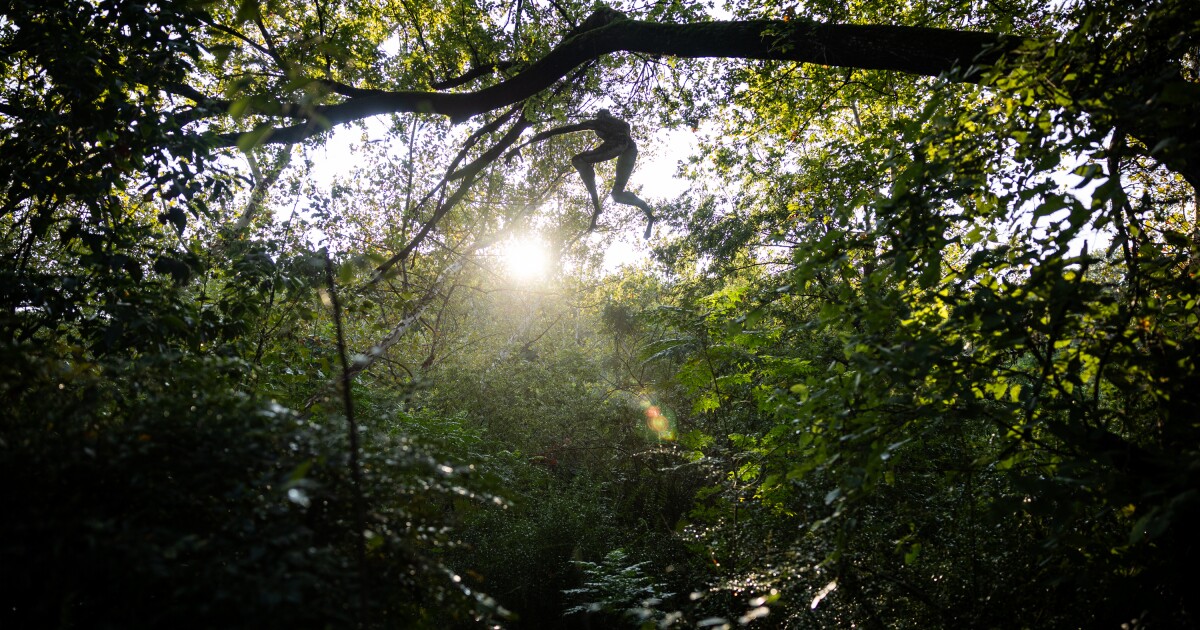
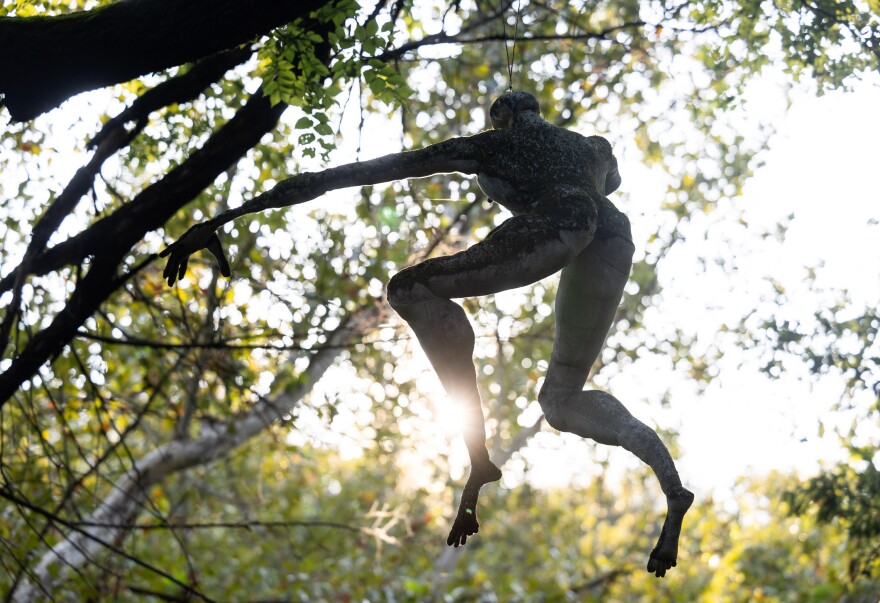
“That thing” was a life-sized sculpture made of green fabric suspended from a huge oak tree. It sort of looked like a human, but with supernatural proportions: 4-foot-long arms ending in massive, chubby hands. A big, muscular butt. A tiny, knob-like head.
Michael Minasi
/
KUT News
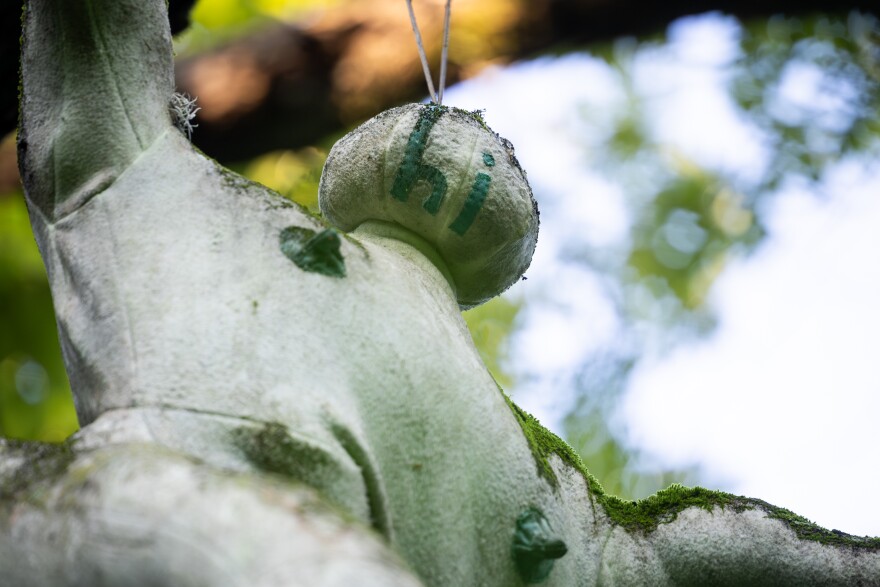
Magda named the sculpture in the greenbelt Hi Doll after stitching “hi” on the doll in big green letters.
The sight stuck with him over the past decade. When he showed the sculpture to his wife, Ana Javed, she, too, became curious.
So, Ana asked ATXplained: What’s the story behind the sculpture, and what are hikers supposed to take away from it?
Trusty internet sleuthing
Ana had two theories about how the sculpture appeared in the greenbelt: A. It was an art installation approved by the parks department; or B. the sculpture was a UT environmental science project designed to keep away invasive wildlife.
Zach said he thought the sculpture was there to “scare the tech bros back to California.”
“That hadn’t worked,” he said.
There’s nothing near the sculpture to confirm their theories. There’s no little plaque or artist signature indicating who put it there or why.
In the absence of physical evidence, I went searching for clues on Reddit.
“You just don’t know what to make of it. [There’s] a message that’s trying to be told, but it just leaves you a little confused because you don’t know what that message is.”
Ana Javed, question asker
There, theories piled.
Someone thought it was Slender Man. Another said they heard it was a totem made to ward off the real thing. Several people said it was the Blair Witch.
But then, beneath a comment suggesting the sculpture be the subject of Season 5 of True Detective, an unlikely hero emerged. The commenter shared an article published a few years ago about an artist named Magdalena Jarkowiec who makes giant mutant dolls — dolls very similar to the one suspended from the trees in the greenbelt.
I found the artist’s email and asked if the sculpture was her work. A few days later, she responded:
“Haha. This is definitely an email I never expected to get … yes, that’s mine.”
Meet Magda: an artist, dancer and staunch rule follower … sort of
Michael Minasi
/
KUT News
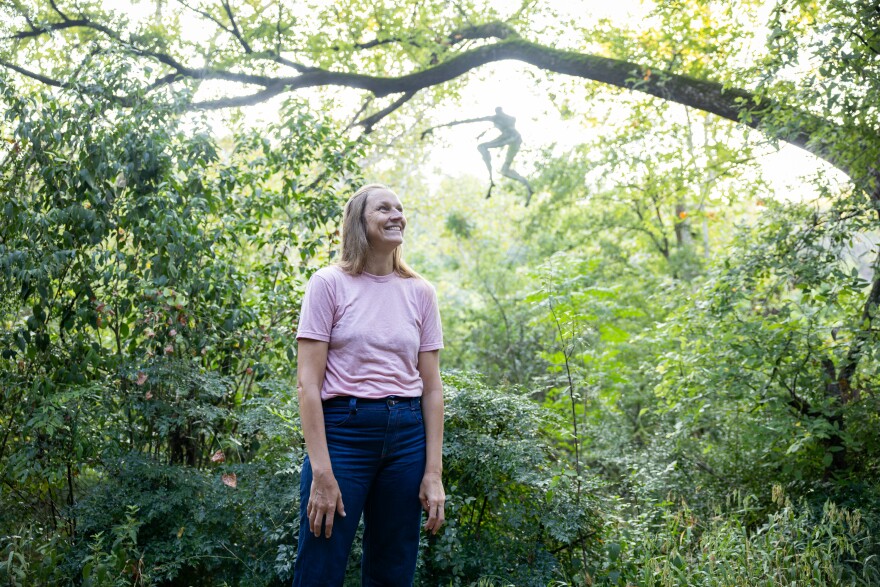
Artist Magdalena Jarkowiec, now also an accredited therapist, poses for a portrait in front of her sculpture Hi Doll along the Barton Creek Greenbelt.
I met up with Magda in the Barton Creek Greenbelt last summer. It was immediately clear that she is a woman of many talents.
Magda is a therapist, sculpture artist and dancer. She grew up practicing ballet, and she teaches dance at UT.
I was ready to call Ana with the good news: Her first theory was right; the sculpture is an art installation.
But there was one key thing Ana got wrong. She said whoever put the sculpture in the greenbelt must have gotten permission.
Not exactly.
Here’s what really happened.
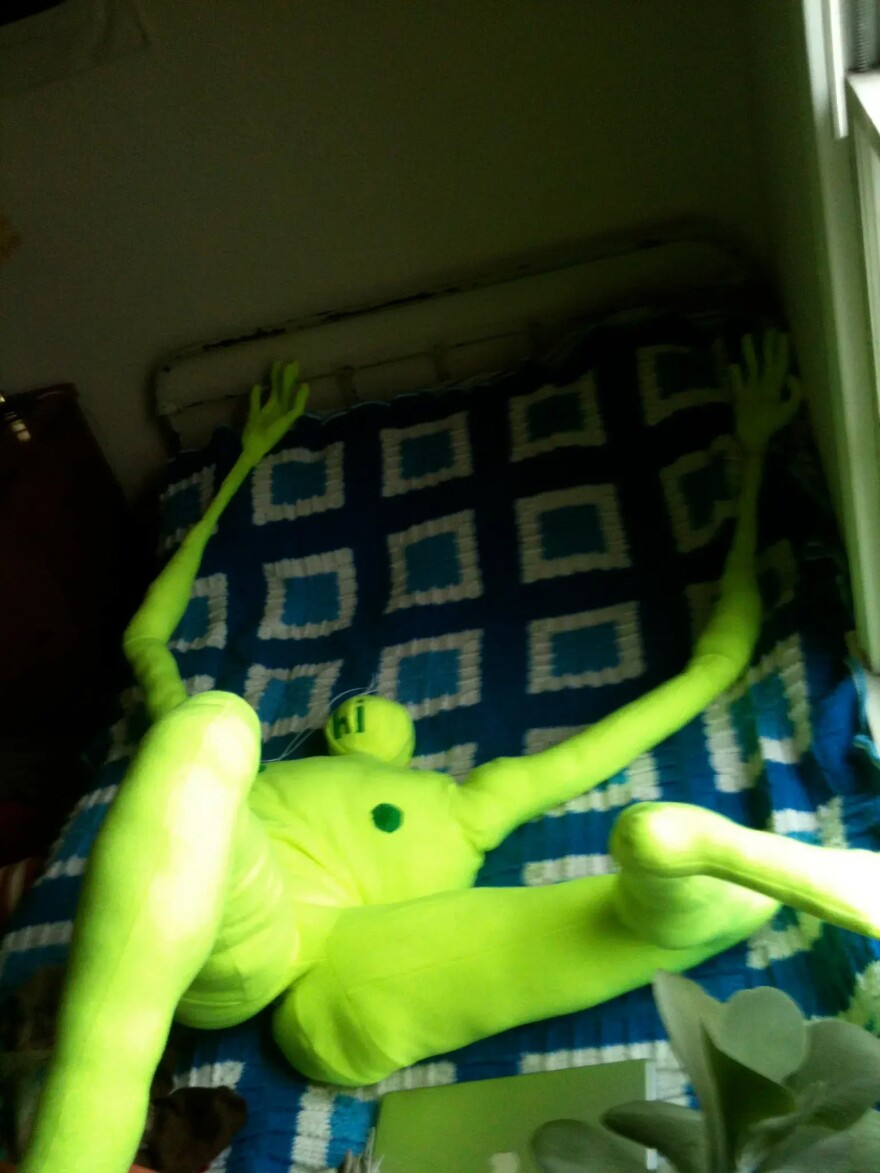
Magda finished making the sculpture about a decade ago. It looked a lot different back then. When she finished it, it was fluorescent green. She sewed the word “Hi” on the sculpture’s face in big green letters and aptly named it Hi Doll.
Courtesy of Magdalena Jarkowiec
Before it was installed in 2014, the Hi Doll was fluorescent green. Today, the color has faded and the doll is covered in plant matter.
Magda wanted to get the sculpture out into the world, but she didn’t know how to approach galleries. Plus, she said, she wanted to give people the experience of “encountering art.” Not intentionally going out to see it, but being surprised by art in the natural world.
“When you’re in a museum or a gallery, you kind of always feel the curatorial presence. You know what I mean? You feel like you’re in an authoritative space … and you’re supposed to have certain reactions to it,” she said. “When you see things outdoors … I just feel like that part kind of melts away.”
Magda decided the greenbelt was the perfect home for Hi Doll. All that was left to do was install it.
“We hung the doll in the middle of the night, I think, because I’m a rule follower, so I would never just go out there,” she said. “I mean I guess I’m not entirely a rule follower.”
Her husband, Shane, was her accomplice.
“I had it wrapped in a sheet,” she said. “Like we parked at Gus Fruh, and we were carrying a body in a sheet into the greenbelt at night.”
Then they had to get the doll up into the trees. Luckily, Shane is a skilled rock climber.
“I just stood here and Shane climbed up the tree and I was like, farther. No, farther,” she said.
Higher and higher — until he got the sculpture to where it’s lived for the last decade.
What is art?
When I interviewed Zach and Ana for this story, it was clear that the real mystery for them wasn’t how the sculpture appeared or even who put it up, but what it means.
Ana said she was “kind of freaked out” the first time she saw the sculpture, but since then, she’s talked to other hikers who see it as a “whimsical, kind of funny, positive thing.”
“You just don’t know what to make of it,” she said. “[There’s] a message that’s trying to be told, but it just leaves you a little confused because you don’t know what that message is.”
Courtesy of Magdalena Jarkowiec
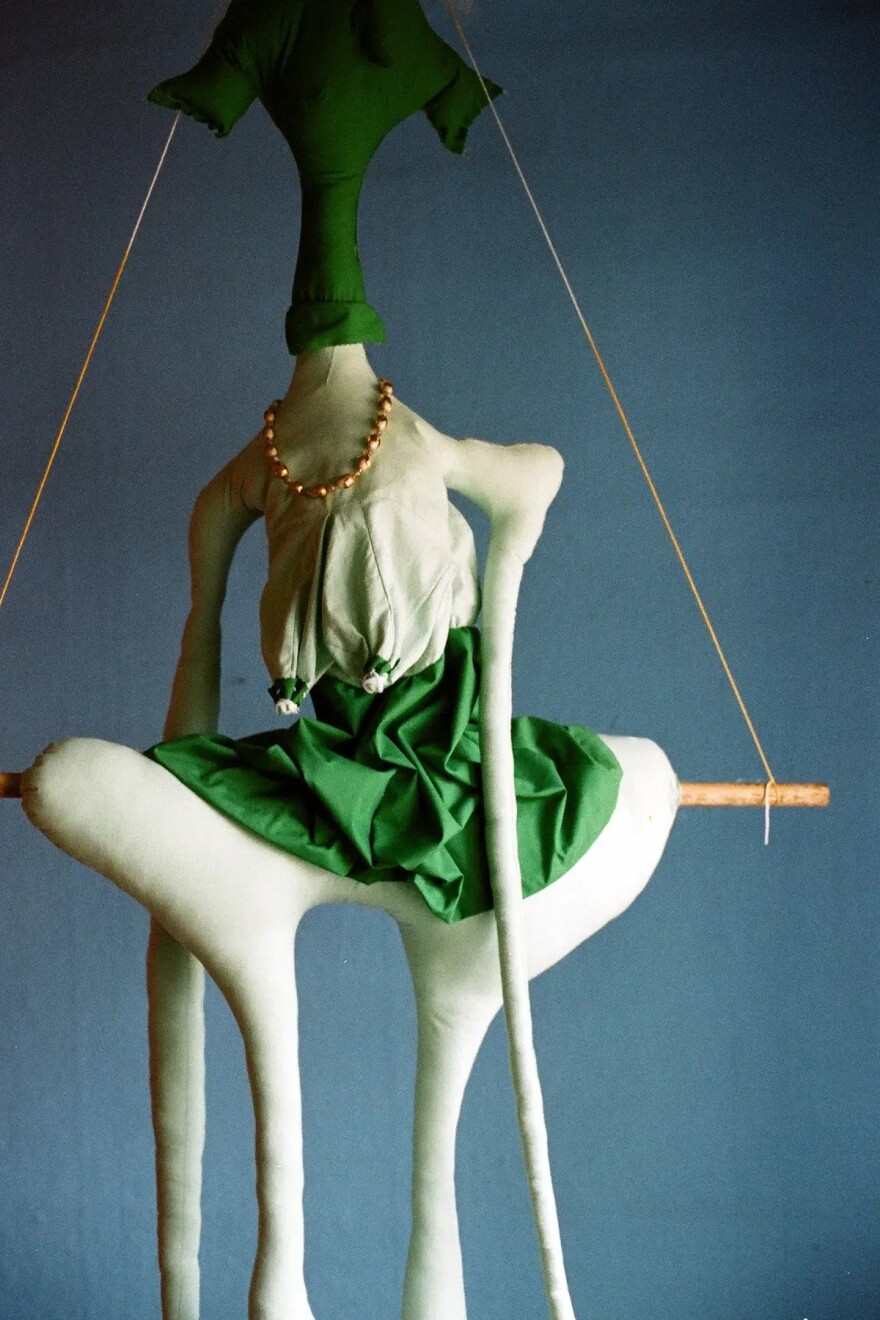
Lydia, one of Magda’s earlier works without a face, has wide hips, saggy boobs and arms so long they touch the floor.
This sent me down a spiral. I hadn’t considered that Hi Doll was sending any sort of “message.” I hadn’t even considered that the sculpture was art. Before I started reporting on this story, my theory was that some college kids put the sculpture in the greenbelt to scare people.
I was intimidated to get into a conversation with Magda about the meaning behind Hi Doll. I literally watched a YouTube video called “How to Sound Like You Understand Art” to prepare.
Sarah Urist Green of PBS’s The Art Assignment begins the video saying, “When you walk into an art gallery, does a kind of anxiety wash over you?”
… Yes.
I tense up when my well-meaning colleagues ask me what I thought about a certain movie, for example. What if I get it wrong? What if I didn’t come to the same conclusion as everyone else?
In her video, Green suggests overcoming this fear by spending time with a piece of art before making any judgments, and focusing on collecting basic information about the artist and their work.
I took this advice and stood in front of the sculpture for a long time with Magda. I asked her why she became a sculpture artist.
She said it all started with her grandma, Zofia.
The ‘magical power’ of sewing
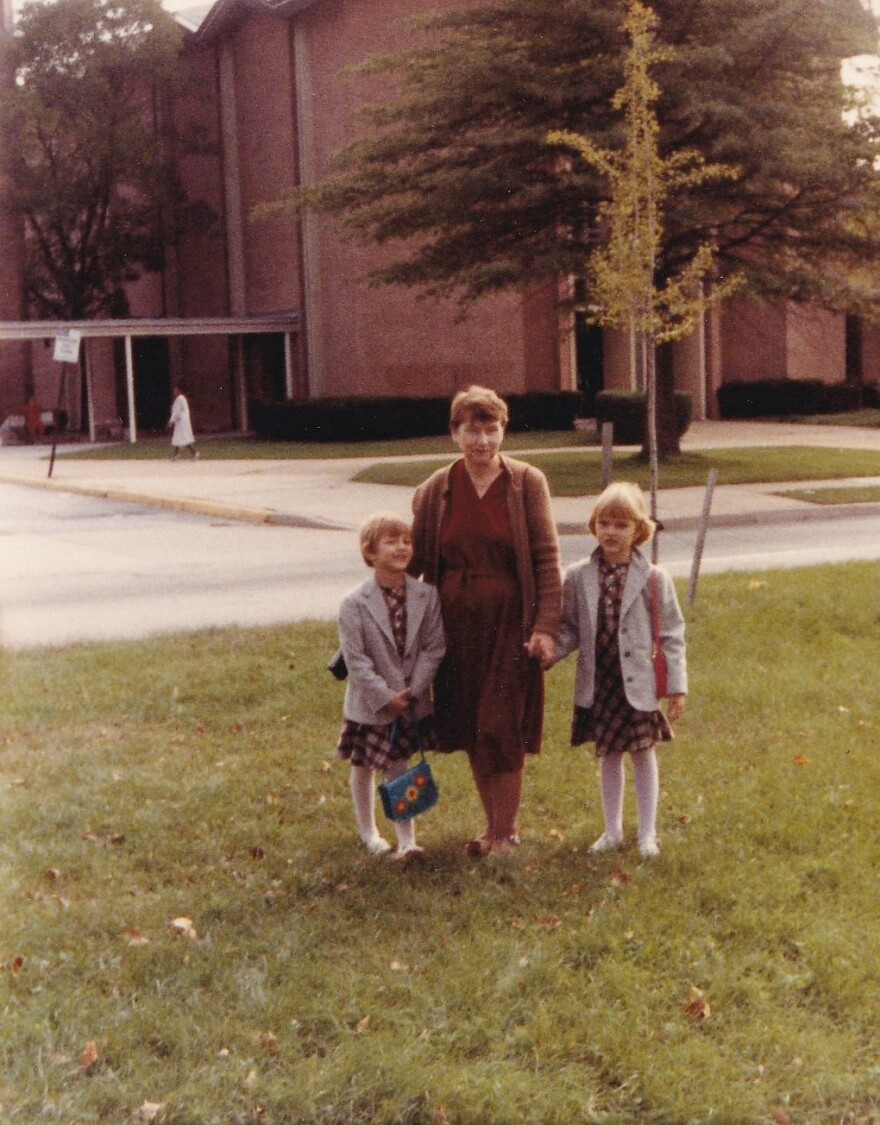
Zofia sewed clothes for Madga and her sister when they were little kids growing up in Poland in the ‘80s.
Courtesy of Magdalena Jarkowiec
Magda (right), with her grandmother Zofia, and twin sister, Maria, in front of St. Matthew’s Church in Baltimore in 1985. Magda and Maria are wearing blazers sewn by Zofia. “The blazers are too big because she made everything so that we could wear it for a few years,” Magda said.
“She had this magical power,” Magda said. “I remember other kids, meeting their grandmas, American kids, and being like, ‘Does your grandma know how to sew?’ And just feeling like they got … shortchanged.”
Inspired by her grandma, Magda taught herself how to sew in high school. She started with clothes, and the more she did it the more she realized she also had that magical power.
When she got to college, she wanted to use that power to make art.
“It’s hard to explain,” she said. “In college, I just was like, I could do this thing with the skills I have. Like, I could just sew like a giant doll, basically, and that’s how I started making them.”
Her first doll was just as creepy as the sculpture in the greenbelt. It had a long neck, no face, one arm, and a leg that starts out normal at the hip and then fizzles out like a ribbon on a Christmas present. Madga named her Bella.
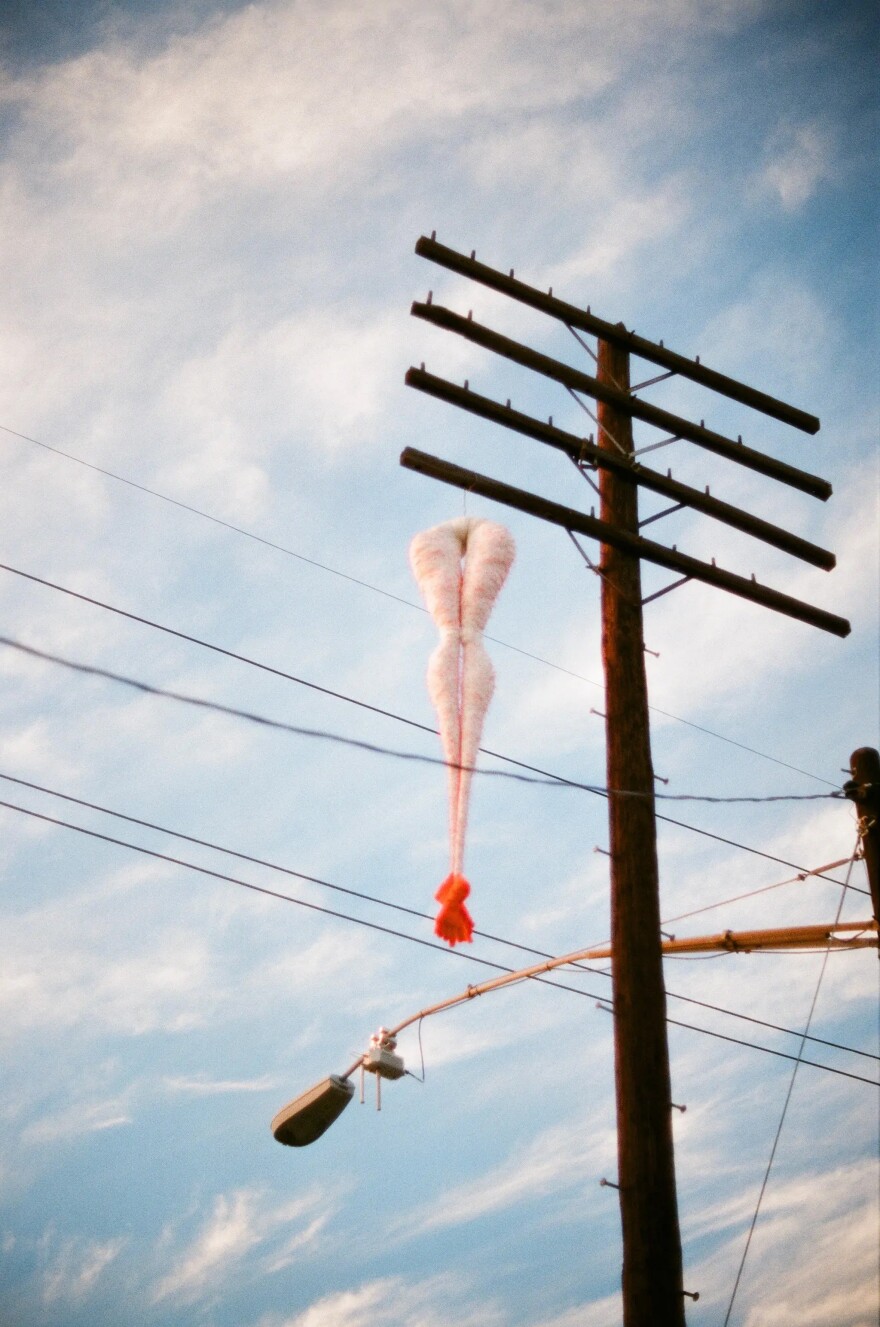
After that, she got the bug. She started making a bunch of sculptures, each one more bizarre than the last. She sewed a doll she named Lydia with ginormous hips, saggy boobs and arms so long they touch the floor. She used white fabric and orange yarn to create Hairy Legs, a sculpture she hung from a telephone pole.
Her work evolved. Magda started adding faces to her dolls. And then, genitalia.
Courtesy of Magdalena Jarkowiec
Hairy Legs, made of fabric, polyester fill and orange yarn, was hung from a telephone pole in 2013.
I asked her about that.
“I think in general, genitalia and nipples, when I realized I could make them pretty anatomically accurate — with fabric — I don’t know. That just really excited me,” she said. “It felt hilarious. It felt unlikely. It really bothers my husband, I think.”
Some of her work is just genitalia. A while back, she made a bunch of cloth vulvas and installed them in the trees outside the Anthropologie on North Lamar.
“It got taken down in like 24 hours,” she said.
A weird part of being a person
Magda told me she felt “possessed by making things” during this time in her life. She said she needed to make art like she needed to eat.
But I still didn’t get it — why giant mutant dolls? And why dolls that are sort of the antithesis to Barbies, with hairy legs and saggy boobs?
She said she thinks growing up practicing ballet had something to do with it.
“When you’re a dancer, you’re obsessed with your body in all kinds of ways,” she said. “The experience of your body, but also what it looks like, because you’re trying to package it into a really, really particular form.”
Magda isn’t alone in this. Many ballet dancers report being body shamed or told they need to lose weight way before they even hit puberty.
“I think that’s why I started making figures,” she said. “Like how do I solve this problem of being a body and it being wrong all the time?”
It’s not just dancers who feel this way. We’re all subtly being told we look wrong all the time — by Instagram ads, by Westlake Dermatology billboards. The message that we should do something to change ourselves is everywhere.
Michael Minasi
/
KUT News
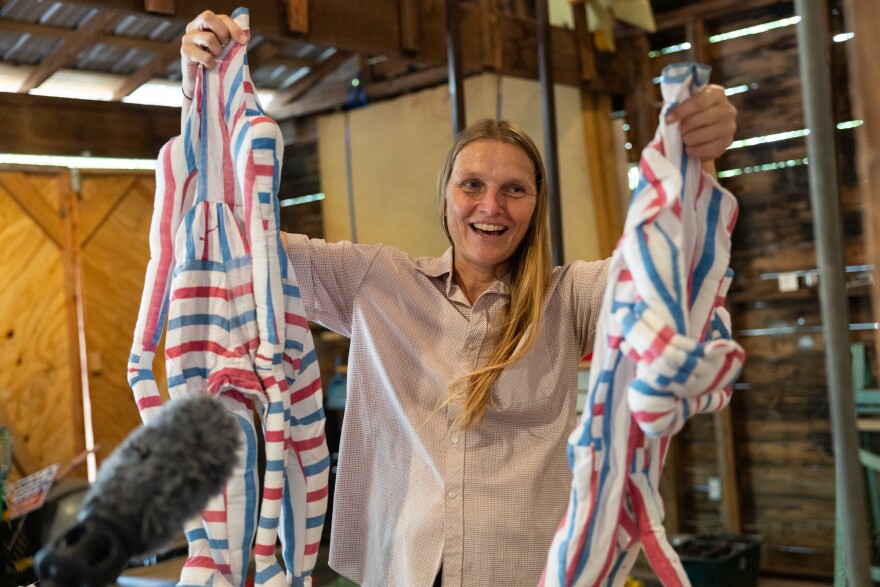
Magda pulls an unstuffed sculpture out of a storage container in her studio.
Magda said there’s another layer to her work. It’s not just her way of dealing with an “imperfect” body, but also her way of processing the weirdness of being confined to a body in the first place.
“Your shape is so defining and your appearance is so defining. … So there’s this huge aspect of yourself you didn’t have any jurisdiction over,” she said. “You can’t control what your shape communicates to other people, and that’s just weird. That’s just a weird part of being a person.”
And you know, I get this.
It’s like how when you’re a kid, you’re not really thinking about your body.
You don’t need to have social awareness if your hair is messy or if you have chocolate on your face. Because in a sense, you’re just busy with bigger things. Making friends. Doing cartwheels. Growing up.
And then at some point, someone says something to you about your weight or your skin, and suddenly your body is no longer just a vessel to do fun things.
But when I look at Magda’s art, I see creatures that skipped all that social conditioning.
Michael Minasi
/
KUT News
Hi Doll, now covered in moss, has been leaping from the trees with feral whimsy since 2013.
Especially the doll in the greenbelt. It’s not being held back by feelings of self-consciousness. It’s confidently and perpetually leaping from the trees with feral whimsy.
And now when I look at the sculpture, it gives me a glimpse of that childhood innocence back.
Maybe I do understand art?
So, that’s my take.
But Magda said it’s OK if you look at her art and still think it’s weird or creepy. She said she hates when people feel like they have to change their mind about an artwork because their impression is different than what the artist intended.
So to Ana’s question, ‘What are hikers supposed to take away from the sculpture?’ I guess the answer is: You’re not supposed to take away anything. It might mean something totally different to you than it does to me, and that’s OK, preferred even, because that’s what makes art cool. That it’s contested.
There was one more thing that was nagging me.
Magda used to hang her sculptures in Austin parks all the time. And every single one of them, except for this one in the Barton Creek Greenbelt, got taken down. What made this one so special?
“I think the main thing is .. it’s not easy to get down,” Magda said.
I guess sometimes it’s just not that deep.
Watch this story performed at ATXplained Live.