
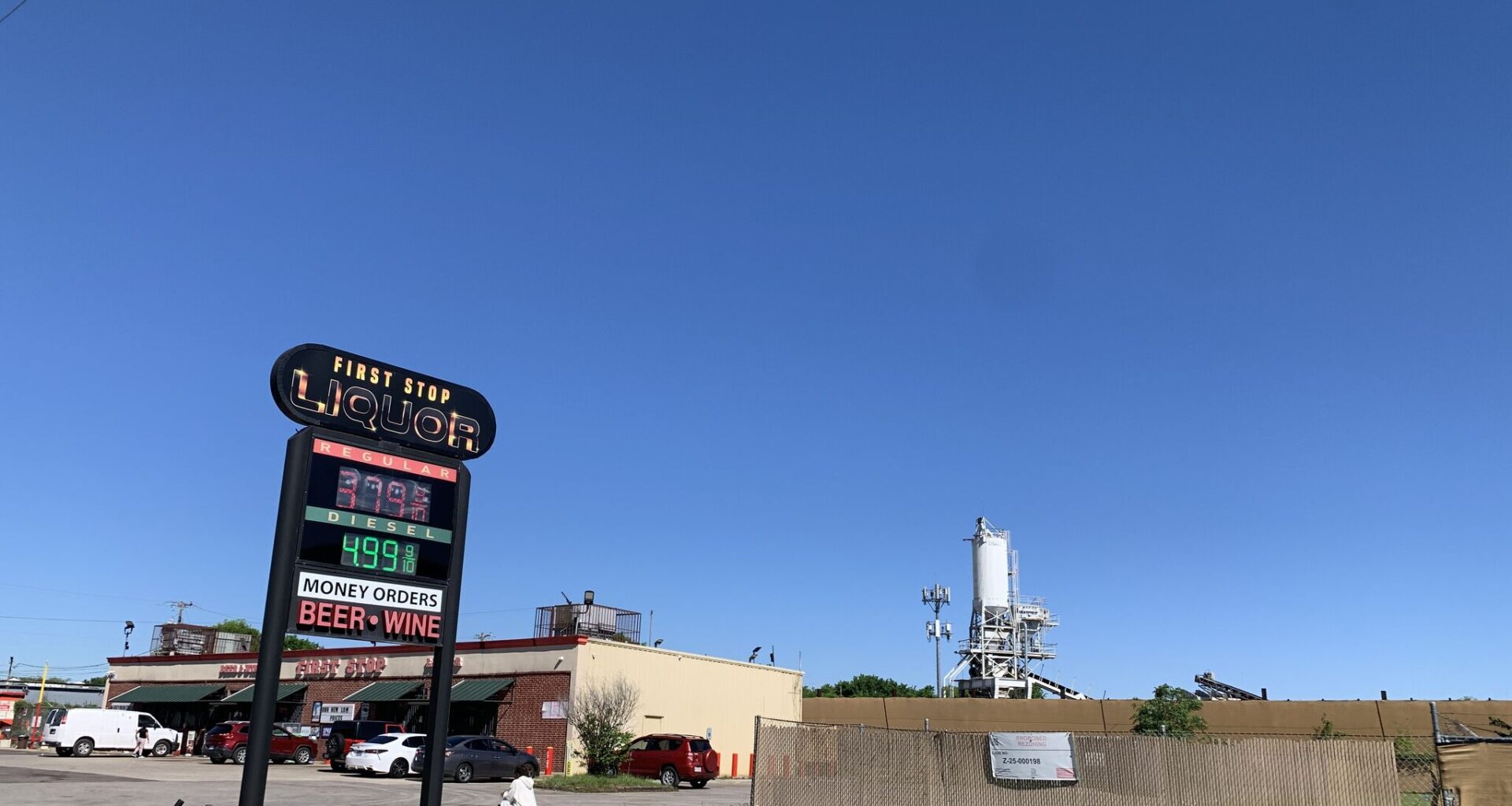
One of several proposed rezoning signs has been attached to the fencing for the temporary concrete batch plant being used for the Mill Creek Drainage Relief Tunnel.
Robert Wilonsky/Staff writer
On Thursday, Dallas’ City Plan Commission will more than likely finally get around to what it’s been delaying for months: denying a request to rezone a stretch of Scyene Road in South Dallas to make way for a waste refinery. In the middle of four neighborhoods. Across from a Dallas Area Rapid Transit line. Adjacent to Parkdale Lake, which is finally about to get looped into The Loop trail system.
The rezoning request, which would allow solely for industrial manufacturing on land designated for both community retail and industrial use, first landed on the CPC’s agenda in January, then again in March, then again this week. City staff long ago recommended denial for numerous reasons, among them being that it’s an example of Backward Dallas in a part of town aching to move forward, Dallas.
Article continues below this ad
“Noxious” is the one-word takeaway from the staff’s case report you don’t have time to read.
I called Tabitha Wheeler-Reagan, South Dallas’ plan commissioner, to ask what took so long to deny the undeniably bad idea of rezoning parts of a neighborhood for industrial use. A few things, turns out, like getting the applicant to hold community meetings, which she ultimately had to do herself. Initially, she also wanted her fellow commissioners to deny the application with prejudice, no easy thing since it bars a developer from coming back to the plan commission for two years.
“We definitely want something there,” said Wheeler-Reagan, co-chair of the South Dallas/Fair Park Task Force that led to the area plan adopted by the City Council last summer. “But not that.”
Make Dallas News a preferred source so your search results prioritize writing by actual people, not AI.
Add Preferred Source
The land in question is a triangle along Scyene between Elsie Faye Heggins Street and Dixon Avenue, some 14.5 acres currently occupied by Tacos Chilo, the First Stop Liquor store and gas station and a temporary concrete batch plant used to construct the five-mile-long Mill Creek Drainage Relief Tunnel that’s 120 feet below the surface – and running some four to five years behind schedule.
Article continues below this ad
One of the proposed rezoning signs along Scyene Road, which drivers has been speeding past for more than a year
Robert Wilonsky/Staff writer
City Hall is quite familiar with the property owned by a family named Hakemy: More than a decade ago, city attorneys tried to eminent domain some of the land for the flood control project, then spent years in court tussling over the easement. Ultimately, four years ago, the City Council approved paying the Hakemys $75,000 for what was below ground while letting them keep control of everything on the surface.
As a result, they’re now trying to plant what city documents call “a facility for the manufacture of materials derived from biomass, plastics, tires, and other inputs” along Scyene, near the Rose Garden, Dixon Circle, Bertrand, Parkdale and other neighborhoods.
Edward Okpa, the family’s representative at CPC, emailed me renderings dated 2008 that show a proposed 126-unit apartment complex called The Villas at Parkdale Lake, anchored by more than 36,000 square feet of retail. I said that looked great.
Article continues below this ad
“We considered it, but given the site limitations and financing challenges,” including Union Pacific railroad tracks and White Rock Creek, he said, “it’s best used for something other than mixed use.” He said the drainage tunnel now prohibits that kind of development. Dallas Water Utilities engineers disagree, as would the countless other developments along the tunnel’s five-mile path toward Uptown.
Okpa said there’s nothing noxious about this proposal, which would also require a specific use permit on top of the zoning do-over, and took umbrage at the suggestion it will be a waste refinery. Said the oft-former mayoral candidate when I called him Monday, the owners’ proposal is an indoor facility that, among other things, “takes wood and turns it into transparent glass,” which is a real thing.
“Everyone in South Dallas talks about housing, housing, housing,” Okpa said. “Where are the employment centers? This would bring 200 jobs to the area, but people who live in that area, they get sentimental, they get emotional, and it’s always, ‘No, no, no.’”
Residents live just across Scyene Road from the industrial use proposed by the rezoning signs.
Robert Wilonsky/Staff writer
It would have been a loud no, no, no in my neighborhood, too. Yours, too, likely.
Article continues below this ad
Things got heated in my northwest Dallas neighborhood last spring when a property owner filed to rezone just a small single-family corner at a busy intersection for neighborhood services. Last fall, residents near Marsh and Walnut Hill lanes beat back dozens of patio homes a developer wanted to plant in their backyards. And then there are those proposed townhomes atop a 151-year-old cemetery which has also riled up neighbors
Here, Okpa’s asking for the OK to plant an Industrial Manufacturing District where people live, where The Loop is about to invest more than $30 million connecting the rest of the city with an inaccessible 110-acre oasis Oncor donated to the city. The only reason this didn’t turn into a firestorm is because those rezoning signs are small, posted on the batch plant fencing or otherwise tucked away on a relatively high-speed stretch of Scyene.
“The community definitely needed to hear about this, and maybe we’ve gotten lax,” Wheeler-Reagan said “We have to get them to pay attention to those signs. We should have gotten phone calls about this.”
I’ll say this for Okpa: The man has big ideas. Well, OK. Tall ideas, at least in the case of that proposed helipad-topped, 25-story high-rise on Martin Luther King Jr. Boulevard toppled by the plan commission because it stomped all over the South Dallas Fair Park Area Plan. Okpa said the owners were going to invest some $70 million in this recycling project except city staff considers it a “potentially incompatible industrial use,” so that’s likely that.
Article continues below this ad
The Loop is about to begin connecting the 110-acre Parkdale Lake and its surrounding greenery to the rest of the city. This currently inaccessible Oasis sits just behind the 15 acres being proposed for industrial manufacturing.
Dallas Park and Recreation Department
But the specifics of the proposal aren’t exactly the point. It’s about turning developable land into industrial land for the foreseeable future. It’s about rendering the possible into the unusable for a generation. And it’s about doing it where people live and where they’re about to play, whether it’s in nearby Wahoo Park, where on Monday I saw a freshly chalked baseball field, or Parkdale Lake.
Philip Haigh, executive director of The Loop, said Monday that he’s only a few weeks away from going to the Park and Recreation Board and then the City Council with the $16 million pedestrian bridge connecting Parkdale Lake with Lawnview Park on the other side of the White Rock Creek and trail. That’s largely a city and county investment with years-old bond funds.
By signing up, you agree to our Terms Of Use and acknowledge that your information will be used as described in our Privacy Policy.
Haigh wasn’t even aware of the proposed rezoning, which is literally in his project’s backyard, until a friend notified him of a neighborhood meeting hosted last week by Wheeler-Reagan.
Article continues below this ad
“The owner was there, and he called this a generational investment,” Haigh said. “I said, ‘That’s the problem.’ Think about it if you had done this on the Katy Trail 20 years ago, it would be hard to change the use today. We want to see this developer succeed with this piece of property. If there’s a higher and better use, we would support that. But this zoning change is not it.”
At the end of our conversation, Okpa said he might table the rezoning request at CPCs Thursday meeting, since the city needs the batch plant to finish the delayed drainage tunnel. That gives his client time to come up with a better proposal, and everyone else time enough to learn the oldest lesson in town: When you see something, like a proposed rezoning sign, say something.