

Madisen Fransella has two main goals: graduate from college debt free and earn as many academic accolades as possible ahead of graduation.
“I want to make them [announce] as many titles before my name as possible,” Fransella said.
The 21-year-old San Antonio College student is in her second year, working toward an associate degree and then plans to transfer to Texas A&M University in College Station to study Urban Design and Development.
She is one of thousands of college students across San Antonio who qualify for Pell Grants due to financial need, to help pay for college. She is also among the many who must divide their time between full-time college studies, a part time job, and sporadic gigs to make ends meet.
“It is impossible to be an independent [full-time] college student, even for community college,” Fransella said. “There is just no way someone could afford rent, groceries, insurance, bills, vehicle maintenance and tuition on a single part-time job, which is the only thing you have time for.”
Every year as Congress puts forward a new annual budget, higher education leaders travel to Washington to defend and advocate for Pell Grant funding, which in recent years has faced projected shortfalls of up to $11.5 billion.
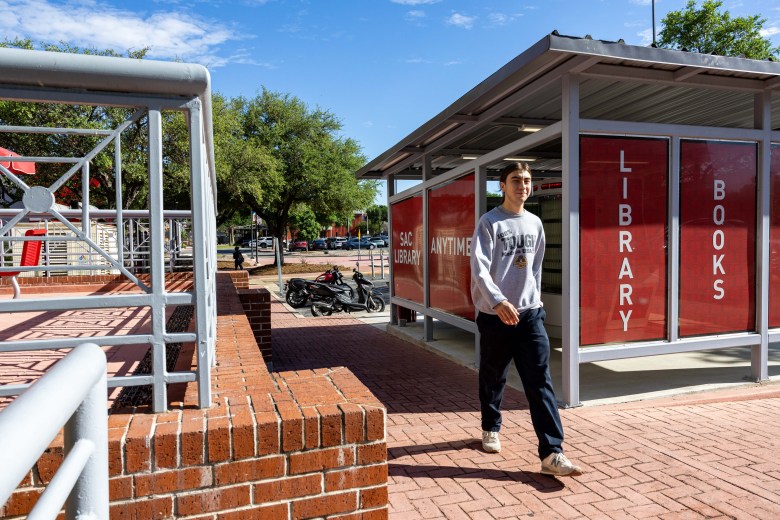 Federal data shows about 70% of Alamo College District students depend on federal financial aid. Credit: Amber Esparza / San Antonio Report
Pell Grants are need-based federal grants awarded to low-income undergraduate students with significant financial need. These grants have historically been reserved for students seeking an academic degree for the first time, but the recently approved Workforce Pell program will open up the funding to some short-term certificate programs.
In 2025, funding for the need-based federal grants was tied to changes in qualification under the One Big Beautiful Bill that would have limited access, but these changes were narrowly avoided. This year, there is no sign of such changes coming down the pipeline, but local higher education leaders fear that if these grants are not funded above the current need, the shortfalls will continue to increase impacting potential students.
At most colleges across the San Antonio-area, at least 50% of incoming undergraduate students qualify for Pell Grants. The maximum students can receive under Pell is $7,395 and at local institutions the average Pell Grant award is $5,943, according to 2023-24 federal grant data.
Pell Grant access increased since the FAFSA Simplification Act was passed into law in 2021 and amended in 2022. The act was meant to expand access by simplifying the application process and expanding eligibility criteria.
Priscilla Camacho, chief legislative, industry and external relations officer at Alamo Colleges District, is part of the cohort of local leaders advocating for increased funding for Pell Grants at the federal level.
Across the five colleges under the Alamo Colleges District — San Antonio College, Palo Alto College, St. Philip’s College, Northwest Vista College and Northeast Lakeview College — about 70% of its nearly 86,000 students depend on federal financial aid.
“We don’t have any doubt that there is bipartisan support,” Camacho said. “It’s going to be a question of, are they going to be able to invest the additional amount needed to ensure that there isn’t a shortfall next year?”
At Alamo Colleges these grants are a core source of financial support for thousands of families in the region, and in the case of Alamo Colleges, it’s aid that allows the colleges to offer programs such as Alamo Promise, which offers qualifying students tuition-free access by covering the remaining tuition and fees left uncovered by federal aid, scholarships or other grants.
To date, Alamo Promise has reached more than 30,000 area students and expanded its reach through partnerships with the University of Texas at San Antonio and Texas A&M University-San Antonio.
More access to grants is good news for students and the colleges, Camacho said, but it also means more funding should be available.
“We need to see those types of bumps in funding in order to ensure that the program doesn’t get into a position where it’s in a shortfall,” Camacho said. “Because Pell Grants are not going to decrease in utilization, it’s going to increase in utilization.”
San Antonio and Pell Grants
Fransella’s time is ruled by multiple calendars: one for her college courses, one for work, one for gigs, and one for personal life. And just like her time, her budget is equally tight. Her part-time job and gigs yield about $20,000 a year and she shares costs of living with her boyfriend.
She receives between $6,000 and $7,000 through Pell Grants per academic year, which has fluctuated based on her annual income. Taking on more hours at the ice cream shop where she works can affect how much she ends up getting in financial aid.
“How they explain it is, this should cover tuition and any other living costs that come with college like getting books, supplies, some food, living costs. And I was like, ‘I have about $500 left over, I couldn’t even pay rent with this, let alone maybe get groceries for a month,’” she said.
At San Antonio College, students receive close to $6,200 on average in Pell Grants per academic year, according to 2023-24 federal data. The average cost for full-time, in-state tuition ranged between $3,412 and $5,542 that same year.
 Madisen Fransella, a second-year urban development student at San Antonio College, studies and works on notes for an anthropology class in the campus library on April 6, 2026. Credit: Amber Esparza / San Antonio Report
At Texas A&M University-San Antonio, the average Pell Grant award was $5,923 annually for incoming students and $5,226 for all undergraduate students. During the 2023-24 academic year, about 66% of all incoming students qualified for the need-based grant in 2023-24, but the cost of attendance at the university was higher at $9,654 annually in tuition and fees for full-time students.
Today, 79% of all undergraduates at TAMUSA qualify for Pell Grants each academic year, said Leanne Johnson, executive director of student financial aid and scholarships.
The use of federal financial aid has increased over the years as university officials work to educate students and their families about access to these grants, she said.
“The eligibility has always been there,” Johnson said. “But it’s [use has] increased on our campus just by increasing financial literacy. We have college advisors in different high schools helping any student, it doesn’t matter where they get to go to school, but helping students fill out the FAFSA.”
The university’s La Familia Parent Workshop also offers parents training on how to help their kids apply for scholarships and financial aid, among other things.
Johnson said these programs have helped increase access, but they do worry that every year money is left on the table by just lack of understanding or ability of students to apply for the aid they would qualify for, or by students not applying after their first year in college.
“The FAFSA Simplification did increase access for a lot of different students,” Johnson said. “At the same time we made a very conscious effort to educate the entire campus.”
Access to financial aid and retention of financial aid remains key to their mission, Johnson said, which was to increase access to higher education on the South Side of San Antonio.
 Currently, 79% of all undergraduates at Texas A&M University-San Antonio qualify for Pell Grants each academic year. Credit: Brenda Bazán / San Antonio Report
“Eighty percent of our students are receiving 92% of their tuition and fees paid for by the Pell Grant. So, it’s the foundation of our students’ access,” Johnson said.
Even with Pell Grant funding remaining flat for the foreseeable future, Johnson said they are grateful to see that this financial aid source has remained protected.
Each year institutions work to grow endowment funds and scholarship opportunities to cover the gaps for students who might have exhausted their financial aid and still need to cover expenses, but Pell Grants remain the main source of aid for many.
“It’s critical,” Johnson said. “You can come up with a couple million every year, you can find donors, and we definitely do that… but it’s really hard to sustain the majority.”
Fransella says she can’t imagine her situation without Pell Grants. Getting a full-time job would mean less time to go to school and do homework, but it would be the only way she could attempt to pay for college without grants.
Maintaining her grants also means maintaining a full-time course load, which she could only do working part time. That’s part of the reason why she isn’t giving herself a deadline to complete college, she said.
“The only way that I could afford to survive without the Pell Grant is if I had financial support from my parents,” she said. “But I don’t mind being on my own timeline because I know myself to be one, a late bloomer, and two, I need extra time to be able to really understand things, soak them in and organize.”
The San Antonio Report partners with Open Campus on higher education coverage.