
Jim Duncan, a retired city planner, has written more than 600 short histories of Austin businesses. We introduced him and this series, “Jim Duncan’s Austin,” on July 6. This week, we adapt four of his histories of local businesses that are “gone, but still kicking.” — Michael Barnes

1910: Austex Chili
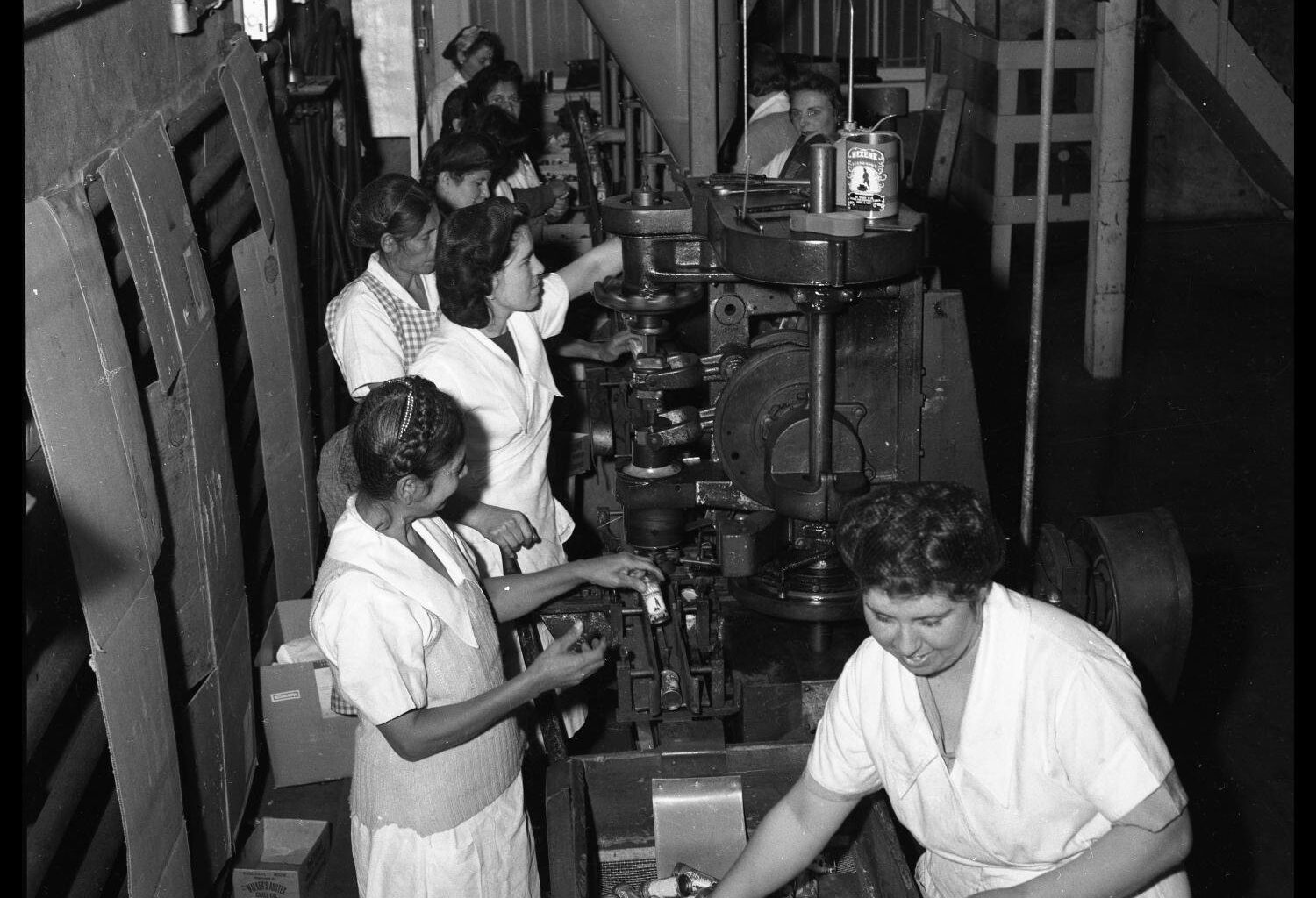
Austin had very little manufacturing during the early and mid-20th century. One exception was the Austex Chili plant on West Third Street near Republic Square Park. Along with a spinach-packing plant, it was the center of an agribusiness node in a part of downtown known as “Mexico” because of its Hispanic residents.
Austin History Center ND 48a05707
When buying canned chili, the only decision Austinites once had to make was “with or without beans,” because the brand was almost always “Austex.”
Article continues below this ad
While Thomas Bailey Walker is usually given credit for creating Austex Chili, kudos should also go to banker Frederick William Catterall. Walker founded Walker Manufacturing and quickly became one of the nation’s largest packers and dealers of canned Mexican foods — chili, tamales and beans — but he had to declare bankruptcy in 1914 with debts of more than $1 million. Catterall rescued the business and continued to operate it under the Walker brand.
He added Austex to the name in 1931.
Walker died in 1922 at the age of 46. Austex offices were at 310 San Antonio St. near Republic Square, now a state garage, and its plant was at 500 West Fifth St., now the federal courthouse.
At the time, the neighborhood was largely populated by Mexican Americans, and Austex employed 15 percent of Austin’s entire Mexican American population.
Article continues below this ad
In 1961, Austex merged with Frito-Lay, which started a series of mergers with Riviana Foods, Castleberry Foods and Bumble Bee Foods. In 2007, the brand ran into problems when eight cases of botulism were attributed to the chili produced in a Georgia plant.
1912: Steck Publishing
Hart Graphics took over the Steck Publishing plant on Shoal Creek Boulevard.
Brian K. Diggs/American-Statesman File
Steck Publishing’s story is one of innovation, growth, acquisitions, mergers and spinoffs. It was once the largest commercial printer in Texas. It printed TV Guide, catalogs, publications and software manuals.
Article continues below this ad
1912: Edgar Louis Steck founded Steck at 110 E. Ninth St.
1928: Steck moved to new offices at 205 W. Ninth St.
1937: Steck produced the first four-color process on newsprint in the U.S.
Article continues below this ad
1957: Steck moved to a new campus at 8000 Shoal Creek Blvd.
1962: Steck was acquired by Vaughn Building and became Steck-Vaughn
1966: Steck-Vaughn acquired Warlick Press; it became Steck-Warlick
1968: Steck-Warlick was acquired by Intext Educational Publishers
Article continues below this ad
1971: Steck-Warlick spun off Steck Data Processing
1972: Steck-Warlick spun off Shoal Creek Publishers
1973: Steck-Warlick sold the Austin office to Hart Graphics
1989: Hart Graphics spun off Hart Label (employee purchase)
Article continues below this ad
2001: Hart Graphics closed shop
Hart Intercave, Hart Label and Shearer Publishing still operate
1922: Adams Extract
Neal Douglass took some shots meant for advertising campaigns. This one for homegrown Adams Extract in 1956, among other things, indicates how much food preparation, such as baking, was done at home back then.
Neal Douglass/Austin History Center ND 56153B0
Although born in Beeville and now based in Gonzales, no food manufacturer owes more of its growth and success to Austin than Adams Extract.
Article continues below this ad
After moving his family from Michigan to South Texas in 1905, John Anderson Adams concocted the popular vanilla flavoring product. At night, by the light of kerosene lamps, his family printed labels and bottled the product. During the day, they sold it door to door with a full money-back guarantee.
After receiving the University of Texas’ first business degree in 1917 and purchasing the firm from his father, Frederick Ward Adams moved the company to Austin in 1922 and into a two-story production structure at 2216 San Gabriel St.
Adams’ son, John Gandy Adams, a World War II Flying Tigers veteran and UT chemistry graduate, took over the firm in the late 1940s and diversified its product line.
In 1947, he designed and built the first assorted food color four-pack line that is still sold today.
Article continues below this ad
In 1955, John Gandy Adams built a new 22-acre headquarters and production facility on what is now South Interstate 35, designed in the Prairie Industrial style by the architecture firm Lundgren & Maurer. The plant enabled the expansion of products to include a full spice and seasoning line in 1959.
John Gandy Jr. succeeded his father as president. After 80 years in Austin, Adams Extract & Spice was purchased by Central Texas Ingredients and moved to Gonzales in 2002, where it now resides.
John Adams died in 1938, Fred Adams in 1980 and John Gandy Adams in 2004.
1956: Glastron Boats
Fidel Rodriguez, supervisor of final details, applies some finishing touches on the assembly line at Glastron Boat Co.
John Davenport/San Antonio Express-News
Glastron was one of the nation’s first manufacturers of fiberglass boats and one of the largest employers in Austin during the 1960s.
Article continues below this ad
The company was born in 1956 when four Austin entrepreneurs joined to design and produce a lighter, faster, sexier sports boat. The partners were Robert Ray Hammond, a boat builder; William Dickerson Gaston, a boat dealer; Robert Alan Shoop, a casket dealer; and Guy William Woodward, an adhesives salesman.
Glastron boats were known for their fiberglass composition and innovative hull design. Two Glastron boats became movie stars: the Batboat in the 1966 movie “Batman,” which premiered in Austin, and the GT150 model that made a record-breaking 120-foot jump in the 1973 Bond film “Live and Let Die.”
After a first-year output of 24 boats, business boomed. Production increased from 4,000 boats in 1958 to 20,000 in 1974. The plant was expanded from 40,000 square feet to more than half a million.
In the 1990s, Glastron was purchased by Genmar Holdings and moved to Minnesota. In 2009, Genmar declared bankruptcy, and Glastron was acquired by Rec Boat Holdings, a subsidiary of Groupe Beneteau, an international boating and housing conglomerate. The boats are now manufactured in Michigan.
Article continues below this ad
Shoop died in 2004, Woodward in 2014, Hammond in 2017 and Gaston in 2019.
Three more from this series
From Spanish Village to Rosie’s, the stories behind Austin’s Tex-Mex staples
The long, strange stories of Austin’s oldest music venues
Article continues below this ad
Austin coffee shops that survived: Ruta Maya, Anderson’s, Mozart’s, Flightpath
Please send tips and questions to mbarnes@statesman.com.