
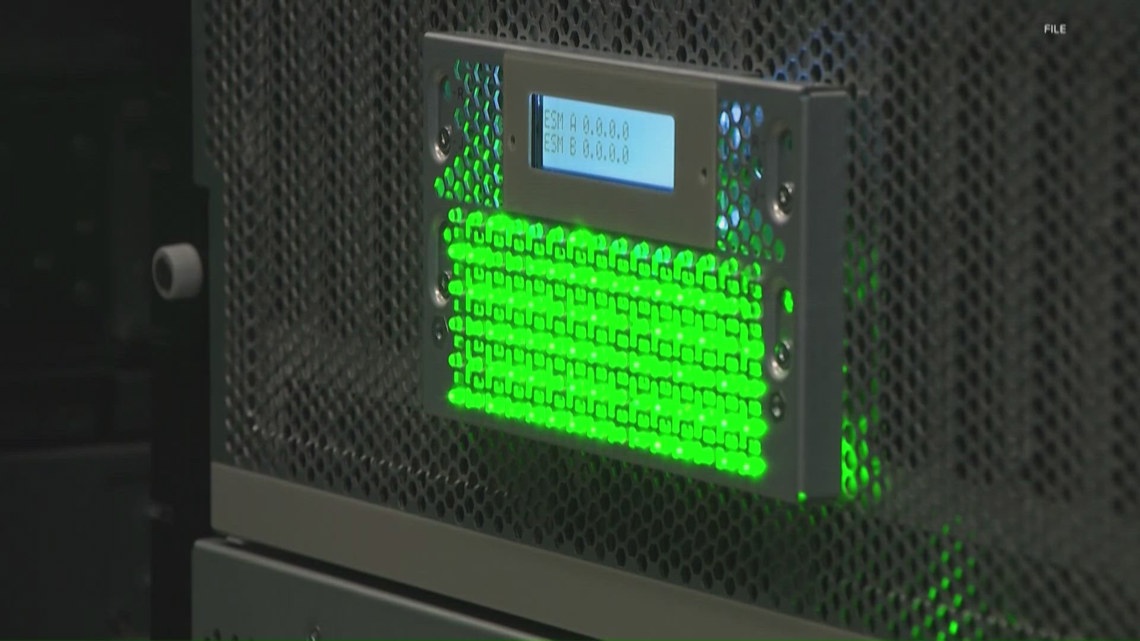
Texas has 300 operating data centers, with more than 100 planned or under development.
AUSTIN, Texas — It seems like everywhere you look across Texas, there’s a new battle brewing about a proposed data center development.
On Thursday, state lawmakers looked at the booming growth of those facilities. They’ve become controversial developments in several cities where residents have urged local leaders to block data center projects. The issue of data centers has resonated with Texans across party lines.
The Texas House Committee on State Affairs held a hearing at the Texas Capitol, where state lawmakers heard invited testimony on the role data centers play in the Texas economy, how they impact the reliability of the Texas power grid and what regulatory framework is currently in place or needs to be in place for their development.
This was a chance for lawmakers to hear from several data center developers, as well as a handful of others involved in this industry. They’re trying to understand this growth we’re seeing statewide and determine whether there is anything they need to address on this topic when the next legislative session starts in January.
Texas has 300 operating data centers, with more than 100 planned or under development.
ERCOT says the majority of the most recent projects added to its “queue” and working towards approval are data centers.
There are more than 450,000MW of generation capacity and resources planned to connect, or expressing interest in connecting.
“It’s been growing rapidly over the last year and a half, and really in the last month and a half, we saw a big chunk of new projects come into this queue, jumping it up over 130,000MW. Of these, over 80% of these, around 87% are data centers,” ERCOT CEO Pablo Vegas said. “So there are other projects in here, traditional large industrial development projects, but the large majority of these are data centers.”
A lot of the projects, Vegas said, will begin to energize or are proposing to energize in late 2027, 2028, or some in 2029 and 2030.
“It takes time to develop power plants and supply to serve. It takes time to develop transmission lines and build those to connect,” Vegas said. “These next two to three years are really critical, which is why the process of this large load interconnection needs to change so that we can try to optimize that connection window.”
With so many new proposals, ERCOT said its current approval process has struggled to keep up because it must constantly reanalyze projects.
By the time they would give a green light to develop a project, Vegas said they have run into situations where multiple parallel projects were developing in that same area, which could change the transmission topology, the landscape at that location, and that then changed the equation because while one project may be okay, two or three may not be.
“Developers who were putting billions of dollars into investments in the state of Texas were facing this untenable situation where they could get approval, get funding and financing, start to develop, and then see the requirements change in the middle of that cycle,” Vegas said. “We recognized that we needed to change that process for this to be able to work for the economy of Texas and for the growth that we want to see happen here.”
Instead, they want to take a batch approach, considering all projects at once so they can look at the entire system.
“We can identify the transmission capacity that will be available based on what’s there today and what’s getting built over the next 4 or 5 years. Then we can allocate to those projects and say, okay, at this site, there’s this amount of capacity that you can have at each of these years, and it may be incrementing and changing over that period of time,” Vegas said. “Then if the project says, well, great, that works for me, I can use that capacity. It’s enough for the project I’m going to do. We would actually hold that capacity for them.”
Vegas said it is likely that a significant financial deposit would be required to hold that spot and ensure the transmission is allocated to a company.
“All these criteria would make sure that the bar is high enough so that if we’re going to start to build transmission for them, we know that that it’s proven transmission and that those projects are going to be there to use it and that it’s not going to be something that’s going to be wasted or stranded in the future,” Vegas said.
State lawmakers questioned Vegas about the grid’s capacity and how many more large projects it can realistically take on. He said that if transmission doesn’t get built or generation doesn’t come online, it can materially change the calculation.
“I don’t think we’ve seen a saturation limit in terms of the demand yet for it from a practical point of view,” Vegas said. “We are consistently evaluating the infrastructure’s ability to serve that demand and making sure that anything that we’re going to connect into our system can be connected reliably and not create an instability or reliability risk for everyday Texans.”
Several data center developers said they like the new batch process because it would give them greater stability and certainty. They think the projects that are furthest along and have the best chance of succeeding should get priority in reviews.
“We’re not going to end up with a perfect answer that not everybody’s going to be happy with. We’re going to lose some projects in this process, undoubtedly just based on where we are and how far along we are,” Skybox Data Centers Chief Development Officer Haynes Strader said. “But the reality is, the ones that are most well set up to succeed should be the ones that work through this process.”
ERCOT said it hopes to present this plan to its board of directors in June, bring it to the Public Utility Commission to review it in July, and potentially begin the first batch in August. Vegas said they would run that batch through the rest of August, and decisions on what transmission is available would come out early next year.
Data center industry leaders tried to make the case to lawmakers that they are doing good work and are good stewards of Texas’s resources.
They highlighted the industry’s economic value, bringing $65.8 billion to Texas GDP and generating $4.5 billion in state and local tax revenue in 2024, supporting more than 428,000 jobs, including nearly 104,000 direct jobs.
Dan Diorio, Vice President of State Policy for Data Center Coalition, said each job in a data center supports four and a half jobs elsewhere in the economy.
“Data centers rely on local skilled tradesmen, electricians, plumbers, pipefitters, steam fitters and HVAC technicians to build facilities but also maintain and upgrade them when operational,” Diorio said. “This requires a strong pipeline to meet current needs, but also to plan for future investment. The industry is investing in workforce development programs to ensure their companies can employ homegrown Texans.”
Data Center industry leaders framed the state of play as Texas being at the forefront of the global technology race for advanced computing.
“If you’re thinking about the global space race of AI, what’s happening is the equivalent of the transcontinental railroad, the invention of the nuclear bomb and the race to get to the moon all happening at once,” Strader said. “That’s the scale of what’s happening across the country. We have the opportunity in the United States to either lead that or to lose that race to China.”
Much of the criticism of data centers has focused on issues such as air pollution, noise, water consumption, and the added strain on the power grid. Throughout their testimony, representatives from data center companies tried to downplay some common concerns.
“Data centers have become this physical thing to be mad about. If you’re afraid of AI, if you’re afraid of this technology, and everyone has a right to be afraid of it, I’m not saying you shouldn’t be. There’s a lot of scary stuff having to do with it,” Strader said. “But the reality is, we want the US to lead in that, and frankly, we want it here in Texas to regulate it.”
The water part is a big deal because it is scarce in parts of the state. One data center developer told state lawmakers today that its average data center uses less water than five houses do in an average year.
“Data centers are extremely efficient water users,” Diorio said. “We will continue to do that, not just because we want to, but because it makes dollars and cents work. These are some of the highest costs for the data center. So it’s in our best interest to keep our operational costs down.”
Older data centers that were bult 20 years ago used evaporative cooling and used a ton of water, but for the last ten years most new facilities have been closed loop, which requires an initial tranche of water but afterwards requires little new water because it recirculates the water in the system to cool the servers and cool equipment and for the ambient temperature in the data center.
“That’s recycled with often less than a 2% loss factor, so you’re talking hundreds of gallons a year,” Strader said. “The real water user is the folks going in and out of the bathroom and using our coffee machines.”
There is also a lot of focus on the strain on the Texas power grid. State lawmakers expressed their desire that an average homeowner should not see their electricity bill rise because of these facilities.
“This is an industry that is fully committed to paying our full costs to service for electricity,” Diorio said. “We depend on utilities and regulators and grid operators to help us do that and ensure that they are allocating costs appropriately.”
Strader said many people view these facilities as a drain on the grid, but that isn’t the full story.
“Our goal is not to increase the transmission cost for any Texan or to decrease the reliability of the grid. For any Texan, it’s quite the opposite,” Strader said. “It is actually almost the reverse of a battery. It’s its existing capacity that’s being consumed and paid for today that can be released to the surrounding communities when we go into backup generation.”
State lawmakers questioned data center leaders about state and local incentives. Texas is one of 37 states that offer tax exemptions for data centers, most of which are centered around sales tax exemptions.
However, some state lawmakers have voiced support for either limiting the scope of those tax breaks or eliminating them altogether.
Lawmakers heard only invited testimony, but Committee Chair State Rep. Ken King (R-Canadian) said he expects to hold another hearing, potentially as soon as later this month, where the public will be able to testify.
A Senate committee is also expected to hold a hearing on data centers this summer, and the topic will certainly come up when the next legislative session starts in January.