
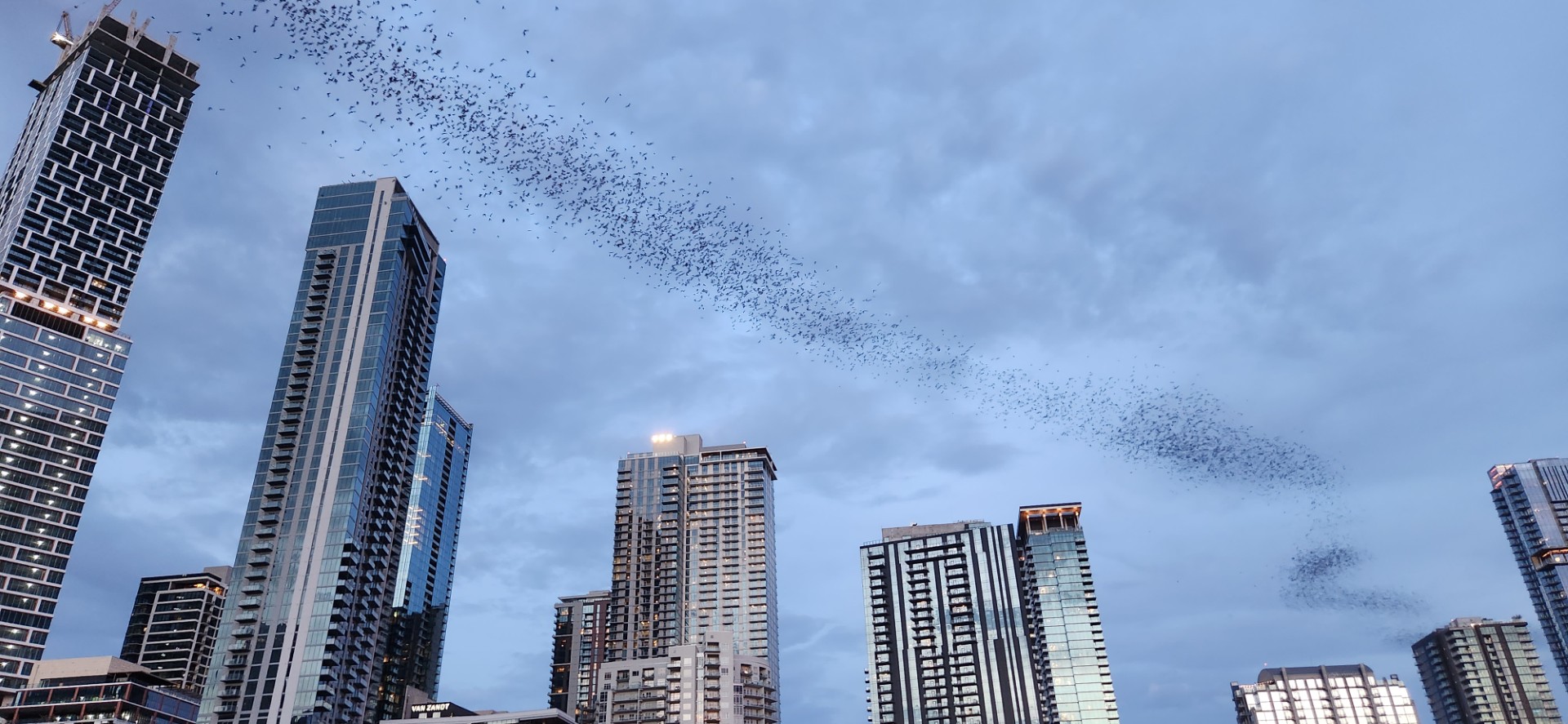
Finding something unique when traveling can be the highlight of a trip.
In Austin, Texas, few things are more unique for travelers than watching hundreds of thousands of bats flying through the sky. That’s what one can expect to see nightly from March to November when an estimated 1.5 million Mexican free-tailed bats return to Austin annually from Mexico.
Tourists and locals gather on the Ann W. Richards Congress Avenue Bridge, on watercraft on Lady Bird Lake, the Statesman Bat Observation Center, and a few downtown hotels near the water with elevated viewing spots to see the spectacle that takes place approximately an hour or two prior to sunset.
According to several sources, this Austin colony is the largest urban bat colony in the world.
The bats arrived in Austin in the 1980s after a bridge expansion created the ideal habitat for bats and their young. At first residents sought to have the bats killed, fearing they carried disease. However, one man, photographer and environmentalist Merlin Tuttle, successfully launched an educational campaign toting the environmental benefits of bats, according to experts. He pointed out that the bats were not a threat to humans and consumed pests that destroyed crops such as corn, cotton, and tobacco.
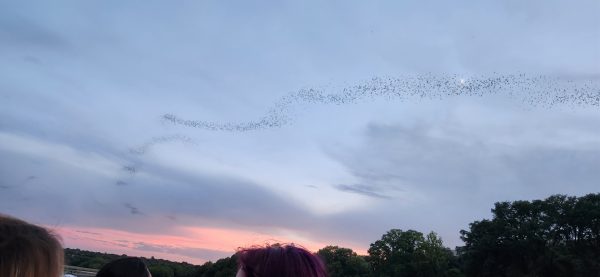
The bats, which do not attack or interact with people, consume 10,000 to 30,000 pounds of insects nightly, sources state.
“The bats have proven to be invaluable neighbors, providing essential pest control, attracting millions of tourists, all while decorating Austin’s night skies,” according to austinbats.org.
A popular way to experience the night flights is to book a tour on a pontoon, kayak, or paddleboard with a guide. Some pontoon boats can be booked for $9 to $14 per person.
In August, I experienced the bats’ emergence while I was seated on a pontoon with a guide who provided historical and environmental information and who made sure we were in the proper position to see the bats as they emerge from the bridge for their nightly feed.
Lady Bird Lake near the bridge was crowded with a variety of spectators in row boats, kayaks, tour boats and paddle boards. The mood was festive as folks played music, waved to one another, and waited.
The bats are approximately half an ounce in size, and when they first come from under the bridge, they are difficult to spot. However, as they form a long undulating trail in the sky, they became more visible against the pastel hues of the night sky.
Spectators gasped with excitement and delight, took photos and videos, and watched the rush of bats streak across the sky.
According to some sources, the emergence of the bats from the bridge can continue for nearly an hour.
For more information on the best places and times to see the Austin bats, go to austinbats.org and austinbatrefuge.org.
