
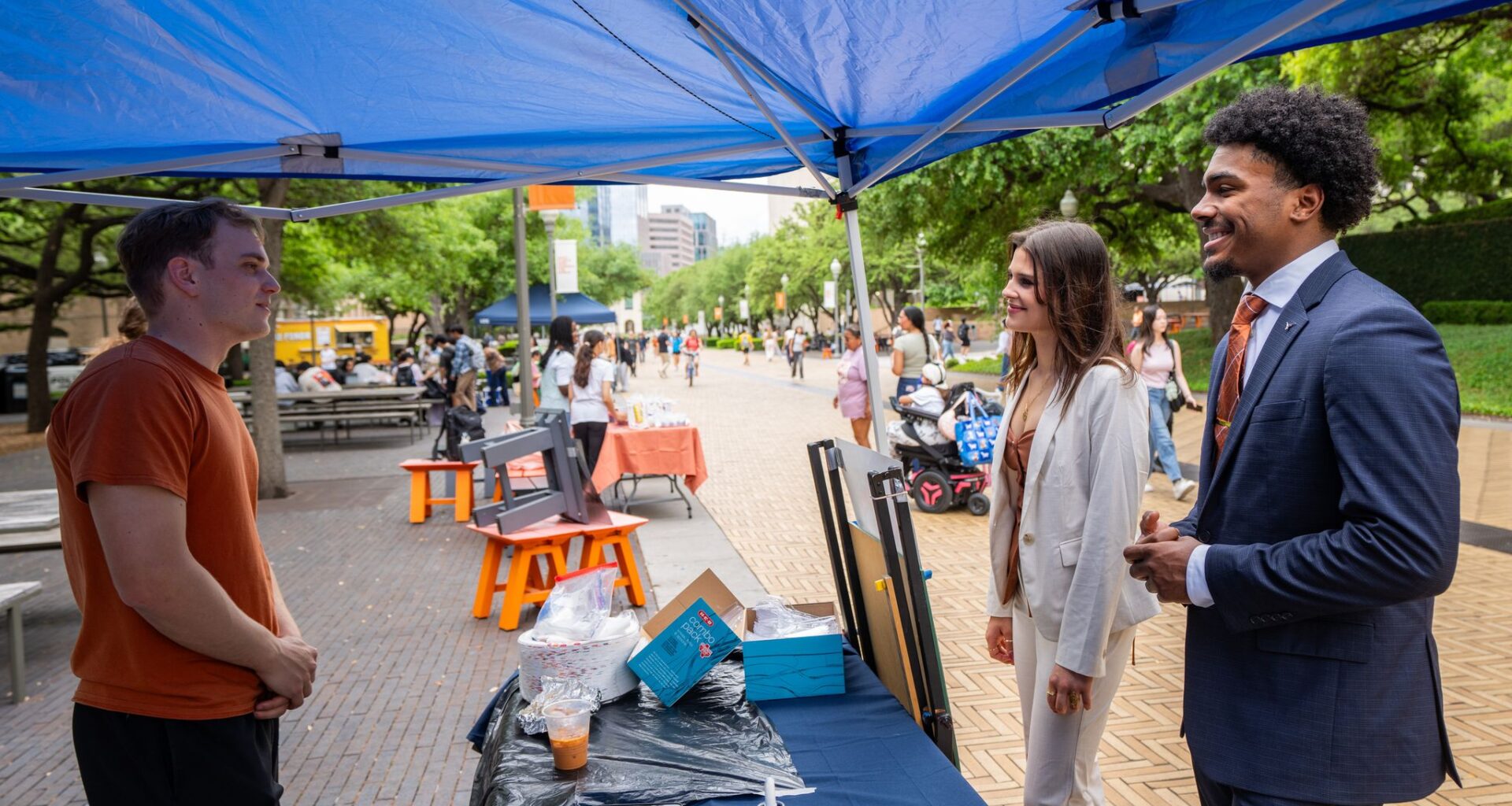
University of Texas Vice President Jaden Watt and President Kiera Dixon speak with students on campus in Austin, Friday, April 3, 2026.
Mikala Compton/Austin American-Statesman
Kiera Dixon and Jaden Watt — the duo who now lead the University of Texas’ student government — know what it means when a university takes away vital support for students.

A college freshman in 2023, Watt found community through the Multicultural Engagement Center, a central hub of student activity that celebrated cultural diversity, sponsored groups centered around students’ racial and ethnic identities and hosted university-sponsored events. The Undergraduate Research Center, a central hub organizing research opportunities, paid for Dixon’s travel to conduct interviews for her research fellowship.
Article continues below this ad
The students watched as UT administrators unilaterally cut both programs under pressure from new laws, leadership changes and pushes for efficiency. As UT leaders restructure the College of Liberal Arts and review the core curriculum that all students take, change at the state’s flagship has “only sped up,” Dixon, the slate’s president, said.
“It’s not just like people are hearing this and not caring. It’s that the more (changes) happen, the more students are becoming disillusioned and out of touch,” Watt, who serves as the vice president, said. “It’s like, you just wake up and check your email again and it’s like, ‘Oh, there’s another massive change to my campus.’ We want to change that.”
Campaigning on a platform of “closing the gap” between the administration and students, Dixon and Watt, who took office this week, say they will push for transparency as their university continues to face scrutiny from vocal politicians.
Dixon and Watt’s goals around advocacy and transparency contrast with their predecessors, who have predominantly operated behind-the-scenes and, more recently, avoided controversial topics. But as new laws and policies limit the ways students and faculty can hold officials accountable, the UT student leaders’ message has resonated across campus.
Article continues below this ad
“Students are feeling like there’s no one fighting for them, there’s no one advocating for them. They’re feeling like these changes are just being imposed on top of them,” Dixon said. “Creating a legacy of student government as being something that can fight for students and that can make change for them is a really big goal of ours.”
After Senate Bill 37 passed in 2025, public higher education institutions shifted decision making power to regents and away from faculty. In response, the UT System shuttered its institutions’ faculty council. The flagship no longer has an elected faculty body providing input in high-level university decisions. In the past year, UT’s president, chancellor and provost were hand picked for their roles by regents, who are appointed by the governor.
Now, student government leaders are some of the only elected UT representatives. The students are determined to expand public forums for students to share feedback directly with President Jim Davis, who has declined requests for public interviews during his first year in office.
Dixon and Watt’s win may challenge UT leaders to more closely engage with student advocates after a year spent avoiding public forums. The students, both government majors in the liberal arts honors program, are determined to deliver on their campaign promises.
Article continues below this ad
“We’re going to get wins for the students,” Watt said. “However is best, and however we need to, because it’s our number one priority.”
The role of student government at UT
University of Texas Vice President Jaden Watt and President Kiera Dixon in Austin, Friday, April 3, 2026.
Mikala Compton/Austin American-Statesman
Watt and Dixon have been interested in student leadership since they were wide-eyed new students attending UT’s Gone to Texas, an annual welcome event for first years frequently featuring fireworks and a lit-up UT Tower.
Article continues below this ad
But it was how the campus drastically changed under Senate Bill 17, which passed in 2023, that sparked more serious interest in campaigning. The law required universities to end diversity, equity and inclusion supports for students, prompting UT to close the Multicultural Engagement Center, the Gender and Sexuality Center at UT and the Division of Diversity and Cultural Engagement. Four months after it initially complied and a week after more direct pressure from the law’s author, the university fired about 60 staff who had worked in student support and DEI initiatives.
Around that time, Watt approached Dixon with an idea for a platform that focused on creating better ways for all students to be heard.
“When I first approached her, it was in the wake of some of those decisions that were happening, and we were saying, ‘Hey, I think we can get in rooms and advocate for students in a very real and tangible way,’” Watt said. “We want to see change in all communities on this campus, advocate for all voices on this campus.”
The Daily Texan editorial board, the opinion section of UT’s student newspaper, endorsed the duo as the “best choice for change,” and the best platform to advocate for student interests. They beat out seven other pairs with nearly 3,000 votes — a small share of the campus’s 43,000 undergraduate student body. The next highest vote getters won 2,001 votes.
Article continues below this ad
UT has three student-run branches of government that operate similarly to the United States’ branches of power: a Supreme Court that ensures leaders comply with student government bylaws; a legislative assembly with representatives from each college that pass policy; and an executive branch now led by Dixon and Watt. The student groups are funded by UT and advised by the dean of students.
Watt and Dixon are aware that student government elections draw remarkably low turnout, and that many at UT don’t know what the body does or doubt it has real impact. But they believe in their new roles’ potential to elevate student voices to the administration, becoming a bridge between both parties during and after their year of leadership. They plan to treat it like a full-time job, devoting each week to meeting with students and university leaders to serve campus.
“I’ve always been very passionate about (student government) as a way to advocate for student voices,” Dixon said. “But I also believe that to accomplish that goal, it needs to genuinely advocate for them, instead of just saying it does.”
Last year’s leaders, Hudson Thomas and Thierry Chu also wanted student government to be more visible. They launched digital student IDs, accompanied university leaders at press conferences, hosted a student startup competition, and organized a vigil after a gunman shot and killed a student at Buford’s Bar in May.
Article continues below this ad
But when President Donald Trump’s administration extended UT and eight other universities a deal that would reward the adoption of conservative priorities with extra federal funding opportunities, the leaders remained quiet even as their peers at seven of the other institutions spoke out against the offer.
UT’s Graduate Student Assembly, another elected body to represent graduate students, has reported pressure to limit speech due to the school’s institutional neutrality policy, which prevents university leaders or groups funded by the UT from commenting on subjects unrelated to the university. UT Spokesperson Mike Rosen did not respond to requests for comment on how UT will work with the new student leaders.
Voice for change
The duo feels their goal is important to the campus community. Talking to nearly 1,000 of their peers during their two-week campaign this spring, Dixon and Watt found students felt disenfranchised and ignored in university decisions.
Article continues below this ad
Students have watched their university change, most recently with the consolidation of ethnic studies departments, a new policy limiting the teaching of controversial topics and declining transparency. But students don’t feel they have a sufficient way to respond, Dixon and Watt said.
Under their platform, the two leaders will host more public forums for students to share how they are affected by high-level decisions and fight policies that reduce academic opportunities.
That push could fill a void. In the wake of the UT System cutting faculty senates, a long standing venue that gave faculty input on university decisions, the student government is one of the only remaining forums for bottom-up input with a direct line to administrators.
President Jim Davis, UT’s first president without ties to academia in more than 100 years, replaced the faculty council with an appointed faculty advisory board, which does not meet publicity. UT officials say a student advisory board regularly meets with the president, but Dixon and Watt said it is inactive. They want to bring it back.
Article continues below this ad
Students “need to be able to trust that there’s somebody in there advocating for my best interest,” Watt said.
The pair want to share non-academic challenges, too. They hope to communicate student concerns about safety, mental health, food insecurity and housing with administration and share university resources and initiatives with students.
Watt and Dixon are confident they can work with the administration effectively, pitching transparency as a win-win for the administration and students.
Article continues below this ad
“We love this campus, and we want to make it better,” Dixon said. “That’s the baseline for all of our conversations (but) we’re not just going to get bulldozed over if there’s something that we know is going to be harmful to the students.”