
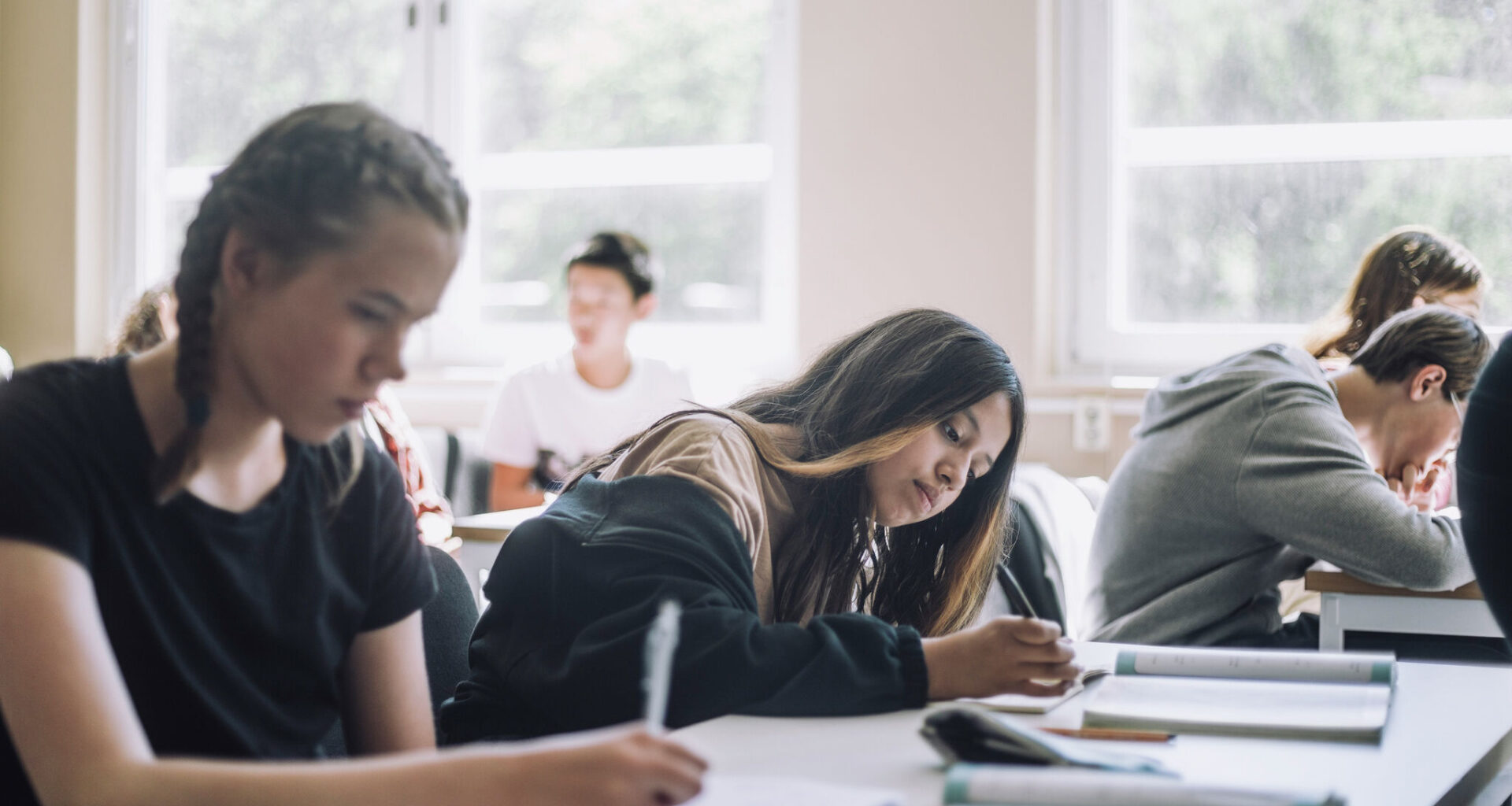
Imagine classrooms where students read actual books and write on actual paper.
Maskot/Getty Images
Last year a new Texas law banned students in public K-12 schools from using cell phones during the school day. School officials love the changes they’re seeing: Not only are cell phones and addictive apps no longer stealing students’ attention during class, but the kids are talking more in the hallways and at lunch — and even, according to one superintendent, making more eye contact.
Texas finally realized that allowing kids to have their cellphones in schools has been an utter disaster, and now the tide is turning in the rest of the nation. It’s taken longer than it should have, but better late than never.
Article continues below this ad
Let’s take advantage of the momentum to move immediately on to the next reckoning, which is with the disastrous series of decisions, over the last few decades, to bring massive amounts of “educational” technology into our schools. Let’s get rid of computers except for use in courses that absolutely require them. Get rid of digital textbooks, in-class ed tech and online homework. Bring back blackboards. Bring back paper textbooks. Bring back paper homework.
Going digital was a bad idea when it began; the history of education reform is a graveyard of utopian technological promises that wasted money and failed to improve outcomes. Radio, video, video games, CD-ROMs — each new tech in turn was supposed to help us teach our kids better. They all failed, just as laptops, software and the internet are continuing to fail.
Article continues below this ad
The data is clear. In the U.S., the largest randomized experiment on home computers ever conducted found no positive effects on grades, test scores, attendance or credits earned. A decade-long study of Uruguay’s nationwide laptop program dramatically expanded computer access but found no improvement in educational attainment. A long-term study of Peru’s One Laptop per Child program across 531 schools found the same. There were no gains in academic performance, completion rates, or university enrollment.The grim reality is this: American public schools have spent hundreds of billions of dollars over the last two decades for worse than no reason. Schools should be a save haven from screens. Instead, we’ve spent loads of money to further immerse children.
Article continues below this ad
Within the schools, this matters for the reasons you’d expect. Kids are more distracted and disconnected. Teachers have to compete with YouTube and TikTok. And administrators are turned into software purchasers.
There is another cost, however, that gets almost no attention but may be the most destructive of all. When homework and the textbook live on a laptop, parents lose the ability to manage their children’s technology use at home.
This is not a minor side effect. It is a structural disaster for any family trying to set limits on screen time. If the school has made the screen mandatory, our kids have to be on their computers every night, since there’s no bright line between working and messing around. Kids often toggle between an assignment on one tab and a YouTube video or a group chat on another, doing both and neither, in a perpetual state of fragmented attention.
Article continues below this ad
The screen never closes, because many schools have made it load-bearing infrastructure for every assignment, every reading, every communication with teachers. This wasn’t done maliciously, but the consequences have been wholly malign.
If there were in fact some learning benefits, maybe we could justify the cost of so thoroughly disempowering parents. But there aren’t. There’s no upside. None.
Article continues below this ad
I’m not naive about the immense obstacles in the way of reversing course. Teachers will have to learn new methods (or re-learn old ones). Schools will have to spend money on textbooks, paper, photocopiers, blackboards, etc. Students will have to get more used to their own thoughts. Administrators and school board leaders will have to eat some crow. Tech companies will have to eat some losses.
It won’t be easy. It should be easy, though, to recognize the path forward. And we don’t have to do this in the whole state all at once. Look for sympathetic principals. Run pilots. Collect testimonials from grateful parents. And then when it proves workable — as we already know it will, because we’ve done it before — you scale.
When or if we finally end this failed experiment with tech in schools, the result won’t be an educational utopia. There is no utopia in mass education. But we can at least stop doing the same dumb thing over and over again just because we lack the imagination and courage to stop.
And one last thing. The next round of snake oil salesmen are already here, wooing us with promises of how AI is going to change everything.
In fact, some of the slickest of this new generation of edtech pied pipers appear to be right here in Texas, at Austin’s private Alpha School. And who knows? Maybe they’re the ones who’ve finally cracked the code. Maybe their tech will teach our kids better than the old human-to-human methods.
I’m skeptical, but I’d love to see them succeed. If they do prove themselves, at scale in different environments and over time, then other schools can cautiously follow.
For now, however, we should take a few breaths, focus on undoing the damage that all the other tech is currently doing, and stop giving the benefit of doubt to the strategy that’s failed us so reliably in the past.
Daniel Oppenheimer lives in Austin.