
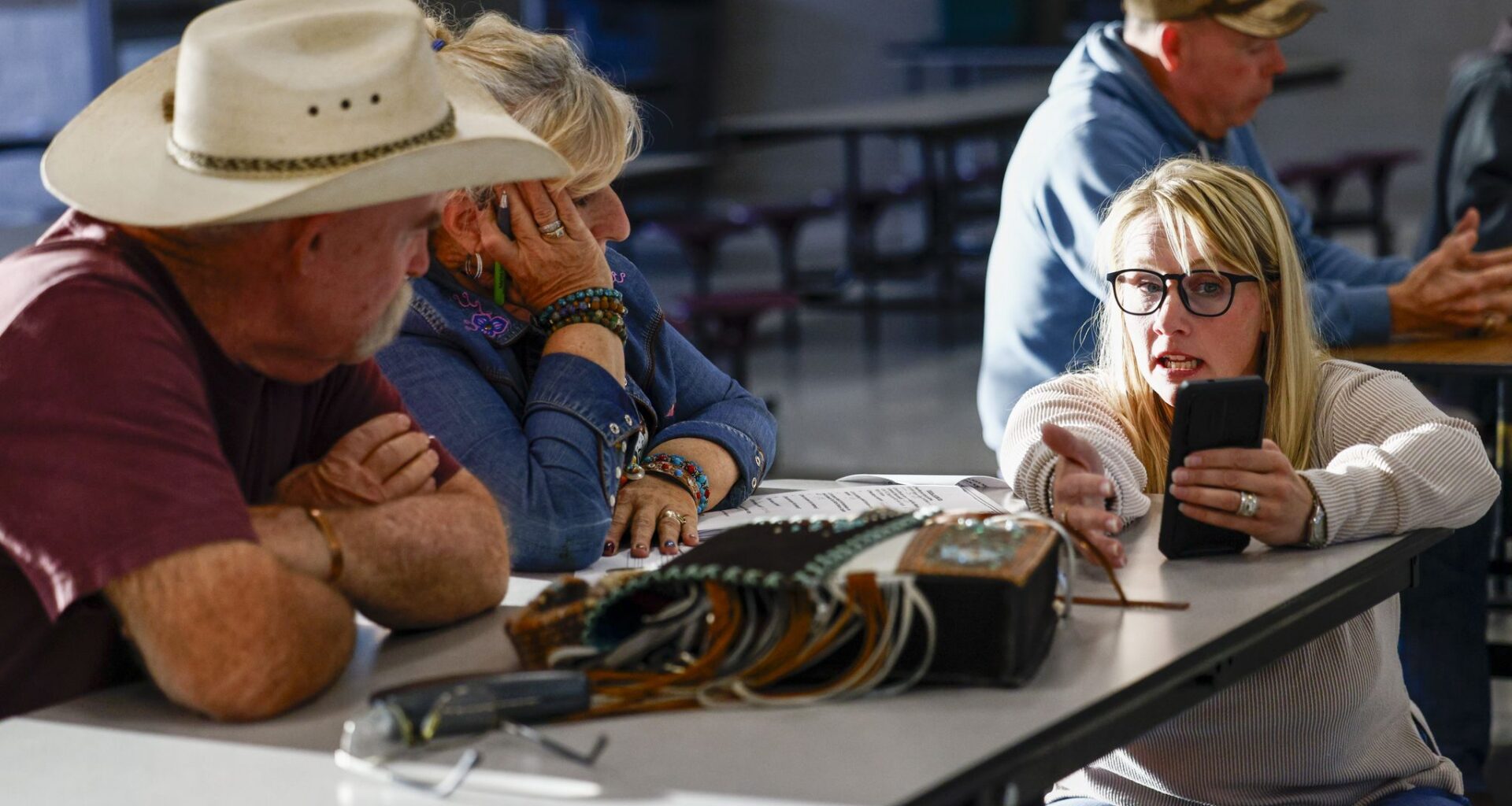
ERATH COUNTY – In this piece of Texas, “love thy neighbor” is more than Sunday school talk.

It’s a way of small town life, often shown through small gestures like waving to the folks on the sidewalk, rooting for each other’s kids at the baseball game, or having friends over for dinner.
But in the last few weeks, caring for each other has looked different.
Article continues below this ad
It’s asking if they’ve gotten their notice in the mail about the proposed 765-kilovolt transmission line, teaching them the difference between an “intervenor” and “protestor;” offering to scan and upload dozens of pages of testimony to the Public Utility Commission of Texas’ (PUCT) website, or – at the very least – listening to them vent about their anxieties, frustrations and fears.
“Sometimes people just need opportunity,” Emily Martin Howle, 7th-generation Erath County resident, said. “That’s all we’re giving them.”
Make Dallas News a preferred source so your search results prioritize writing by actual people, not AI.
Add Preferred Source
She is one of many locals who banded together in full force within the last several weeks to become unofficial experts on transmission lines and Texas’ regulatory process and bring more attention to the proposed project that will impact hundreds of people in their community.
Article continues below this ad
The flashpoint between Erath County residents and power officials is the latest example of how Texas’ famously pro-growth policies are colliding with communities’ desire to preserve local character and traditions.
Many neighbors also complain the regulatory process is confusing, overwhelming and inaccessible to some without technology, placing a burden on residents.
The volunteer efforts, which included a public meeting that drew more than 400 people from across the region, can be credited with hundreds of residents filing to intervene in the regulatory process.
“The group has done incredible work on gathering information from the files that have been filed, telling people how to get involved and what the deadlines are,” Erath County Judge Brandon Huckabee said. “It truly affects everybody … and they’ve really brought people together to work to get their voices heard.”
Article continues below this ad
Erath County Judge Brandon Huckabee greets Stephenville ISD Superintendent Eric Cederstrom during a community meeting about the proposed Dinosaur-Longshore 765-kV line at Lingleville Junior High School, Monday, April 6, 2026, in Lingleville, Texas.
Elías Valverde II/The Dallas Morning News
‘This is about maximum participation’
For nearly a year, residents all over Texas have been alerted they could be in the path of impending high-voltage power lines that state officials say are needed to help fortify the electric grid, and electrify the oil-rich Permian Basin.
Lines as large as the 765-kV don’t yet exist in Texas, but in other parts of the country, the steel lattice power lines range as tall as 130 to 180 feet or about the height of a 15-story building. The lines will also require a right-of-way about 200 feet wide to be cleared.
Article continues below this ad
The project has sparked growing opposition across the state, with local grassroots groups forming – or majorly expanding – in an effort to halt the project.
The Dinosaur Valley-Paluxy River Protection Alliance drew attention to a route that would skirt two sides of beloved Dinosaur Valley State Park. The Friends of San Saba River advocacy group multiplied from fewer than 50 members to nearly 200 after the announcement of the proposed line. An advocate and organizer in Burnet County wrote and commissioned a song called “Two Hundred Miles of Greed” that has more than 2,600 views on YouTube. All the while, large, established policy groups like the Texas & Southwestern Cattle Raisers Association are aiding their members with resources on how to get involved.
In mid-March, volunteers in Erath County quickly organized. It was a domino effect of sorts for the area potentially impacted by the Dinosaur-Longshore 765-kV line.
Article continues below this ad
What started as separate residents hearing about the proposed line or receiving their notice packets in the mail turned into weekly public meetings inside the Lingleville ISD cafeteria, knocking on neighbors doors and spending hours scanning hand-written documents for those either technologically-challenged, or without any digital devices.
Local residents listen as organizing volunteers answer questions during a community meeting about the proposed Dinosaur-Longshore 765-kV line at Lingleville Junior High School, Monday, April 6, 2026, in Lingleville, Texas.
Elías Valverde II/The Dallas Morning News
An unlikely group of acquaintances, or in some cases complete strangers, have made it their mission to make sure neighbors are taking care of neighbors throughout the PUCT’s regulatory process.
“We’ll all be able to say what we want to say and the chips will fall where they fall, but this is about maximum participation and voice from the community at large,” Eric Duff, another organizing volunteer, said. “ … It’s been special to be a part of something bigger than just a transmission line route.”
Article continues below this ad
From the beginning, that’s the message Martin Howle and the other volunteers have told anyone who will listen: “We’re all in this together.”
Taylor Castleberry, who lives in Fort Worth but grew up in Erath County and has been helping with the volunteer efforts, said what’s happened has almost been something comparable to a Hallmark movie.
“These people love each other,” Castleberry said. “ … It is bringing a community together because they care about each other and they care about their town and it’s not a selfish thing at all.”
Duff said the unity has come from empowering the community and putting the maximum amount of options they have in front of them.
Article continues below this ad
“We’re just probably the first and only transparent, honest, empowering group or voice they’ve heard in this whole thing,” Duff said. “I think that’s where the trust comes from, not because they believe we can stop it or what we’re telling them to write or whatever is amazing.”
Organizing volunteer Eric Duff speaks with fellow organizing volunteers Taylor Castleberry (from left), Heather Kincannon and Paige Castleberry during a community meeting about the proposed Dinosaur-Longshore 765-kV line at Lingleville Junior High School, Monday, April 6, 2026, in Lingleville, Texas.
Elías Valverde II/The Dallas Morning News
‘Public input is critical’
In an emailed statement, PUCT communications director Rich Parsons wrote that the agency has multiple ways Texans can participate in the decision making and planning processes for the transmission line routes.
Article continues below this ad
“It’s critical the Commission and staff know and understand how Texans could be affected by the routes under consideration,” he wrote, adding that “public input is critical” and strongly encouraged.
“Landowners affected by proposed transmission line routes have unique perspectives and knowledge of the affected areas, and it is important their input is included in the record of these cases,” the statement read.
The 765-kV project involves six transmission providers, including Dallas-headquartered Oncor which is constructing about 60% of the project. The PUCT has the final decision on what route the line will be constructed along, but the companies were first responsible for researching and compiling recommended routes, and fielding feedback from the public.
“Oncor believes public input is an important part of the carefully regulated process for proposing and building new transmission lines, and we support opportunities for community members to be heard,” company spokesperson Kerri Dunn wrote in an emailed statement. “While the Public Utility Commission of Texas (PUCT) oversees the regulatory review, Oncor has made it a priority to share information about this project and engage with local landowners, officials and other critical stakeholders.”
Article continues below this ad
Oncor employees have responded to hundreds of emails, phone calls, letters and other communications from Texas residents about the project, according to the statement, including how to participate in the PUCT’s review process.
“We recognize that regulatory processes can be unfamiliar, and we remain committed to sharing information about the project and directing stakeholders to the participation opportunities,” Dunn wrote.
When asked during an event last month if there was concern about residents and potentially some lawmakers calling for the slowdown of the 765-kV project, ERCOT president and CEO Pablo Vegas told reporters the justification for the transmission growth strategy “is well grounded in data.”
Article continues below this ad
Vegas said investing in higher-voltage infrastructure will be both economically and operationally beneficial in the long term.
“We want to be efficient with where we put infrastructure and we want to make sure we get the most impact for that,” Vegas said, adding that if the progress toward building the power lines slows down then it risks slowing the state’s economic growth.
“You can’t have the economic growth without the transmission in order to connect and move the power around the state that’s needed,” Vegas said. “The plans for growth on the data center as well as on the generation side, are spread throughout West Texas, East Texas, South Texas, all along the coast. So, we really need to have a backbone to be able to move the power around efficiently and safely to that growth, and if we materially slow down the highways of the electric system, then we’re not going to be able to get to our destination.”
A community of concerned neighbors
Many of the rural residents who would lose generational property to the infrastructure build out argue they don’t want to sacrifice the land they’ve cared for and cultivated – and love – to power data centers, or the needs of big companies.
Article continues below this ad
And Texans in the affected area stand to lose a lot.
It’s the large farms and ranches that would be spliced into fractions, like the Terrell family’s Great Southern Ranch that began operations in 1947. It’s now roughly 2,500 acres with a few hundred head of cattle.
The patriarch, 88-year-old Frank Terrell who also had a career as a doctor, still works seven days a week to operate the farm and can hop out of a side-by-side vehicle to open and close a gate with the grace of a teenager.
Frank Terrell, 88, points to a map showing where the Dinosaur-Longshore 765-kV line would cut through his family’s 2,500-acre Great Southern Ranch, Monday, April 6, 2026, in Erath County. Terrell worries about the effects the electricity from the power lines could have on his family and their herd of beef cattle.
Elías Valverde II/The Dallas Morning News
“This is a guinea pig deal here,” Terrell said sitting across the dining room table from his wife Kathy. The two aren’t only worried about the land that they’ve nurtured for generations, but also what effects the electricity from the power lines could have on them and their herd of beef cattle.
Article continues below this ad
“It’s not just us, it’s everybody involved,” Kathy said. “We’re fighting an uphill battle and we’re trying to stop it for everybody.”
She means what she says, as Kathy, 86, has been knocking on neighbors’ doors to hand out fliers and offer whatever information she does know. The fight has become a family affair, with the couple’s three daughters and at least one grandkid volunteering to spread the word around town and file documents.
“Our life has stopped as a family,” she added. “This is all we’ve done since finding out.”
Nearby others have also been studying maps released by Oncor and the PUCT and replaying what of theirs would be bulldozed.
Article continues below this ad
Shelly and Jimmie Fair of Bar Ditch Winery stand on their back patio and scan the horizon of their vineyard that has rows of grapes they use to make and bottle varieties on site, like Mustang Wing and Chick Wine.
The couple, ages 67 and 72, have known about the plans since last summer and had more time to sit with the news, but they’ve frequently thought about what transmission lines next to their grapes would do to not only to their business but the pollinators and wildlife surrounding it.
Shelly and Jimmie Fair’s Bar Ditch Winery is seen from the backyard of their home, Monday, April 6, 2026, in Erath County. The Dinosaur-Longshore 765-kV line will pass a couple hundred feet behind the tree line that is behind their vineyard.
Elías Valverde II/The Dallas Morning News
“The last thing we’re going to do is be angry and bitter the rest of our lives,” Shelly said. “But we’ve stepped up to help where we can because we don’t want this to pit neighbors against neighbors.”
Article continues below this ad
Vanessa Halford, executive director of the White Horse Christian Academy in Stephenville, worries about her business, too. She founded the private school 10 years ago and it’s grown to 169 students.
This academic year is the kids’ first in the brand new building, and Halford showed renderings for plans to continue improving the campus, including constructing a baseball field and track.
Schoolchildren play in a field at White Horse Christian Academy, Monday, April 6, 2026, in Stephenville, Texas. One planned route of the Dinosaur-Longshore 765-kV line would cut diagonally through the field where children play.
Elías Valverde II/The Dallas Morning News
“But the line would cut diagonally right through there,” she said, pointing to the open field where elementary-aged kids were wrapping up recess. She said some parents have already warned her that they’d pull their students out of the school if the transmission line runs across her property because they’re concerned about health impacts.
Article continues below this ad
“This line could halt – and bankrupt – any future growth, dreams, plans,” Halford said.
A pending decision
After a busy stretch of close to, if not literally, 24/7 efforts the last few weeks, the community has entered something of a waiting period.
The major deadline for intervenors – people who are directly impacted and can have a legal interest in the proceeding – to submit their testimony passed Wednesday evening.
Article continues below this ad
Now, the PUCT will continue reviewing Oncor’s application, and a decision is expected by August because state law requires the agency to approve, modify or deny it within 180 days.
The process will involve a full legal hearing before the State Office of Administrative Hearings, after which a judge will create a proposal for the PUCT that includes selecting a transmission line route, but the PUCT will have the final decision on what route “best meets the criteria established by state law.”
But for locals like Jerry and Marcia Norris, the waiting game is likely to prolong the uncertainty.
The couple, who will be married 58 years in July, have been thrilled to settle into the new home they built on a piece of land in Dublin. On their property, they can watch deer parade around, birds flutter and the sky change colors as the sun sets over a large pond.
Article continues below this ad
Marcia and Jerry Norris look out over their property from the back porch of their newly built home, Monday, April 6, 2026, in Erath County. One proposed line would pass over the driveway to their home and another line would cross through the back of their property.
Elías Valverde II/The Dallas Morning News
The couple managed to start settling into the home days ahead of Thanksgiving, where they still shared a meal with their family. But they said they were notified just weeks ago about possible routes for the transmission line that would corner their house on two sides.
The house is so new that it’s not included in the public maps provided by the agencies.
The couple were talking about the packet of information they received in the mail and how overwhelmed and disheartened they felt when a hummingbird buzzed to a red bird feeder they nailed to a tree.
Article continues below this ad
They said their daughter gave it to them as a housewarming gift. Jerry noted it has a camera inside of it that can identify the birds.
“But we can’t figure out how to turn it on,” he laughed.

By signing up, you agree to our Terms Of Use and acknowledge that your information will be used as described in our Privacy Policy.
“We don’t do technology,” Marcia agreed.
Article continues below this ad
Then she held her 17-page intervenor testimony document, which she wrote with the volunteers’ guidance, in the air and waved it: “It’s a miracle we got this typed up.”
This reporting is part of the Future of North Texas, a community-funded journalism initiative supported by the Commit Partnership, Communities Foundation of Texas, The Dallas Foundation, the Dallas Mavericks, the Dallas Regional Chamber, Deedie Rose, Lisa and Charles Siegel, the McCune-Losinger Family Fund, The Meadows Foundation, the Perot Foundation, the United Way of Metropolitan Dallas and the University of Texas at Dallas. The News retains full editorial control of this coverage.