
Audio recording is automated for accessibility. Humans wrote and edited the story. See our AI policy, and give us feedback.
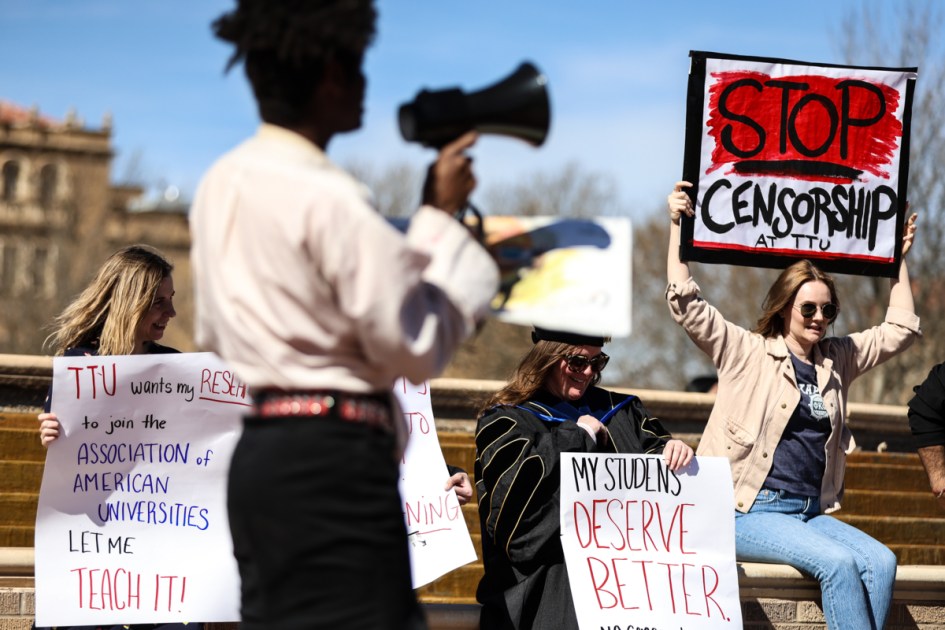
Texas Tech University System’s chancellor on Friday ordered campuses to phase out academic programs “centered on” sexual orientation and gender identity — a dramatically expanded policy that also places limits on what can be researched and which faculty can be hired.
Chancellor Brandon Creighton’s memo gives provosts until June 15 to identify targeted programs and requires the system’s five universities to freeze admissions and halt students from declaring majors in the phased out programs. Students already enrolled can finish their degrees.
It also says graduate theses and dissertations may center on those topics only as a temporary exception for currently enrolled students and that future faculty hiring will “prioritize recruitment in alignment with this memorandum.”
The memo also said faculty must recognize only “two human sexes” and not teach gender identity as a spectrum or more than two genders as fact — policies Creighton introduced last year.
In core and lower-level undergraduate courses, the memo says instructors generally cannot assign materials that are “centered on” or “include” sexual orientation or gender identity and defined the concepts:
“Centered on” is when course content, readings, assignments or lectures that have sexual orientation or gender identity “as the primary subject, main theoretical framework, central narrative or driving pedagogical purpose.”
“Includes” means “these themes are present, but serve only as secondary background context, demographic data points, or minor components of a broader academic subject.”
If an industry-standard textbook contains such content, the memo says faculty do not have to redact it, but they cannot highlight it, test students on it or spend class time on it.
The memo makes some exceptions for upper-level undergraduate and graduate courses, including analysis of active public policy and legal disputes, historical subjects such as the AIDS epidemic where sexual orientation or gender identity is inseparable from the topic, datasets that include those variables and some clinical, counseling or psychology instruction.
The memo also says “currently employed faculty members may continue to research and publish topics of their choosing,” but future faculty will be recruited and hired in accordance with the memo’s priorities.
Jen Shelton, an associate professor of English who has taught at Texas Tech for 25 years, said the provost’s office had repeatedly assured faculty that their research would not be affected. She said this feels like a “betrayal.”
“The good news is I think the whole university has been betrayed. I think even the provost did not expect it to look like this because it’s people from the provost’s office who have been coming to us and saying, ‘Don’t worry. This part is all going to be fine,’” Shelton said in an interview with The Texas Tribune.
In December, Creighton ordered faculty to submit for review course content touching on race, sex, gender identity and sexual orientation. If campus leaders wanted to keep the information in a course and it was not required for professional licensure, certification or patient care, they had to forward it to the Board of Regents for final review. Regents were expected to take up the issue publicly at their Feb. 26 meeting but did not, leaving professors in limbo.
Speaking at the Texas Public Policy Foundation’s summit in Austin on Thursday, Creighton said Texas Tech had “built an AI algorithm” to review syllabi, reading materials and lesson plans from roughly 14,000 courses across the system and would release findings within days.
At the summit, Creighton, who was a Republican state lawmaker responsible for major higher ed reforms before becoming chancellor last year, said what some faculty call “academic drift” had left “quite a bit of garbage in curriculum” on university campuses across the country. He said the Texas Tech University System has “a very good plan in place” to address that.
“I believe it will produce the best curriculum in America, and I believe it will be a national model once we’re finished,” he said.
In a news release Friday, the system said that of the 1,403 courses initially identified, only 92 were reviewed by the board of regent’s Academic, Clinical and Student Affairs Committee and fewer than 60 were recommended for modification. Another 299 were “proactively modified” before reaching the committee.
The Texas Tribune partners with Open Campus on higher education coverage.
Disclosure: Texas Public Policy Foundation and Texas Tech University System have been financial supporters of The Texas Tribune, a nonprofit, nonpartisan news organization that is funded in part by donations from members, foundations and corporate sponsors. Financial supporters play no role in the Tribune’s journalism. Find a complete list of them here.