
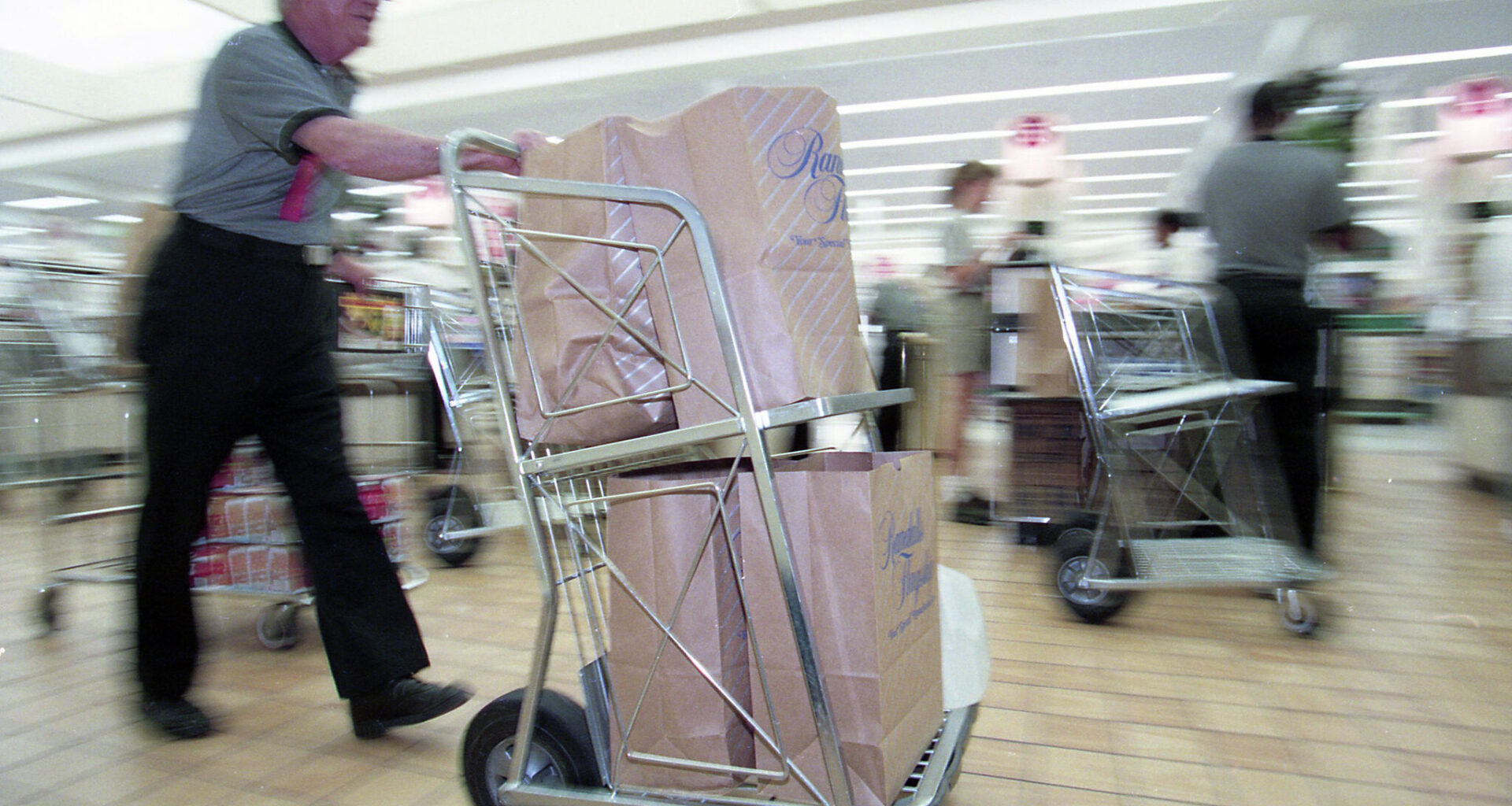
In February, Randalls announced the impending closure of its store at Sage Road and San Felipe Street in Houston. The news came less than a year after the Houston-born grocery chain shuttered its location at West Bellfort Avenue near the 610 Loop. After these and other recent closures, the near-60-year-old grocer is down to 26 Texas locations, a far cry from when it once boasted more than 110 stores statewide.

What happened to the grocery store that once commanded a significant presence in Houston? What has happened to Randalls?
History of Houston-born Randalls
The first Randalls opened in 1966, the product of a partnership between businessmen Robert Randall Onstead, R.C. Barclay, Norman N. Frewin and T.A. Morgan. The grocer soon became a chain by the start of 1970. Courtesy of Houston Historic Retail, a 1985 Houston Chronicle article by Judith Crown noted the chain had overtaken Safeway as the No. 2 grocer in Greater Houston by percent share of grocery sales in the five-county area (Kroger was no. 1).
Article continues below this ad
“The comparison between the two chains is striking because Safeway has 75 stores in the five county area—more than twice as many as Randall’s,” Crown wrote. “But Safeway executives point out their stores are smaller—they estimate that almost 80 percent of Randall’s stores are more than 40,000 square feet, while only 20 percent of Safeway stores are that large.”
Randalls gained more prominence in 1989 when Boris Yeltsin, who had just been elected to the USSR’s Congress of People’s Deputies, happened to visit the Clear Lake location during an overseas trip. The experience was reportedly life-changing for the future president of Russia. In his autobiography, Yeltsin wrote: “When I saw those shelves crammed with hundreds, thousands of cans, cartons and goods of every possible sort, for the first time I felt quite frankly sick with despair for the Soviet people.”
Boris Yeltsin and a handful of Soviet companions made an unscheduled 20-minute visit to a Randalls after touring the Johnson Space Center in 1989.
Larry Reese/Houston Chronicle
In 1999, California-based Safeway bought Randalls for about $1.4 billion. The grocer’s troubles began soon after. Longtime customers reportedly complained that some of their favorite brands had been discontinued. They may not have said it directly, but there were fears that somebody had California-ized their favorite store. In a 2005 Chronicle article written by David Kaplan, a shopper named Jim Davis bemoaned the good old days when he knew the employees and managers there.
Article continues below this ad
“Whenever Davis had a complaint, he’d be sent via phone all the way up to Randalls’ president, the late Robert Onstead, and ‘that blew my socks off,'” Kaplan wrote. “After Safeway took over six years ago, Randalls ‘became a business, not the friendly place you looked forward to going to.'”
Randalls’ decline under Safeway was well documented, despite the various overtures the company had made. By 2015, the grocer was already bleeding locations and facing external threats from other competitors, including Fiesta, H-E-B and Walmart. That same year, Albertsons acquired Safeway for around $9 billion, including the latter’s Randalls and Tom Thumb grocery divisions.
If there was hope for a Randalls turnaround, it never came. Albertsons closed the Houston grocer’s only distribution center along Telge Road as well as its corporate offices in 2017. The grocer’s functions were moved within Albertsons operations that were based in Fort Worth. In the years since, the chain has only continued to lose locations.
Article continues below this ad
Randalls vs H-E-B, Kroger
I haven’t been inside a Randalls for years, but I figured if I was going to learn more about its situation, I should visit one, targeting the location at 5586 Weslayan St. Now, mind you, I’ve visited my fair share of Fiestas, H-E-Bs, Krogers, Trader Joe’s and other grocery stores in the area. I was genuinely shocked to find how retro Randalls feels.
I shared my experiences with Phil Lempert, the owner of food and retail analysis outfit Supermarket Guru. Lempert largely concurred with my assessment of Randalls as a store trapped in a kind of stasis. “H-E-B is getting stronger by the day,” Lempert said. “Their stores, especially the newer ones, are fabulous. I don’t think Randalls is even trying.”
You only have to look at the grab-and-go section that greets you when you walk in. One of the bigger trends in dining this year concerns the “grocer-raunt,” as retailers nationwide are investing in their food programs, mostly through grab-and-go meals, to appeal to customers who are looking for cheap and timely ways to satisfy their hunger throughout the day. H-E-B, Kroger and Walmart have devoted a noticeable amount of real estate in their stores to accommodate demand. In 2025, Kroger partnered with Burns Original BBQ in Houston to open a bistro/grab-and-go section at one of the grocer’s locations in the northeastern part of the city. Walmart has been modernizing stores across the country, including a location in Houston’s Channelview, and part of those revamps include updating the grab-and-go sections with sushi, ready-to-eat foods and beverages.
Article continues below this ad
Various shots of the interior of the Randall’s grocery store off Weslayan Street in Houston, Texans.
John-Henry Perera/Chron
Randalls, meanwhile, had only managed to carve out a single shelved fixture near the front entrance. The rows were stocked with various meals, but they were nowhere near the diversity you could get at its competitors. Randalls’ sushi section inhabited a small part of their overall deli and was limited to a smattering of rolls and nigiri; it’s paltry when compared to H-E-B’s Sushiya program, which continues to add offerings like Japanese sandos.
“With what’s happened in the economy, more and more people are going for prep food than going to the restaurant,” Lempert said. “No. 1: It’s much less expensive. No. 2: People want to eat more at home. They don’t have to give a tip, they don’t have to pay 10 percent tax on it, they’re also able to buy things they can reuse more as leftovers.”
The aisle-to-aisle shopping experience at Randalls is still largely the same as anywhere else. One interesting quirk, though, is that Randalls as a brand is largely absent. There are no Randalls chips, Randalls dips, Randalls meats or Randalls produce. As other stores focus on pumping value for their in-store brands, the choice here feels deliberate.
Article continues below this ad
Randalls shrinking, not expanding
Lempert agreed and argued that given the number of store locations, it wouldn’t make sense for Albertsons to invest money in shoring up the Randalls brand from the ground up. “Because it’s so tiny in the Albertsons world, they’re not going to make huge investments in Randalls whether that’s to clean up or expand,” he said. “You really have to invest a lot to compete with H-E-B.”
The exterior of a Randalls flagship store in Houston, Texas. The chain has closed multiple Houston area locations in the last several years.
John-Henry Perera/Chron
Ultimately, it was the “expand” part of Lempert’s comment that stood out. In Houston, we’ve not seen a new Randalls opening in quite some time; the Uptown Houston location of the grocery chain is set to close this month. Randalls did not respond to Chron’s multiple requests for comment for this story.
Article continues below this ad
“If you’re not growing, you’re dying,” Lempert said. “Everybody else is expanding. You’re going to get less market share. H-E-B becomes more important. Kroger becomes more important. Even if you’re staying the same, you’re shrinking market sure.”