
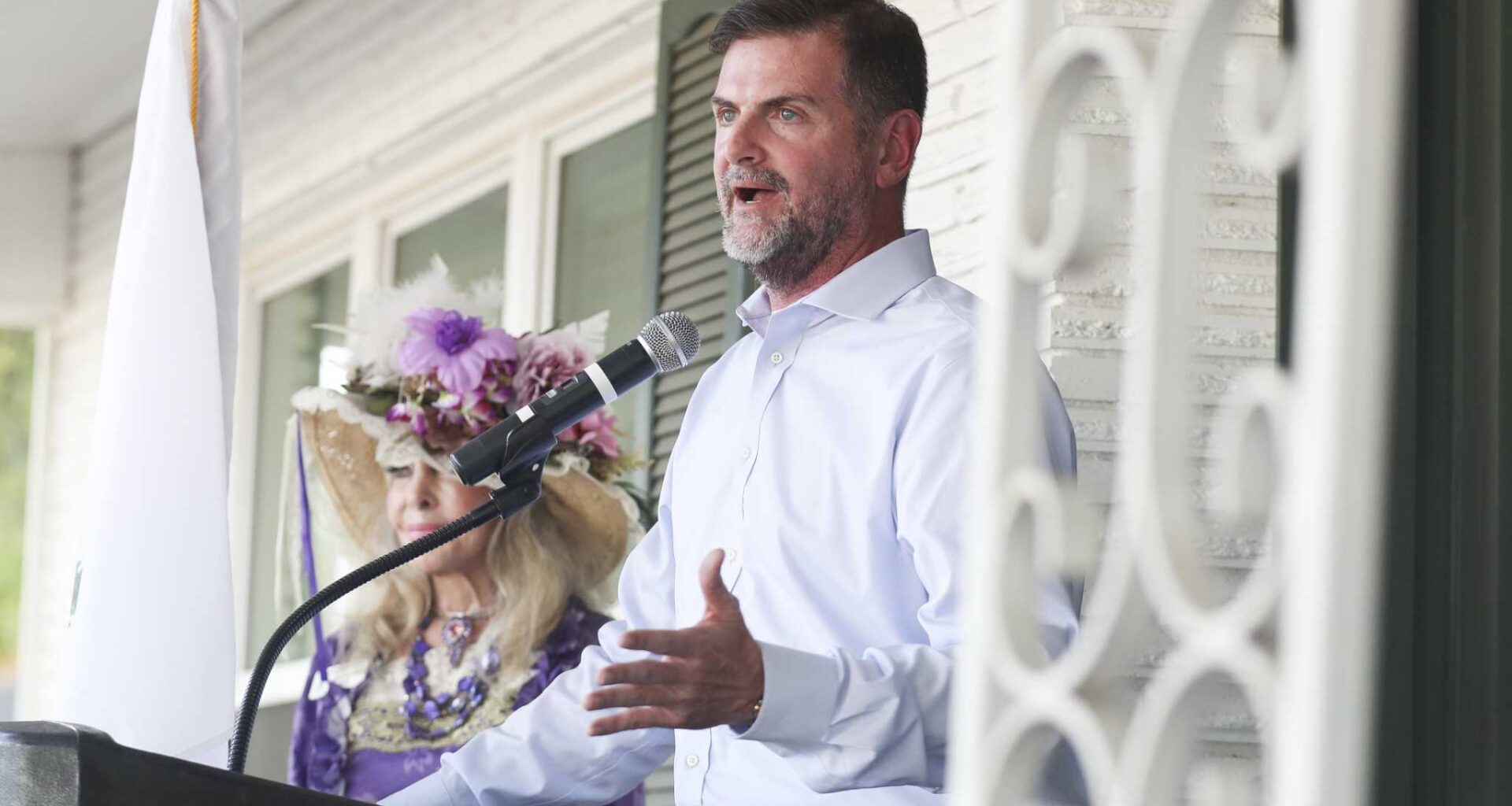
Former Texas State Sen. Brandon Creighton, shown speaking during a Founder’s Day celebration to honor city founder Isaac Conroe, Tuesday, Aug. 2, 2022, in Conroe.
Jason Fochtman, Houston Chronicle / Staff photographer
Guests and dignitaries cut the ribbon opening the new building 05/16/2022 for the newly completed Texas Tech University Health Sciences Center Physician Assistant building on Midland College campus. Tim Fischer/Reporter-Telegram
Tim Fischer/Midland Reporter-Telegram
The Texas Tech University System will end its academic programs “centered on” sexual orientation or gender identity — part of new guidelines that restrict how those topics are taught amid a push to curb what conservatives call “woke” higher education.
The rules are some of the most rigid to date as they go beyond the undergraduate level and affect how sexual orientation and gender identity are researched at the graduate level and how they are considered in faculty hiring.
The Texas A&M University System recently banned the teaching of “race or gender ideology” in its core curriculum, and the University of Texas System prohibited its schools from making students take courses on “controversial topics” to graduate. While some A&M and UT faculty have raised concerns about ambiguities in their policies, Texas Tech’s guidelines are explicit.
Article continues below this ad
HIGHER ED: We asked Texas students, faculty about the ‘indoctrination’ debate. Here’s what they said.
By June 15, the Texas Tech System’s provosts will identify specific degree programs, official tracks, majors, minors and certificates that meet the threshold of being “centered on” sexual orientation or gender identity, according to the rules.
Those programs will then freeze admissions across the Texas Tech System, which has almost 66,000 students at its three universities and two health institutions.
Meanwhile, all core and lower-level undergraduate courses will be required to remove topics of sexual orientation or gender identity from their materials. Passing references are supposed to be avoided in primary materials for core courses, but they don’t have to be redacted. Exemptions can occur in certain non-core and upper-level courses, like when they involve demographic data or biographical context, but no course can make the topics its central focus.
Article continues below this ad
Other exemptions include material required for professional licensure, certification or patient car. And on a temporary basis, the topics can be included for some graduate-level coursework required for students to complete the canceled programs.
“This work is about ensuring that every course we offer is rigorous, relevant, and directly tied to preparing students for success in a 21st-century workforce,” Texas Tech Chancellor Brandon Creighton said in a letter to the system’s presidents and provosts Thursday. “It is about reinforcing the integrity of our curriculum, strengthening public trust, and maintaining our competitiveness as institutions of higher education.”
300 courses ‘proactively modified’
Creighton — a former GOP state senator who authored legislation banning diversity, equity and inclusion in Texas higher education — said that Texas Tech was “already aligned” with its mission and doesn’t require a sweeping overhaul of its courses. The board of regents’ Academic, Clinical and Student Affairs Committee led a system-wide review of 14,000 courses this semester, and only 92 were flagged for potential violations of system guidelines. Less than 60 of those were recommended to be modified, Creighton said.
The number of modified courses is higher: Almost 300 courses were “proactively modified” before the review, and 688 courses were overreported, not applicable or modified midprocess.
Article continues below this ad
Another 324 courses were exempted for reasons related to licensure, certification or life-saving patient care, Creighton said.
“The data is clear, and the results speak for themselves,” he wrote. “They reflect a deliberate, disciplined process — not a sweeping overhaul. They demonstrate that our classrooms are already aligned with our core mission and that only a very small percentage of courses require modification.”
Current faculty members may continue to research and publish about gender and sexual orientation, though future faculty members will be recruited in alignment with the guidelines, according to the memo outlining the rules.
Students can independently research the topics or make them the center of performance pieces, but graduate theses and dissertations will not be allowed for graduate students who enroll in the future. Current graduate students in the soon-to-be-canceled programs will be able to complete their theses related to the topics, however.
‘Brazen disregard’
The Texas Tech chapter of the American Association of University Professors, a faculty advocacy organization, objected to the new guidelines on Friday. They said that the policies violate student and faculty members’ constitutional rights.
Article continues below this ad
“The policy handed down in today’s memo is shocking in its brazen disregard for our commitment to delivering a meaningful, complete, and truthful education, and finally demonstrates the true agenda: the accusations of ‘indoctrination’ were nothing but an excuse to inflict a preferred indoctrination,” chapter president Andrew Martin said in a news release.
“If this policy stands, politicians and the monied interests who support them will have effectively taken over the curriculum of our institutions in the TTU System, whose credibility will be indefinitely and irreversibly harmed,” he said. “Any thought of Texas Tech University rising to the status of membership in the prestigious American Association of Universities is now obliterated.”
Creighton said he enforced the policy to comply with state and federal law, as well as a Texas Tech system policy recognizing two biological sexes. State and federal orders recognize only two biological sexes.