
SEATTLE — This pitiful start has a precedent. Two seasons ago, the Houston Astros lost 18 of their first 25 games, creating a deficit few clubs have ever overcome to clinch a playoff spot. In doing so, it became the first team in major-league history to start 7-18 and still win a division title.
Perhaps that can provide solace to this struggling ballclub. A 6-1 loss against the Seattle Mariners on Sunday extended Houston’s losing streak to seven games. The 2019 team that won a franchise-record 107 times also had a seven-game losing streak. Any positives are accepted at times like this.
Here is another: The Astros possess baseball’s highest-scoring offense. Deploying the sport’s worst pitching staff renders that moot. Houston’s pitching staff has issued more walks (96) than its offense has scored runs (93). Playing without their ace, $95 million closer and two other starting pitchers, the Astros have the highest WHIP and ERA in the sport.
An eternity remains in the season, but concerns are plentiful. Here is a list of six, ranked from least to most concerning.
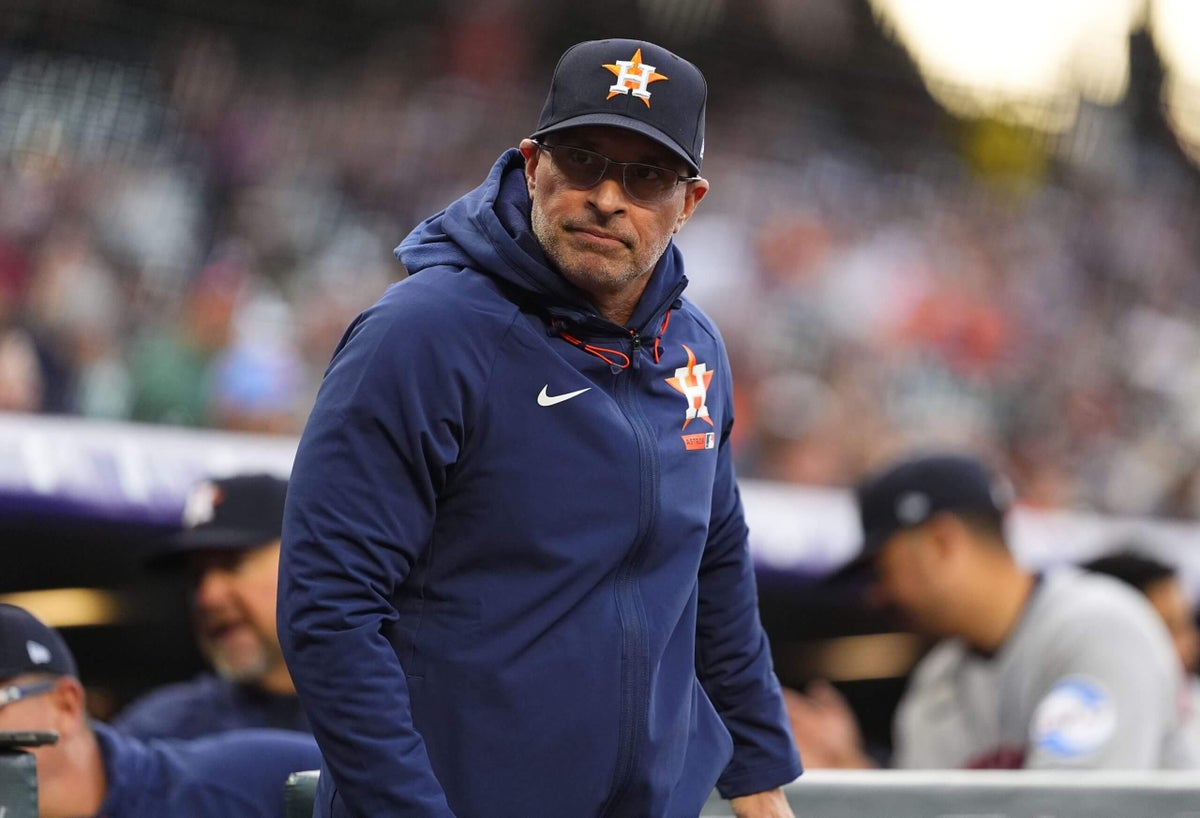
6. Joe Espada’s managing
A team’s record is a reflection of the manager, even if much of what transpires might be out of his control. Because Espada is in the final year of his contract — and owner Jim Crane refused to offer him a vote of confidence this winter — substantial scrutiny would always surround him this season. Bear in mind, too, that Crane once parted ways with a general manager weeks after winning a World Series.
Starting 6-10 is a far cry from championship contention, but it’s difficult to see what meaningful changes Espada — or any other manager — could enact to this injury-ravaged roster. The lack of length from Astros starters is magnifying every bullpen decision Espada makes. So few of Houston’s relievers are pitching well that most decisions are backfiring, even those with sound logic and process.
Jeremy Peña’s sporadic playing time after a spring-training finger fracture, coupled with brief absences from Carlos Correa and Isaac Paredes, has created some odd lineup configurations, but it’s hard to quibble with batting order construction for baseball’s highest-scoring lineup.
Things that reflect poorly on a manager — such as effort-based mistakes or general disorganization — have not appeared across the first 16 games.
Espada has maintained an almost constant state of positivity and optimism across his three-year tenure as Houston’s manager, even during that aforementioned awful start in his first season. Expecting that to change now seems misguided, even if more fire, brimstone or blunt assessments of his team’s play might satisfy some of the most frustrated fans.
5. Yainer Diaz’s disappointing start
Diaz is an outlier within an offense that has improved its approach. The free-swinging catcher entered Sunday chasing outside the strike zone 41.6 percent of the time, along with a 58.4 percent swing rate. Only six major-league hitters are seeing fewer than the 3.29 pitches per plate appearance Diaz is averaging.
As a result, Diaz is slashing .208/.250/.292 during his first 48 at-bats. His solo home run Sunday accounted for Houston’s only scoring — and was just his second extra-base hit of the season.
Diaz defines the term “bat-first catcher,” so his offensive shortcomings do get magnified. Blaming him for Houston’s pitching implosion isn’t fair, but catchers do shoulder at least some of the responsibility when a staff struggles to this extent. According to Baseball Savant, Diaz is already worth minus-1 catching runs after generating a minus-3 mark last season.
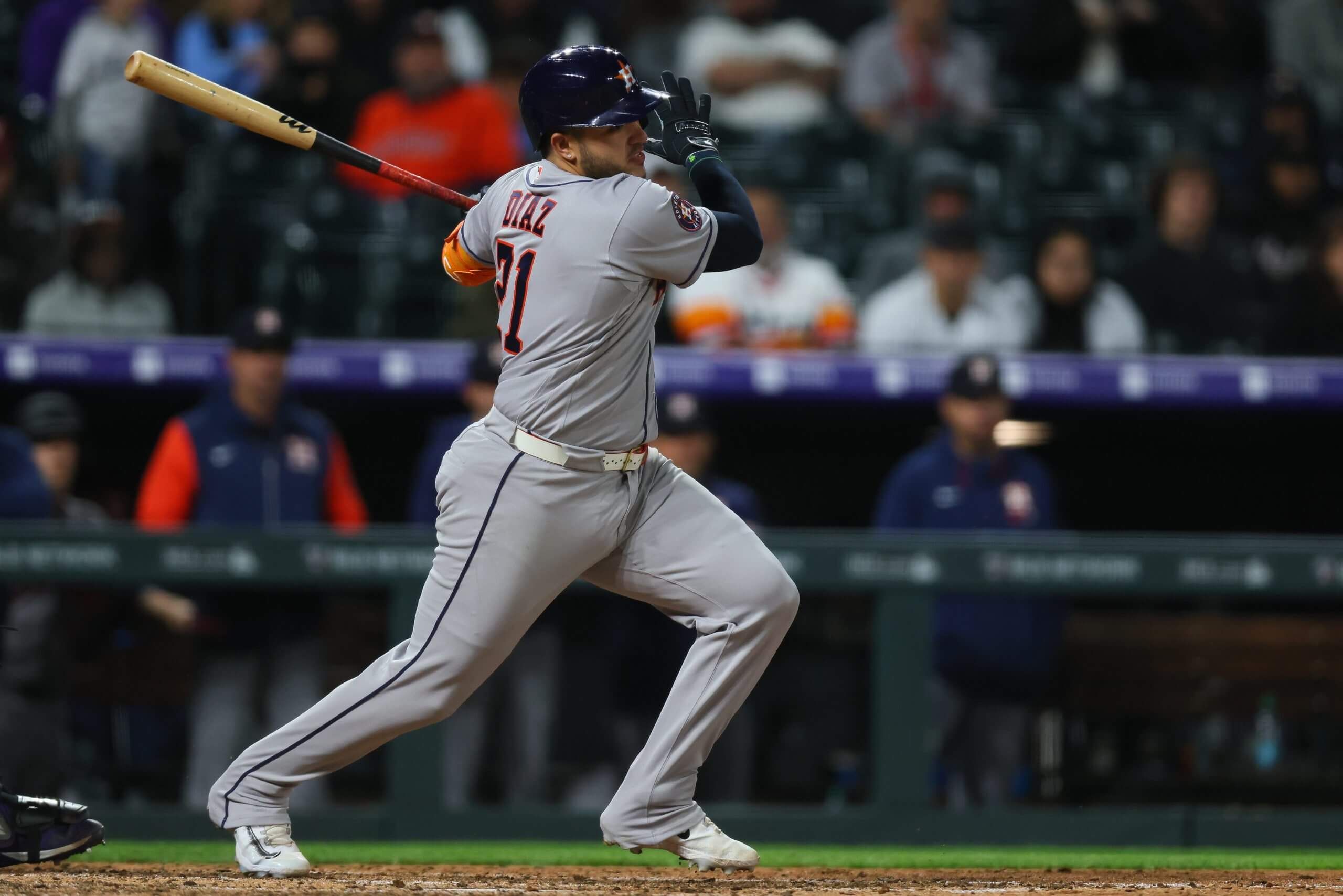
A bat-first player, Diaz posted a 93 OPS+ last season for the Astros. (Justin Edmonds / Getty Images)
His backup is 35-year-old Christian Vázquez. The calendar still says April. Both facts seem to stave off any substantial change in the playing time at catcher. Perhaps if the team believes its pitching staff could benefit from someone different, that tone would change.
As it stands, five Astros have taken more plate appearances with a runner in scoring position than Diaz, who has hit seventh, eighth or ninth in all but one game he’s played. Houston’s lineup still has the American League’s highest OPS and has scored more runs than any offense in baseball.
For the 2026 club, Diaz’s poor offensive start has not meant much. For the franchise’s long-term future at the position, though, it must at least begin to prompt some questions.
4. Bryan Abreu’s brutal beginning as closer
Abreu threw his first scoreless inning of the season Sunday — in the eighth inning of a game his team trailed by five runs. That it arrived April 12 and in such a low-leverage spot underscores how horrific Abreu’s season has started in Josh Hader’s stead.
Abreu has walked 11 batters and surrendered nine earned runs across his first five innings. Even if a renaissance arrives, the numbers are so poor that Abreu’s season-long stats might never normalize. For a player in his platform season, with dreams of securing a free-agent contract commensurate with closers, it’s a crushing development.
He’s been the least valuable pitcher on Houston’s beleaguered staff, according to FanGraphs’ and Baseball Reference’s calculations of WAR. Abreu’s fastball velocity is down more than 2 miles per hour from his career average, but team officials say Abreu is healthy and it’s a product of mechanical flaws.
Opponents are chasing outside the strike zone just 14.9 percent of the time against Abreu, who is generating a 35 percent swing rate. His career average is 45.7 percent.
Hader hasn’t even started facing hitters in his recovery from a biceps injury. Espada has already eased Abreu back from high-leverage spots, and, if the Astros can ever get into a save situation, seems content to deploy a closer-by-committee approach.
Hader’s return at full efficacy would resolve some of the issues. Even if he does, though, this is still a bullpen built around Hader and Abreu as lockdown relievers. If Abreu can’t return to that form, Hader’s getting to full health might not matter.
3. The offseason pitching additions
Throughout spring training, general manager Dana Brown boasted about his bevy of additions. He acquired six major-league arms to offset the loss of Framber Valdez in free agency and provide depth in case injuries affected the staff.
Working for an owner who has never guaranteed a pitcher more than $95 million — and with one of the sport’s most fallow farm systems — somewhat limited the pool of realistic targets in Brown’s offseason pursuit.
Even with an endless supply of money or trade capital, though, few straightforward solutions existed to weather this extent of injuries. There is no one-for-one replacement for Hunter Brown. Sure, Dylan Cease, Ranger Suárez or Freddy Peralta would’ve helped, but nothing in Crane’s past suggests any of them were actual options.
Now, focus should shift to the six pitchers Dana Brown did acquire. Only four of them are still on Houston’s 26-man roster — and that includes Tatsuya Imai, who is away from the team while being examined for “right arm fatigue.”
Roddery Muñoz resides in Triple-A Sugar Land, and Nate Pearson is still building up after an offseason elbow procedure. Pearson is the only one of the sextet to have not seen major-league action this season. The other five have combined for a 6.56 ERA across 48 innings, prompting early questions about evaluations by a general manager, who, like Espada, is in the last year of his contract.
2. Injuries
This winter, Houston hired a new strength and conditioning coach, a new director of sports medicine and performance and a new assistant athletic trainer. On numerous occasions, Dana Brown lauded the “deep dive” his front office took into the team’s maligned return-to-play procedure. Injuries are no longer described as “discomfort,” either.
There is no proof any of this has helped.
The Astros’ injury issues remain almost inexplicable and are threatening to torpedo their season before June. In the past seven days alone, three members of the Astros’ season-opening starting rotation traveled back to Houston for evaluation by team doctors. Two of them, Hunter Brown and Cristian Javier, reside on the injured list with no timetable for a return.
Cody Bolton, who took Brown’s place in the rotation, faced nine batters Sunday before an athletic trainer arrived at the mound. Bolton departed with what the Astros described as mid-back tightness. Jayden Murray relieved him — and became the 17th pitcher to appear in a game this season. Entering Sunday, only the Toronto Blue Jays had deployed more.
Toronto is perhaps the only club that can commiserate with the Astros. Both teams are a shell of their spring training selves, decimated by injuries to pivotal players they’re struggling to replace. The Blue Jays are 6-9. Houston is 6-10.
1. Organizational depth
Few franchises in the sport have enough depth to overcome such constant attrition, but fewer feel more ill-equipped to handle it than the Astros. Their farm system remains devoid of impact talent at the upper levels. They have zero top 100 prospects on any outside publication’s rankings.
Shay Whitcomb, who goes unused when he is summoned to the major leagues, is Houston’s only healthy position player on the 40-man roster. Houston’s top prospect, Brice Matthews, has struck out 12 times in 22 at-bats as part of an outfield platoon. Matthews was drafted as an infielder.
None of this is news to team officials or rival evaluators, all of whom have reiterated that the Astros’ success hinges on good health and their established players’ performing to career standards. When it doesn’t happen, disaster can ensue.
These 16 games are proof of it.