
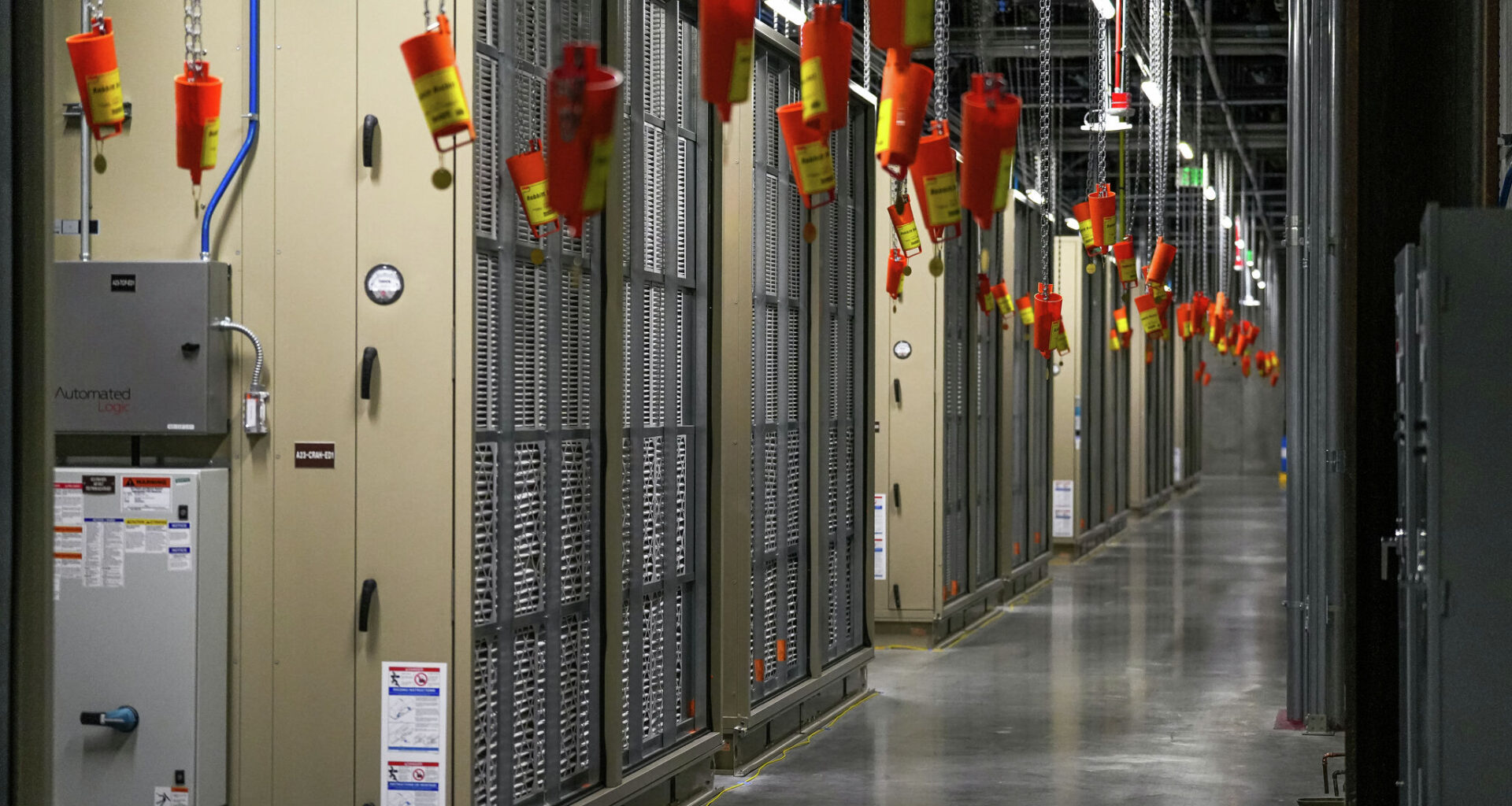
Large air conditioners push cool air into server rooms at the Sabey Data Center in Round Rock, Texas on Monday, Aug. 11, 2025. Residents in rural counties across Texas are pushing back against new data center developments, worried about a ‘big tech invasion.’
Austin American-Statesman/Hearst/The Austin American-Statesman vi
As data centers push into rural counties across Texas, residents are rallying around a message that feels Texan to its core: protect our land, protect our neighbors and don’t let outsiders dictate the future of our communities.

Texas is primed to become the world’s largest market for data centers by 2030. There are 411 documented data centers in Texas, according to Data Center Map, and that boom is far from slowing. In some counties, the rapid growth feels less like an opportunity and more like a threat to the places they call home.
Article continues below this ad
To many, the fight is personal. It’s about family land held for generations, quiet roads and open pasture, and the fear that the next wave of development could change the communities they’ve built faster than they can stop it.
Dozens of grassroots groups have formed across the state. Among them is Grimes County Citizens for Responsible Development, of which Marie Egyed is a founder.
“This really is an amazing story of David and Goliath and the grassroots movement,” Egyed told Chron on Monday. “We are truly being invaded by big tech.”
Egyed said she supports Texas leading the “the AI race.” However, small, rural communities are being asked to absorb the devastating costs of overdevelopment without enough say in what comes next.
Article continues below this ad
“I’m fighting to preserve our way of life, our dream…and our rural lifestyle,” Eyged said.
The Grimes County Citizens for Responsible Development hosted its first community meeting at the Iola Community Center in March. Co-founder Marie Egyed said roughly 300 people attended.
Google Maps Street View
For rural Texans, data centers threaten land, water and livelihoods
In Leon County, a 16,000-person county between Houston and Dallas, residents have been fighting for months against a 900-acre 1,500-megawatt data center—an industrial-scale project that would draw enough power to supply about 375,000 homes.
Article continues below this ad
Standing with them is Daniel McCoslin, a self-defined grassroots conservationist and founder of Citizens for Responsible Growth in Leon County. He said his family has lived on Leon County land for ten generations.
“Not only is it going to destroy a way of life that we’ve built for generations, it’s going to destroy agriculture, livestock and wildlife. There’s 11 endangered species…in Leon County,” McCoslin said of the proposed Kahla data center. “People are concerned.”
McCoslin has spoken with doctors, fire marshals and even data center insiders, and the concerns are broad: animal agriculture, health risks, light pollution and fire safety.
“We don’t want this here,” McCoslin said of the Kahla project. “It’s a lot of pollution…it’s going to affect our way of life. It’s going to affect my ability to make money.”
Article continues below this ad
Down in Grimes County, residents are bracing for another major project that could transform roughly 800 acres into a solar farm, natural gas facility and large-scale data center, as reported by KBTX 3. For many locals, the biggest fears are similar: water, power and fire.
“We were so dry out here…we were losing 100-year-old oak trees because we didn’t have enough water to keep them alive and they’re (planning on) building things out here that (are) going to take even more water,” Egyed said.
Even smaller projects can leave a mark. In Brazoria County, local officials say nearby residents have complained about round-the-clock noise from a 6-acre data center.
“It’s about washing machine noise level, but it’s 24 hours a day,” Brazoria Mayor Philip Ray said of one resident’s complaint, adding that the company, Giga Energy, is actively working to address the issue.
Article continues below this ad
Texans welcome tech—but not unchecked growth
Across Texas, residents say they are not opposing growth or technology itself—they are pushing back on what they see as unchecked expansion, limited transparency and too few protections for the people already living nearby.
“It makes sense to do our part as a country,” Egyed said. “That’s responsible, if everybody just does a little bit, rather than these companies coming and completely annihilating some of these counties.”
Article continues below this ad
McCoslin put it more simply: “People are like, ‘Oh, you just don’t want technology.’ No. We just want responsible technology.”
There appears to be broad agreement that local jurisdictions have too little say—or even notice—when these projects move in. Rep. Cody Vasut, who represents Brazoria County in the Texas House, said counties have little authority over zoning, noise or light, and that lawmakers largely agree that more local control is needed.
In typical Texas fashion, the debate is how to balance stronger oversight with private property rights.
“He’s trying to…figure out how to word (the bill) so we can regulate (data centers) and not regulate the rest of the world,” Ray said of Vasut. “The last thing we want is somebody to tell us what we can and can’t do with our property.”
Article continues below this ad
Rep. Cody Vasut, R-Angleton, speaks with fellow lawmakers in the House Chamber at the Capitol in Austin, Tuesday, Sept. 2, 2025. Vasut said lawmakers have largely agreed more local control is needed over data center developments statewide.
Austin American-Statesman/Hearst/The Austin American-Statesman vi
As local control falls short, residents look for ways to fight back
While local governments often say they have limited power to stop large data center projects, citizen groups point to a few ways counties can still push back—or at least slow things down.
Both Egyed and McCoslin pointed to Van Zandt County, where officials approved an indefinite moratorium on green energy projects while the Texas attorney general reviews their impacts, as reported by KLTV 7. For residents in other counties, the move offered a model.
Article continues below this ad
“There’s precedent now,” Egyed said.
Even without a moratorium, McCoslin said counties still have leverage—especially when it comes to tax incentives.
“One of the biggest tools we have is to not grant a tax abatement,” McCoslin said.
Article continues below this ad
At its core, residents like Egyed and McCoslin say their fight comes down to something simple.
“I’m also fighting for common sense,” Egyed said. “It is so surreal that somebody in charge somewhere thinks that this is okay.”