
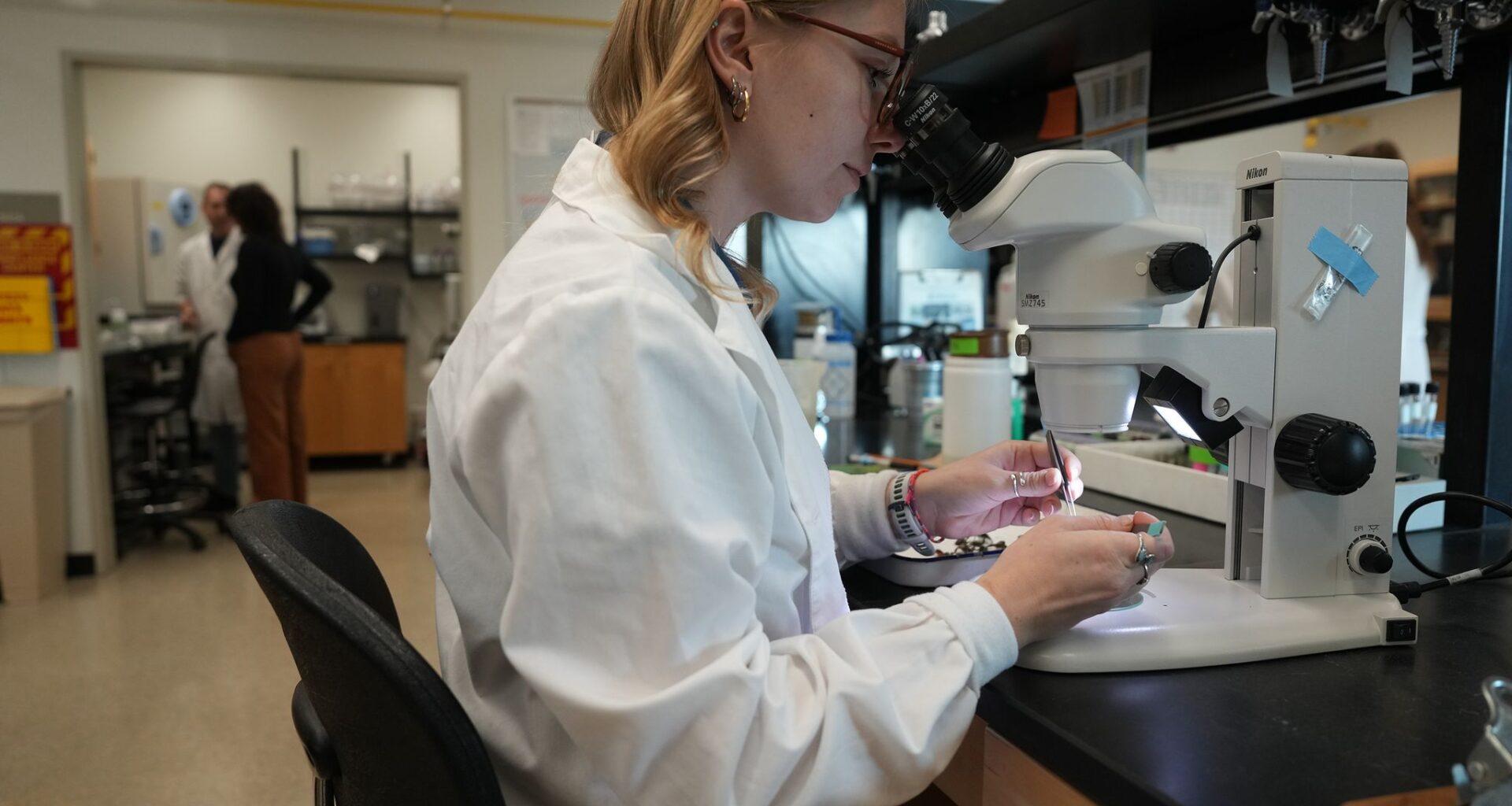
McKenna Reinsch, a master’s student, looks at specimens that were found with oysters, under a microscope at Texas A&M University’s Harte Research Institute in Corpus Christi on Monday, Dec. 15, 2025.
Elizabeth Conley/Houston Chronicle
For decades, Texas oysters have remained popular offerings in restaurants and seafood markets. But scientists and state officials have grown concerned about threats to oyster reefs along the Gulf Coast.
What — or who — should take the blame for the flailing health of Texas oyster reefs is hotly debated, as is the extent of the damage. But one thing the state, oyster fishers, environmental groups, recreational anglers and researchers all agree on is their desire to see a thriving population of the vital mollusks, which drive profitable fisheries, purify water, capture carbon, protect shorelines and form the foundation of reef ecosystems.
Texas is trying a slew of initiatives to save its oyster population. Here’s what to know about the efforts — and whether they’re working:
Article continues below this ad
Texas will lease pieces of its sea floor for new oyster reef cultivation
This past fall, the Texas Parks and Wildlife Department launched a lease program for portions of the shoreline that currently have no oyster reefs or degraded reefs.
The agency received 152 applications from both oyster fishing operations and conservation groups proposing to renew the coast’s oyster reefs in spots that they will cultivate and care for throughout their 15-year leases.
Any new deals it grants, known as “certificates of location,” will be the state’s first oyster leases in decades.
Article continues below this ad
The state bought back over 20% of oyster boat licenses this year
For years, the Texas Parks and Wildlife Department offered to buy back the fishing licenses held by individual oyster boats in the state in order to reduce fishing pressure on publicly accessible wild reefs, but found little success.
In 2025, the agency changed its tack. Instead of a complex bidding process, the state offered a fixed buyback price of $30,000 per license, paying with a combination of public money and philanthropic support. It will be accepting applications again this spring until May 15.
The buyback effort, called the S. Reed Morian program, obtained 112 of Texas’ 545 commercial oyster fishing boat licenses in a single cycle last year, reducing pressure on Texas oysters.
Public and private push to farm oysters
In 2019, Texas became one of the last coastal states to pass legislation allowing for a commercial oyster farming system.
Article continues below this ad
The industry has recently gained more traction, with proponents suggesting that growing oysters in mesh cages suspended in the water column will increase the number of mollusks Texans can harvest without dredging public reefs.
There are only about a dozen fully permitted oyster farms in Texas waters so far. Proponents are pushing to increase their prevalence, though the practice does have skeptics in the industry who claim the practice is too expensive and risky.
Major reef restoration projects involve new partners: funders, fishers
A renewed push to restore degraded reefs in Texas’ public bays has led to unusual partnerships.
Groups like the Nature Conservancy and the Galveston Bay Foundation have been restoring oyster reefs for years. But their work has been increasingly conducted in collaboration with other entities – for instance, the Nature Conservancy is now working with the major local fisher and processor Prestige Oysters on restoration reefs that are partially self-policing and partially harvestable.
Article continues below this ad
Other newcomers to the scene, including the recently launched Coastal Preservation & Restoration nonprofit, argue that reef restoration still needs to expand exponentially to preserve a future for Texas oysters. CPR plans to pull in significant new private capital to scale up reef restoration along the coast.
Legislative push takes an all-fronts approach
Multiple new bills that Gov. Abbott signed into law in 2025 aim to increase the sustainability of Texas oysters.
The laws include granular efforts like giving restaurants tax incentives to recycle shells. But the measures are just the latest installment in a series of moves by the Legislature that aim to turn the tide for oysters.
The state’s focus on oyster reefs really supercharged in 2017 when the legislature passed a suite of more punitive rules, including making penalties for unlawful oyster harvesting much stricter. The same push triggered programs that are still being built out to this day, like the license-buyback program taking oyster boats off the water.
Article continues below this ad
State works with fishers to balance unintended consequences
For several years, the Texas Parks and Wildlife Department closed the vast majority of public oyster zones to fishers after their testing showed the reefs did not have enough mature oysters to sustainably fish. But this had unintended consequences, pushing fishers onto the relatively few reefs that remained open.
The state has since made efforts to change the dynamic, even opening some harvesting areas where sampling did not decisively show enough market-sized oysters so that the state’s oyster fishing boats would be more spread out and put less pressure on specific reefs.
The state now also tests throughout the season that ends April 30, opening and closing areas in response to real-time data.