
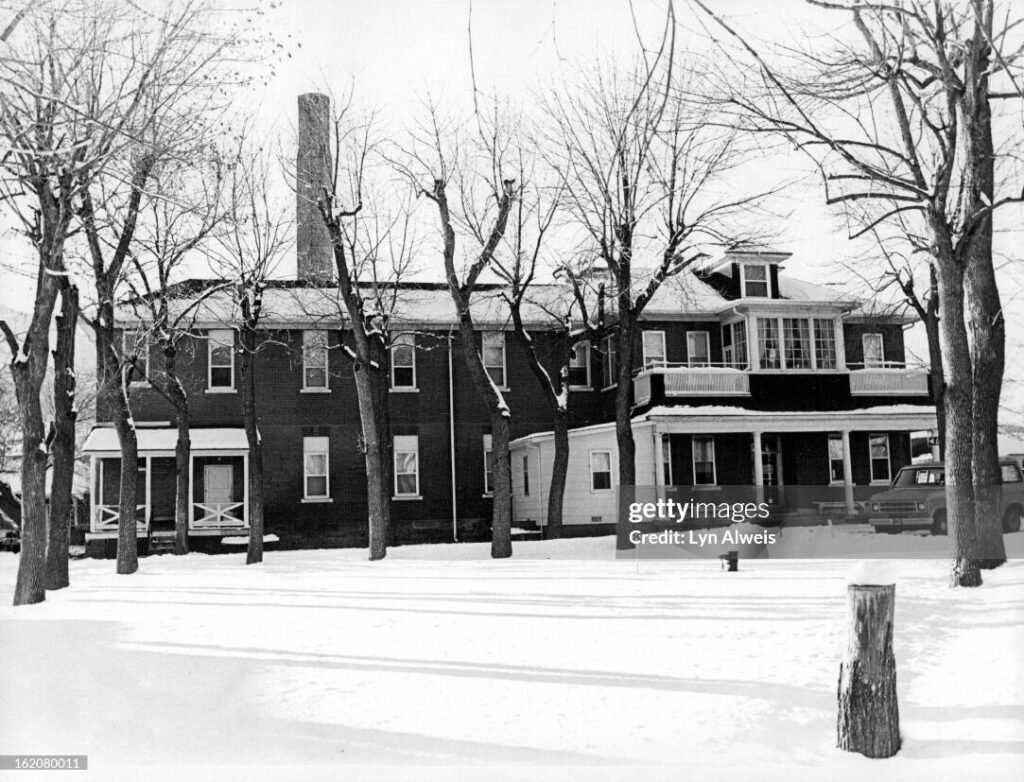
Since 2017 the Colorado Springs Pioneers Museum has told the area’s history with an interactive alphabetical “Story of Us.” “P” stood for the Poor Farm in the exhibit.
Fittingly, the Poor Farm had been here since the beginning of the city. In 1880 the county commissioners chose a cottage on El Paso Street for a site where the poor could get help with health issues. That location was expanded first in 1881 and then grew to seven rooms in two stories in 1886, expanding right along with the new city’s growing population.
Then came even bigger plans, though residents weren’t happy with a plan to demolish the first site for a larger “County Home” in their neighborhood.
In 1899, the El Paso County commissioners capitulated, moving the home to the 525-acre Leibig Ranch, far outside downtown near Bear Creek. In January 1900, the home and hospital had opened but burned down during the night. No one was injured.
By October 1900, county commissioners had replaced it with a $25,000 El Paso County Poor Farm — assured as “fireproof.”
The museum exhibit says “poor farms were types of ‘poor houses,’ a system borrowed from the British and used widely in eighteenth and nineteenth century America. Poor farms were taxpayer supported institutions that offered indebted people a period of ‘relief.’”
In this area, “residents struggling financially could request relief directly from an El Paso County Commissioner, who could decide whether or not to give them short-term relief funds. If their need was thought to be long-term, the Commissioner could recommend their placement in the Poor Farm. At times, judges sentenced petty thieves to short stints at the Poor Farm, but the El Paso County Poor Farm never operated as a ‘Debtor’s Prison.’”
The “farm” in the name was chosen by commissioners with plans that the facility not be a heavy load on taxpayers. As an actual farm operation it was intended to be self-sufficient. In addition, it would require the poor to help pay their own way as possible. “Residents worked in a variety of areas on the farm, including: planting, weeding, harvesting, watering, cleaning, milking, washing and cooking. To oversee the operations at the farm, a Superintendent, Matron and Farm Manager were hired.”
The Old Colorado City Historical Society recorded that the farm grew over time with “a dairy farm, pigs, alfalfa, chickens, a reservoir, flood ditches, nurses quarters, and many other constructed buildings. The buildings included all the housing for the animals, tuberculosis huts and a “pest house,’ where smallpox patients lived. If you could imagine today, the main home of the Poor Farm was just North of where the Bear Creek Community garden is now. The hospital stood where the current Parks and Rec office is,now.”
According to the Pioneers Museum, as decades went along, the system of care for the elderly, poor and ill changed with the addition of pensions, Social Security (1935), Medicare and Medicaid (1965), nonprofits and private companies. “No longer deemed necessary, poor farms began to close. When the El Paso County Poor Farm ceased operations in 1984, it was one of the last institutions of its kind in the country.”
Old Colorado City Historical Society historians said, “In 1972, after much community debate, the farm was given over to the El Paso Parks & Rec. Developers wanted to build homes and the citizens wanted it to be a park for the community. In 1984, county commissioners decided to tear all the buildings down — despite efforts of history preservers who tried to save the historic buildings just as Manitou and Old Colorado City did. It didn’t stick and by 1985, the buildings were demolished and all debris cleared out.”
When 21st Street at Gold Camp Road was being widened in the late 1950s, remains of a little cemetery were discovered at the top of the hill. Early records weren’t available from the Poor Farm years, with many destroyed in that early fire. However, deaths had been a possibility because the farm had housed many of those suffering from tuberculosis and smallpox as well as the elderly and the indigent.
A pauper’s cemetery topping the hill above Bear Creek Dog Park with seven graves was recently renovated with a new black iron fence and beside the gravestones of the unidentified are memorial flowers and stuffed animals.
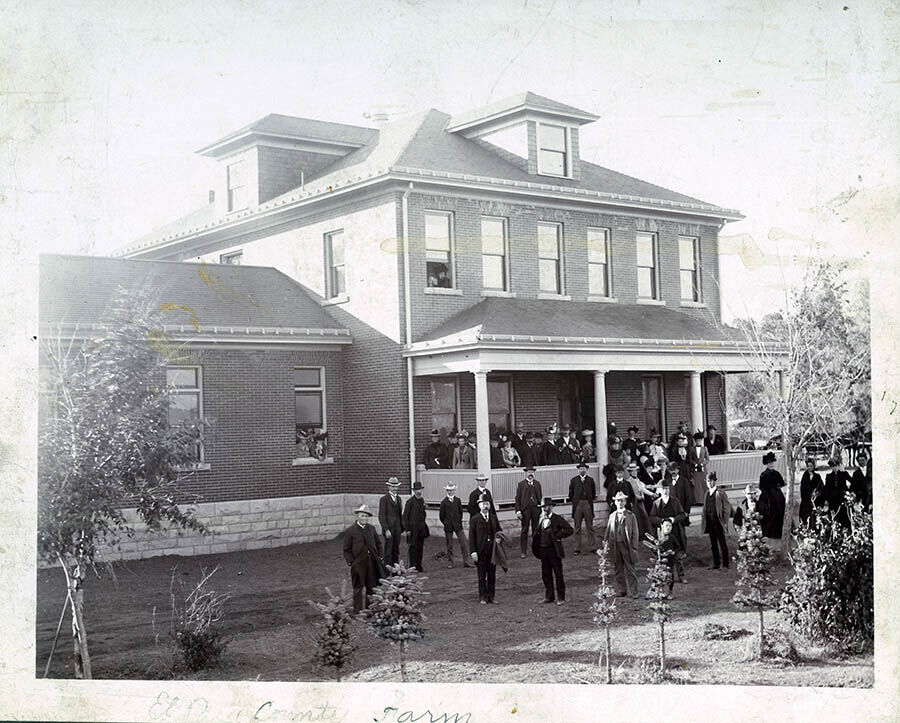 1900 opening of El Paso County Poor Farm at Bear Creek. Photo: Colorado Springs Pioneers Museum
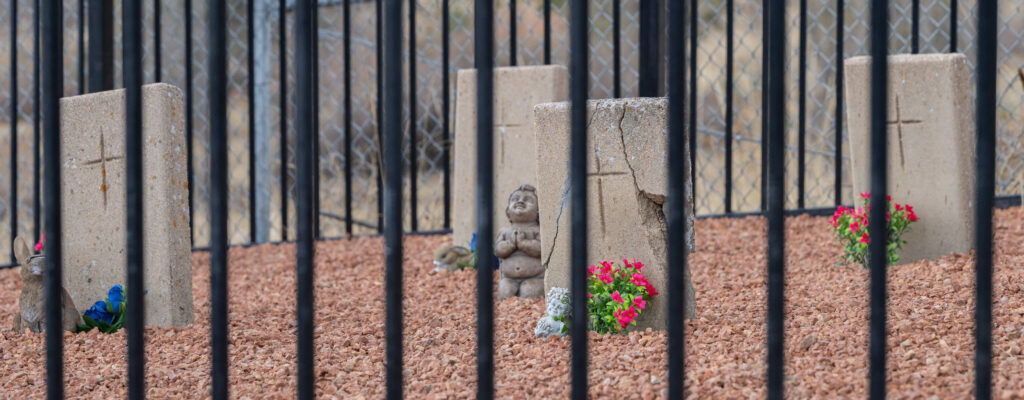 El Paso County Poor Farm Paupers Cemetery for unidentified people at 21st Street and Gold Camp Road. Christian Murdock, The Gazette