
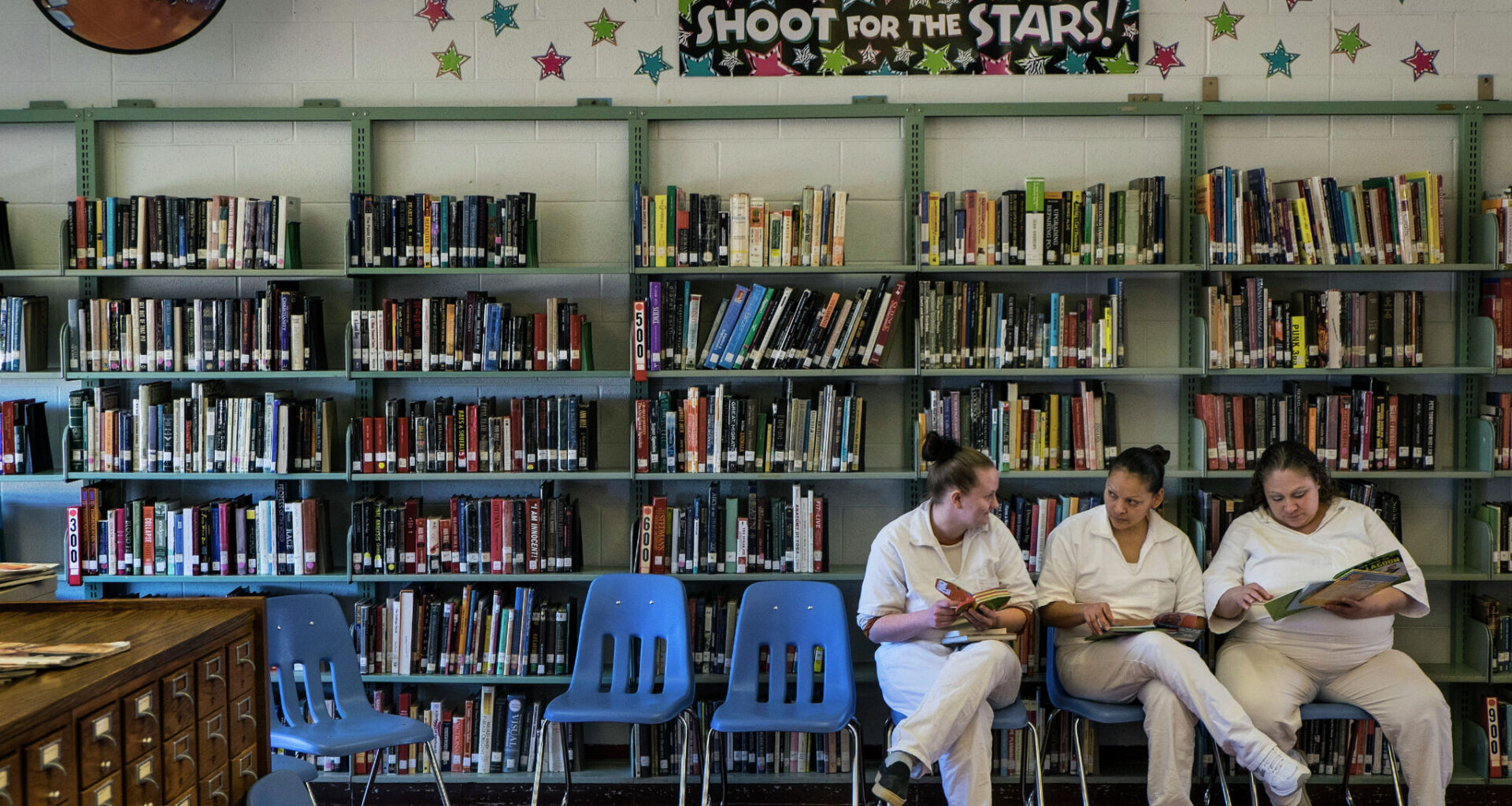
Inmates Heather de la Cruz, Lupita Acuna, and Paula Lopez, left to right, wait to record the books they picked out to read to their children for the Women’s Storybook Project at the Mountain View Unit in Gatesville, Texas, on February 14, 2015. The Women’s Storybook Project of Texas which began in 2003 allows women inmates to record their voice reading books that are then mailed to their children.
Rodolfo Gonzalez/Austin American-Statesman
A new rule barring Texas prisoners from receiving hardcover or many used books in the mail is making it costlier and more difficult to send reading material to inmates, according to advocacy groups.

This month, the Texas Department of Criminal Justice put into effect a policy that inmates may only receive softcover books in “new or like new” condition, meaning they are free of “tears or stains.”
Article continues below this ad
The agency says the change is driven by a rise in drug smuggling. Officers have discovered synthetic drugs hidden in book bindings and pages soaked with narcotics, TDCJ spokesperson Amanda Hernandez said.
“In 2025 alone, we discovered 385 books that contained narcotics in our mailrooms, and this is just what staff were able to detect,” Hernandez told Hearst Newspapers in an email.
A Wichita Falls woman was recently sentenced to six years in prison for hiding synthetic marijuana, or K2, and other drugs in Bibles, magazines, newspapers and legal mail sent to inmates at the Allred Unit, per a Thursday news release from TDCJ.
The Inside Books Project, a nonprofit founded in 1998 that sends about 30,000 free books to Texas prisons each year, says the changes will severely limit its ability to continue its work. The group relies largely on donated, used books, and about half of its budget goes to postage, coordinator Scott Odierno said.
Article continues below this ad
Most inmates still have access to thousands of physical books in libraries and law libraries within each facility, and digital books through a prison technology firm that contracts with the state. But prisoners in solitary confinement are not allowed into the libraries, meaning requesting mailed reading materials is one of the only ways they can obtain books.
“We’re essentially a lifeline to a lot of people,” Odierno said. “We get letters from people every week that are telling us that they would basically go crazy if they didn’t have (us).”
Odierno said the group screens every book twice before mailing and “never had a problem with contraband” in its nearly three decades of operation. It has one paid staff member and does not receive federal or state grants, raising money solely through donations from the public and online book sales.
Books with narcotics “are being sent by individuals, they’re not being sent by book projects,” he said, adding that TDCJ hadn’t presented him with more detailed data on how prevalent literary drug-smuggling is.
Article continues below this ad
Inmate Lacy Jorgensen, 28, reads a book in her bunk on Wednesday, October 25, 2017 at Burnet County Jail in Burnet, Texas. The jail has had one of the largest increases in female population in the state.
Ashley Landis/Dallas Morning News
Inmates often request trade books or textbooks to help them learn job skills, and many of them are not available in softcover.
“We’ve already had to take about 3,000 hardcover books out of our circulation and thousands of softcover books,” Odierno said.
Under the new rules, all donated books will be routed through the Windham Library Services Department in Huntsville before reaching prisoners. TDCJ is also developing an online portal where senders must register and provide details about each book or magazine.
Article continues below this ad
TDCJ Executive Director Bobby Lumpkin described the changes as “vital to keeping our staff and the inmate population safe.”
The Inside Books Project noted that agency staff are often responsible for drug smuggling. Texas Inspector General Lance Coleman reported 201 contraband-related arrests in Texas prisons last year, including 56 involving employees, during a Feb. 26 Texas Board of Criminal Justice meeting. His office has uncovered large-scale mail-based drug operations, including one sting that seized more than 1,500 grams of synthetic material and another that yielded $375,000 in cash and packaging equipment.
A detainee reads in his bunk in the Male Pod at the South Texas Detention Center in Pearsall, TX., Thursday, March 16, 2006. The facility is operated by the Immigration and Customs Enforcement branch of the Department of Homeland Security.
J. MICHAEL SHORT/AP
Texas Board of Criminal Justice Chair Eric Nichols acknowledged the tension between access and safety.
Article continues below this ad
“It truly pains me to think that we are being forced as a Board to put any restrictions on the ability of members of our populations in TDCJ to any type of reading material,” Nichols said in a Feb. 20 news release. “But what pains me even more … is the fact that there are illegal and dangerous drugs that are being introduced into our TDCJ facilities and that are causing overdoses and, yes, overdose deaths in our facilities.”
Overdoses accounted for about 2% of deaths over the past two decades, compared with 11% from suicide, 13% from homicide and 65% from natural causes, according to a Texas Justice Initiative analysis of state data. Almost twice as many prisoners have died “accidental” deaths than have died of alcohol or drug intoxication, per the data.
Since 2005, more than 15,000 people have died in Texas state prisons.
Article continues below this ad
The new restrictions add to existing prohibitions on reading material for incarcerated people in the Lone Star State. More than 10,000 books are banned in Texas prisons, from maps that could aid an escape to graphic novels depicting nudity or violence. One of them is “The Color Purple” by Alice Walker, which describes sexual abuse of a minor.
READ MORE: Most Texas prisoners live without AC. A landmark trial could change that.