
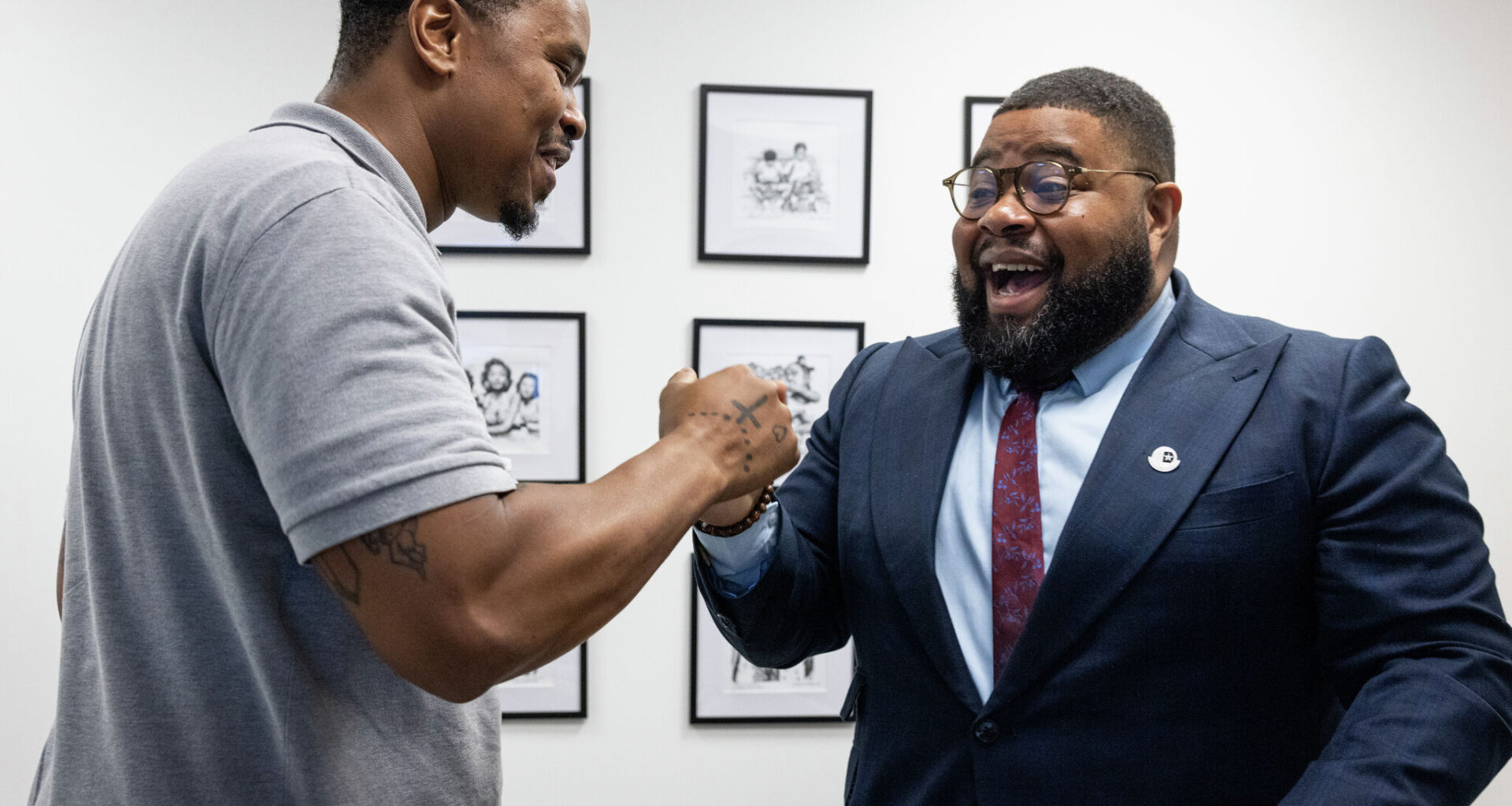
Harrison Blair, president and chief executive of the Dallas Black Chamber of Commerce, greeted local artist Lakeem Wilson in front of his “Life in Black Ink” series on Feb. 13 in Dallas. Wilson’s work is part of the chamber’s art collection.
Angela Piazza/Staff Photographer
This story is part of our focus on solutions put forward to tackle big and small social problems in our communities. Our evidence-based reporting explores what is being done in North Texas and looks for examples set by people doing it better elsewhere.
On a recent afternoon, Harrison Blair ambled through the Dallas Black Chamber of Commerce, gazing at the art adorning the office’s walls.

In a painting hung in the foyer, a young boy held wads of cash against his ears. A message, “money can’t buy motivation …” hovered over the boy’s head.
Article continues below this ad
“That speaks to who we are as a chamber,” said Blair, the organization’s chief executive, gesturing to the piece by South Dallas artist Lakeem Wilson. “It’s not always about revenue only. It’s about the impact that you’re making.”
Since 2023, the South Dallas chamber has acquired about 20 artworks from mostly Black American artists with ties to the area. Most of the works are on view in the chamber’s offices in Vista Bank on Martin Luther King Jr. Boulevard.
Blair was inspired to build the collection after seeing art at the downtown Dallas JPMorgan Chase corporate office and Dallas nonprofit The Stewpot, where people experiencing homelessness sold their work.
This piece by Dallas artist Jennifer Monet Cowley is part of the Dallas Black Chamber of Commerce’s collection.
Angela Piazza/Staff Photographer
The idea turned into action toward the end of 2023, when Blair encountered the work of Oak Cliff resident Frank Frazier and members of his artist collective, including Wilson, at the annual Congressional Black Caucus gathering in Washington, D.C.
Article continues below this ad
Make Dallas News a preferred source so your search results prioritize writing by actual people, not AI.
Add Preferred Source
“We scrambled to get as many of the pieces as the chamber’s budget would allow us at the time,” Blair said. Since then, the organization has paid about $30,000 in total for its pieces.
The chamber’s work involves promoting financial literacy and providing access to grants and contracts. But part of its 100-year longevity, according to Blair, is a flexible approach to serving the needs of the community. “Art was a new place for us to sink our teeth in,” Blair said, noting that artists are also business leaders.
Nationwide, a growing number of chambers of commerce have partnered with arts agencies to advance economic development efforts, according to Randy Cohen, vice president of research at Americans for the Arts, an advocacy organization.
Article continues below this ad
Harrison Blair, chief executive of the Dallas Black Chamber of Commerce, explains a piece by Don O’Bannon in the chamber’s art collection.
Angela Piazza/Staff Photographer
In New Orleans, a chamber of commerce recently held an after-hours event at a jazz museum. And the West Dallas Chamber of Commerce hosted an art walk where visitors perused open studios and saw live mural painting in the Tin District.
Referencing the Dallas Black Chamber’s ambitions, Cohen said, “I never really heard of a gallery type of opportunity.”
At a time when art spaces are grappling with rising overhead costs that have caused some to shutter and others to relocate or adjust their business models, the chamber’s private collection could emerge as an alternative public art space.
Article continues below this ad
Private art collections are not new to Dallas. There have been buzzy ones like the Karpidas Collection in the Design District and the Power Station in Exposition Park. But the chamber appears uniquely anchored to southern Dallas, considering its representation of artists.
The Forest Theater is featured in artist Lakeem Wilson’s “Life in Black Ink” series, with a copy hanging on the wall at the Dallas Black Chamber of Commerce office in Dallas.
Angela Piazza/Staff Photographer
The collection, still in its early stages, is not intended as a replacement for a gallery or a museum. But, through its venture, the chamber has shown a way to expand public access to art using an existing space.
So far, the relationship between the artists and the chamber has been mutually beneficial. The art beautifies the chamber’s space and serves as a visual extension of its brand, Blair said. In turn, artists in the collection said having their work purchased lends them a stamp of legitimacy.
Article continues below this ad
Private art for a public space
Local gallerist Daisha Board advises the chamber on its art purchases. She presides over a namesake gallery focused on representing artists of color that relocated from the Tin District last year to a smaller space in Oak Cliff. Art curated by her gallery now hangs on the walls of Ateliê, a restaurant in that neighborhood, and is available for purchase there.
“The market has definitely contracted,” Board said, noting that she lost corporate contracts before her move, a loss that she attributed to the political moment.
Local gallerist Daisha Board, seen here at Daisha Board Gallery in November 2021, advises the Dallas Black Chamber of Commerce on its art purchases.
Nan Coulter
President Donald Trump’s administration has slashed federal funding for diversity, equity and inclusion initiatives and threatened to investigate corporations in the private sector that promoted such programs.
Article continues below this ad
Board also had to deal with steep tariffs, which made shipping and logistics more costly. “The risk is always on the small business or the gallery that carries the brunt of the load for investing in these artists,” she said.
In contrast, she said, the Dallas Black Chamber is largely shielded from the perennial concern that gallery owners have around profit margins for the art on display.
Economic salve for artist and collector
The chamber buys directly from each artist. It’s a transaction that Oak Cliff painter Don O’Bannon says is particularly attractive. When galleries have brokered his sales, he said, their cut can range from 40% to 50% of the buying price.
Article continues below this ad
A black shoe polish piece done by Dallas artist Frank Frazier hangs in the Dallas Black Chamber of Commerce’s conference room.
Angela Piazza/Staff Photographer
Gallery representation is an ideal scenario for artists who may prefer to outsource business negotiations. But for Wilson, who has several works owned by the chamber, a direct transaction helps him connect with collectors, who can be recurring clients. “There’s no middleman,” he said.
The visibility can serve as a catalyst toward other opportunities and as a résumé builder, said Jennifer Benoit-Bryan, director of SMU DataArts, an arts research center.
Although the chamber is paying for the pieces, the collection could be an economic stimulant for it, as well. The art around the office has made it not just a place for business and meetings, but a place to linger a bit longer, Blair said. If visitors like the atmosphere, they may have more of an incentive to renew their paid memberships or become members.
Article continues below this ad
A private collection of this nature is a strategic asset, according to Barbara Chamberlain, a lecturer in Johns Hopkins University’s museum studies program. “It’s a face they show their clients and customers, so customers can say, ‘Yes, this business understands me and my priority,’” she said.
Artist Lakeem Wilson worked on a piece in his home studio on Feb. 18 in Dallas. Wilson estimates he’s made about $3,500 from the Dallas Black Chamber of Commerce purchasing his work, which he described as a “significant amount.”
Angela Piazza/Staff Photographer
Looking ahead
It’s unclear what kind of dent the chamber’s private collection will make in South Dallas’ art scene. It’s currently accessible to the organization’s 900 members, who must pass through security to view the artwork. Blair said visitors have seen it as well when they’ve come for meetings and other events.
Article continues below this ad
Blair aims to spread the word about the art through social media and to one day allow people to buy the art on display. He also hopes to welcome more local artists into the space and expand to mediums like spoken word and the performing arts.
Still, there is a limit to the chamber’s wall space and budget. Lakeem Wilson estimates he made about $3,500 from the chamber purchasing his work, which he described as a “significant amount.” But he said it’s not “every month they’re buying a new piece that’s paying a bill.”
Blair, as chief executive, must be mindful of the chamber’s budget, and the board has to approve art purchases.

By signing up, you agree to our Terms Of Use and acknowledge that your information will be used as described in our Privacy Policy.
“We’re not making huge investments,” he said. “We just wanted to get our feet wet and learn.”
Article continues below this ad
Staff editor Tim Diovanni contributed to this story.
Did you know that what you just read was a solutions journalism story, supported by the Solutions Journalism Network? It didn’t just examine a problem; it scrutinized a response. By presenting evidence of who is making progress, we remove any excuse that a problem is intractable.