
East Texas leaders, state officials form water advisory board to protect region’s resources
Published 5:44 am Tuesday, April 14, 2026
KILGORE – County judges, commissioners and state lawmakers will hold regular meetings to discuss regional water problems and solutions as part of a newly formed committee.
The East Texas Water Advisory Board will bring together elected officials to discuss ways to protect the region’s water resources and find safe, sustainable ways to use or sell water, among other objectives.
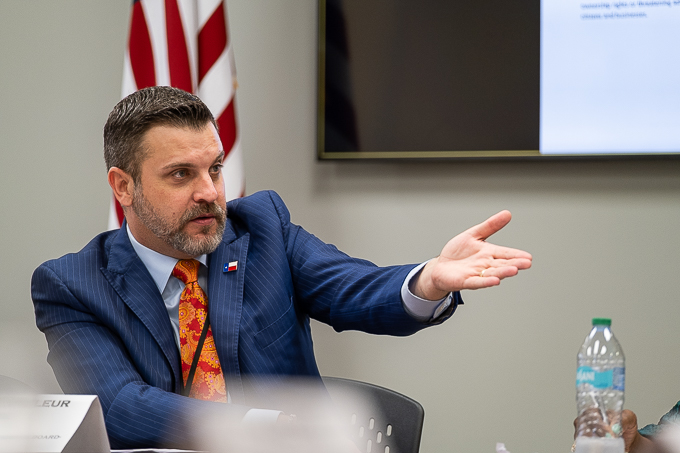
Marion County Judge Leward LaFleur was appointed chairman of the board, and Longview businesswoman Brandee Brown was appointed vice chair during the board’s first meeting Monday at the East Texas Council of Governments office in Kilgore.
The council serves 14 East Texas counties and helps its leaders apply for grants and coordinate large-scale projects, such as broadband internet expansion and transportation programs.
The board’s formation comes as Texas lawmakers and regional leaders reckon with the reality that the state could face a water shortage in the coming years, prompting innumerable policy changes and political battles for water supplies. Water-related issues are expected to be one of the most pressing issues for state lawmakers in the 2027 legislative session.
Northeast Texas has the most plentiful water supplies in the state, making it a target for the ever-growing thirst of North Texas. In 2025, controversy erupted in the region over the rumored sale of water rights from Lake O’ the Pines to the Dallas-Fort Worth area. The proposed sale of water rights from the Northeast Texas Municipal Water District, which manages Lake O’ the Pines, to the North Texas Municipal Water District was scrapped.
However, LaFleur and other East Texas leaders warn that North Texas water planners will continue to turn to this region as a future water source, so protecting the region’s surface water and groundwater will be vital.
“We have a bounty of natural resources, and the No. 1 being water,” LaFleur said. “We got a lot of water here, and a lot of people want the water that we have.”
The water planning board’s authority and role haven’t been fully defined yet, LaFleur said. That’ll be up to its members moving forward. But at the very least, the group will bring together local government officials so they can find factual information about the region’s water resources and provide that to state lawmakers as they decide the state’s water-related future.
“That’s the No. 1 goal is, ‘How do we get information to lawmakers that isn’t from the paid spokesperson of X, Y, Z company?’ ” LaFleur said. “We’re just local officials talking to local people.”
The board’s meetings will be open to the public and will include a public comment portion.
Advisory board members need to distill the often murky details surrounding water-related discussions, and members of the public need accurate information, LaFleur said. Too many social media pages and groups are filled with information that is inaccurate and fear-based.
“This is a hot topic,” he said. “It’s going to be a hot topic for generations, not just years.”
By bringing together East Texas officials to form a coalition, its leaders can be more effective and have a stronger presence when water-related decisions are made in Austin, LaFleur said.
“We’re just in our infancy,” he said of the advisory board. “We’re trying to figure out what we can and can’t do.”
LaFleur, Gregg County Judge Bill Stoudt, Smith County Judge Neal Franklin, Harrison County Pct. 1 Commissioner William Hatfield, Anderson County Judge Carey McKinney and Laura-Ashley Overdyke of the Caddo Lake Institute are among the board’s voting members.
State lawmakers will be ex-officio members of the committee, meaning they will not cast votes, but will attend meetings to discuss matters.
“We’ve put together a pretty good group to come up with ideas,” LaFleur said. “Right now, the possibilities are endless.”