
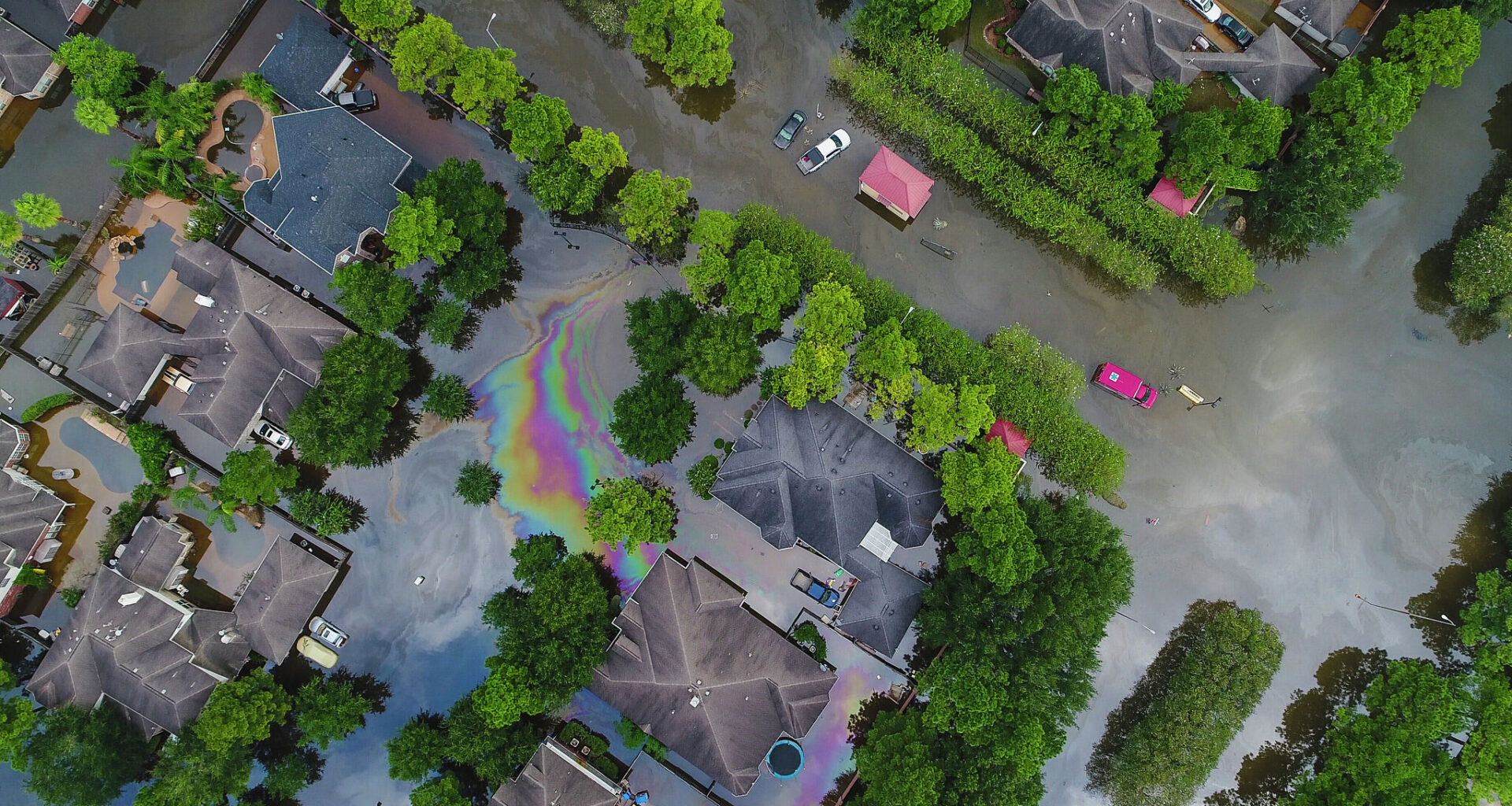
Homes in the Canyon Gate area of Cinco Ranch are surrounded by water from Barker Reservoir after flooding, Saturday, September 2, 2017, in Houston.
Mark Mulligan/Houston Chronicle
The Harris County Flood Control District is asking Commissioners Court to send two employees to Tokyo to study the Japanese capital’s underground web of flood channels.
The U.S. Army Corps of Engineers is funding a majority of the trip, which is expected to cost $20,710. The district would cover any additional costs, up to $2,710, said spokesperson Emily Woodell. The intent is to study Tokyo’s large-diameter tunnels, an approach that could be used for stormwater diversion in Harris County, she said.
“The Flood Control District has studied and advocated for large-diameter tunnels for years,” Woodell said in a statement. “We continue to see them as a promising way to address flooding in Harris County.”
Article continues below this ad
DUE DATES LOOM: Millions of dollars for Harris County flood projects are in jeopardy as Harvey deadline looms
Woodell did not say who flood control intended to send to Tokyo. If approved, the employees are expected to depart May 16 and return May 22, according to public agenda documents.
The two flood control employees will accompany Corps of Engineers staff, who invited flood control on the trip, according to a March 25 letter addressed to flood control Executive Director Tina Petersen.
Tokyo’s $2 billion tunnel network was completed in 2006 after 13 years of construction, according to a March 2020 report published by the Kanto Regional Development Bureau.
Article continues below this ad
The system features 6.3 kilometers of tunnels that ferry overflow from surrounding waterways into the Edo River, which feeds into Tokyo Bay. The 2020 report estimated the project had prevented nearly $1 billion in flood damage since its partial completion in 2002.
Large-diameter tunnels aren’t a new idea for Harris County. Officials have conducted multiple studies examining the feasibility of a countywide tunnel system, as well as a single tunnel beneath Buffalo Bayou, which would help relieve Addicks and Barker reservoirs.
A 2020 Corps of Engineers report indicated tunnels would be significantly less cost effective than improving the waterways feeding the two reservoirs, but Woodell said officials are still considering tunnels. The Corps instead recommended making Buffalo Bayou wider and deeper, sparking backlash from conservationists and residents.
Despite the Corps’ recommendation, billionaire Elon Musk in 2025 lobbied local officials to support a pitch from his tunneling company, The Boring Co., which he said could complete the project at a fraction of the price. Musk’s proposal involved the construction of two 12-foot tunnels under Buffalo Bayou — less than half the capacity of the single 40-foot tunnel flood control studied.
A Houston Chronicle investigation cast doubt on Musk’s claims, finding the cost difference between the two proposals was roughly proportional to the difference in capacity.
Article continues below this ad
READ MORE: A massive underground tunnel may be the way to alleviate Houston’s flooding, Army Corps says
The flood control district in 2022 released a report supporting a 130-mile, $30 billion tunnel network across Harris County. The 2022 report built on a 2019 feasibility study, and a third study is currently underway, according to flood control’s website.
The studies are not focused exclusively on tunnels, but they are among the solutions officials are considering. Scott Elmer, assistant director of operations for the flood control district, said in 2022 that tunnels were “an additional tool” that could be used to reduce flood risk in densely populated areas.
But at more than 10 times the cost of the $2.5 billion flood bond voters approved after Hurricane Harvey in 2018, a countywide tunnel network is not something residents should expect to see anytime soon.
Article continues below this ad
“While tunnel concepts have been studied and remain under consideration, they are complex and costly and must be carefully evaluated alongside other solutions to determine where they may provide the greatest benefit,” Woodell said. “At this time, tunnel systems are still in the planning and evaluation phase and are not the sole solution to flooding challenges.”