
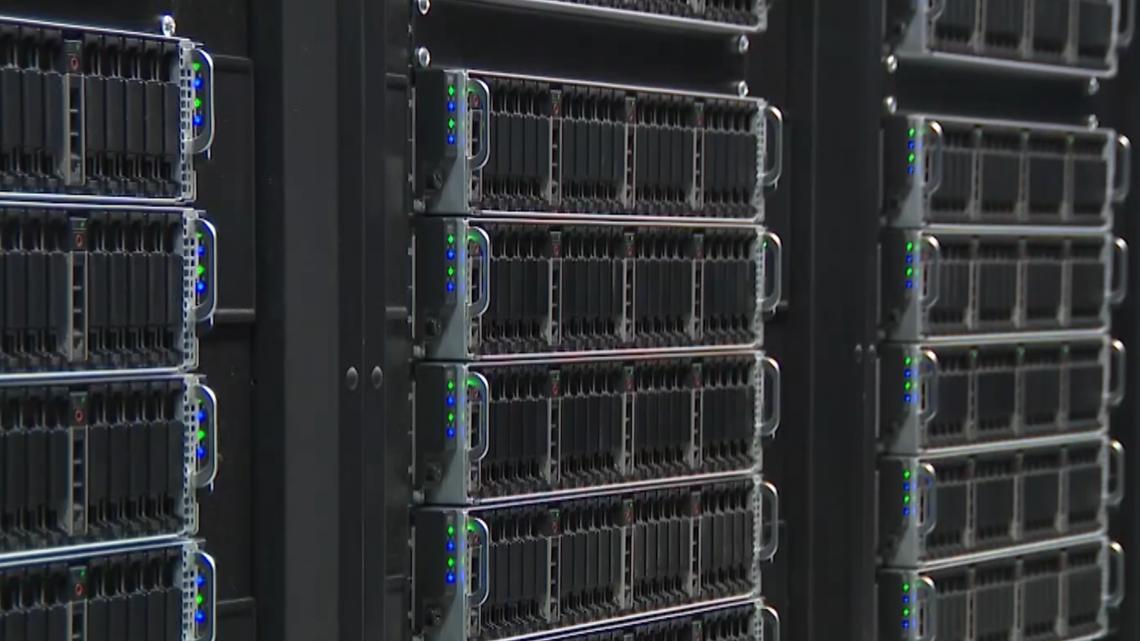
Data centers are multiplying across Texas at a record pace, and experts warn that homeowners could end up footing the bill.
WACO, Texas — Every time you ask an artificial intelligence chatbot a question, stream a movie or back up your phone to the cloud, it runs through a data center.
As those facilities multiply across Texas at a record pace, a growing question is emerging, who pays to power them?
TEXAS AT THE CENTER OF THE BOOM
Texas is ground zero for the national data center explosion. The state currently has more than 400 data centers, second only to Virginia, with the Dallas-Fort Worth area alone hosting nearly half of them.
A major reason is a fiber optic corridor running straight down Interstate 35, making Central Texas one of the most sought-after regions in the country for data center development.
Oncor, the state’s largest transmission and distribution utility, says it has more data center connection requests right now than any other utility in the nation.
Oncor Vice President Brian Lloyd laid out the scope of the challenge before the Texas House State Affairs Committee last week.
“The scope and scale, both in the number of requests and the size of individual data requests, that is what is new, and what has overwhelmed the existing processes,” Lloyd told lawmakers.
Lloyd told the committee that Oncor’s peak electricity demand could double within the next five years — if the transmission infrastructure can be built fast enough to support it.
That growth isn’t just coming from data centers. Lloyd said even without a single new data center, Oncor’s peak demand would still grow 60 percent — driven by oil and gas, manufacturing and other industries already expanding across the state.
“We could very well double our peak demand in the next five years if there’s adequate transmission that we can build,” Lloyd said.
The concern for homeowners is simple — when utilities have to build new infrastructure to keep up with exploding demand, they often pass those costs to residential customers.
Nationally, electric bills are projected to rise an average of 8 percent by 2030. In regions with high concentrations of data centers, some projections show bills could climb anywhere from 25 to 70 percent.
The problem is compounded by a timing gap — data centers can be built in as little as 18 months, but new power plants take up to five years to come online. That immediate strain on the grid can drive up costs quickly.
State Representative Pat Curry says the concern is real — but manageable with the right rules in place.
“If you don’t put guardrails on those things — then yes — you could end up driving up rates — you could end up really in a mess if you’re not careful,” Curry said.
Oncor pointed to its South Dallas transmission project as an example of how data centers could actually benefit ratepayers. Lloyd told lawmakers the project — which would serve up to 4 gigawatts of new data center load — would generate more revenue than it costs to build.
“We get $160 million of new revenue for $143 million of cost — if this load pays for the contracted capacity that we are building for them — that’s a great thing for the rest of the ratepayers of the state,” Lloyd said.
Nationally, North Dakota saw electricity rates drop nearly one cent per kilowatt hour between 2019 and 2024 — after data centers brought enough new customers onto the grid to spread fixed costs across more users.
A GENERATIONAL OPPORTUNITY — IF DONE RIGHT
Lloyd called the current moment a once-in-a-generation opportunity for Texas — but said getting the rules right is critical.
“We have a historic opportunity to make a generational investment in the Texas power grid, in a way that makes Texas attractive to these businesses, but also improves reliability and resiliency for the rest of the state, as well as keeps rates stable,” Lloyd said.
Rep. Curry echoed that sentiment, saying the key is making sure data centers come to the table with the resources they need before breaking ground.
“The right data center, with the right valuation, that adds tax base to the community, in the right location, utilizing the proper resources that don’t drain on the rest of the community, is the right thing to do,” Curry said.
Curry also pointed to a potential upside for property owners.
“If we get it right, it could lower your tax rates significantly, just by adding billions of dollars worth of valuation, but if we get it wrong, you’re going to see it on your electric bill every single month,” Curry said.
The Texas Public Utility Commission is currently developing new rules that would classify data centers as their own customer category — separating their infrastructure costs from what everyday residential customers pay.
State lawmakers say they are also pushing for guardrails — keeping decisions as local as possible and requiring data centers to demonstrate they have secured the water, power and financing they need before moving forward.
Oncor says it is pushing for key decisions to be finalized before the end of this year.