
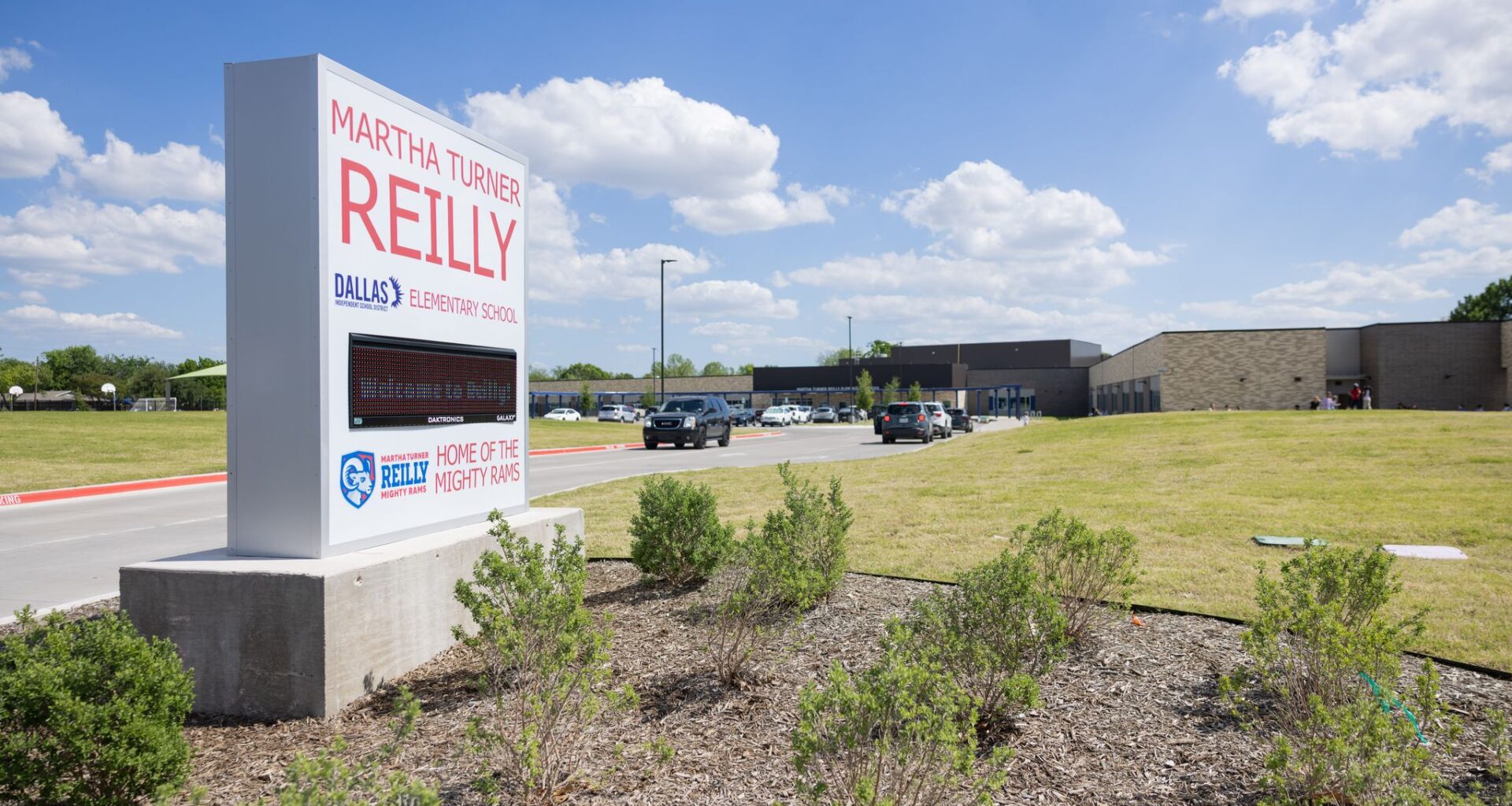
The sign for Martha Turner Reilly Elementary School in Dallas, Wednesday, April 8, 2026.
Juan Figueroa/The Dallas Morning News
When voters in Dallas ISD go to the polls next month, they’ll see the largest school bond proposal in Texas history on the ballot — just like they did six years ago. This time, the ask is bigger, and it comes with a property tax increase.

If voters approve the proposal in May, Dallas ISD officials will use the $6.2 billion bond package to build 26 new and replacement schools, renovate and upgrade other campuses and update the district’s aging swimming pools, among other projects. As election day nears, bond proponents are pointing to progress, both in terms of academics and the condition of Dallas ISD’s facilities, as evidence voters should continue to invest in the district.
Article continues below this ad
Dallas ISD is the second-largest school district in Texas by enrollment, with a little over 132,500 students and more than 200 campuses. School districts in Texas receive funding from the state for operating expenses such as salaries, employee benefits and utilities. Any money for major construction, renovations, land, buses and technology requires districts to borrow using voter-approved bonds that are repaid with property taxes.
In 2020, the district asked voters to approve a $3.7 billion bond package, which was the largest school bond proposal in state history at the time. Two proposals representing $3.5 billion of the package passed, giving the district money for construction, repairs and tech upgrades. Voters rejected three smaller proposals for construction projects that included athletic facilities, stadiums and a district-wide performance center. Those three proposals totaled $152.9 million.
Among the projects voters rejected in 2020 was a $26 million proposal to renovate the district’s aging swimming pools. District leaders have put that proposal back on the ballot this year.
Make Dallas News a preferred source so your search results prioritize writing by actual people, not AI.
Add Preferred Source
Related: Dallas ISD’s $6.2 billion bond issue is on the May 2 ballot. Here’s what to know
Article continues below this ad
A key difference between the 2020 proposal and the one on the ballot this year is tax impact. While the 2020 proposal didn’t carry a property tax increase, this year’s bond package would raise taxes by an estimated $2.79 per month on a home valued at $500,000, which is the average home price in the district.
Joe Carreón, president of the Dallas ISD Board of Trustees, said the 2020 bond issue was meant to build on the progress the district made in its 2015 voter-approved bond issue. Using money from the 2015 bond package, the district built nine new or replacement schools and made improvements to roofs, plumbing and HVAC systems at buildings across the district. The 2020 bond allowed the district to continue to renovate and replace dilapidated schools and still stay ahead of maintenance issues at other campuses, Carreón said.
The bond package also allowed the district to make big investments in its neighborhood schools, some of which have been fixtures in their communities for a century or more, Carreón said. William Lipscomb Elementary School, an Old East Dallas landmark dating to 1921, got security and infrastructure upgrades. The district renovated and expanded Rosemont School, a century-old campus in Oak Cliff. The district also used bond money to rebuild 16 schools, including Thomas Jefferson High School, whose previous building suffered extensive damage in an October 2019 tornado.
Article continues below this ad
The bond package also allowed the district to expand its career training programs. It established Biomedical Preparatory at UT Southwestern, a partnership campus between Dallas ISD and UT Southwestern Medical Center. The school is designed to get students involved in biomedical science and other STEM fields from an early age.
The district also used bond money to build three new career institutes — North, South and East. A fourth, Career Institute West, is under construction at the site of the old Amelia Earhart Learning Center on Wes
tmoreland Road in West Dallas. It’s expected to open later this year.
The career institutes and the UT Southwestern partnership are a part of a larger renewed focus on career and technical education programs. For years, district leaders have been looking to expand programs designed to give students hands-on exposure to high-demand, high-wage career paths before they finish high school. It’s an approach that has gotten the attention of district leaders elsewhere in Texas.
Article continues below this ad
Career Institute West isn’t the only project from the 2020 bond issue that’s still in the works. According to the district’s timeline, construction is expected to continue on those projects until 2031, although Superintendent Stephanie Elizalde told The Dallas Morning News’ editorial board in December it could be completed sooner.
The career institutes offer classes in vocational programs such as carpentry, aviation and cybersecurity. Students in those programs spend part of their day in core classes at their home campuses, and the rest at the career institutes. Having those programs at four centralized sites rather than spreading them out across every campus makes more logistical and financial sense, Carreón said. Many of those programs need more space than most campuses could offer, and they use expensive equipment, he said. The career institutes have spaces designed with those programs in mind, and they allow students from several high schools to train on equipment at each site.
Drexell Owusu, chief learning officer for the Perot Museum and co-chair of the political action committee supporting the 2026 bond issue, said students in the district are reaping the rewards of the 2020 bond program. During a meeting with The Dallas Morning News’ editorial board, he noted the training programs at the district’s career centers allow students to earn industry certifications before they graduate high school. Students can use those credentials to launch their careers right away, or continue their training in college.
Article continues below this ad

By signing up, you agree to our Terms Of Use and acknowledge that your information will be used as described in our Privacy Policy.
“We have been using our bond dollars both to try to continue to shore up our buildings as they exist today, but really to drive meaningful innovation and support of the district,” said Owusu, who also served as co-chair of the Citizens Bond Steering Committee for the 2020 bond issue. “And I think we’re seeing some positive outcomes.”
The 2026 bond issue goes before voters May 2. Early voting begins April 20.
The DMN Education Lab deepens the coverage and conversation about urgent education issues critical to the future of North Texas.
The DMN Education Lab is a community-funded journalism initiative, with support from Bobby and Lottye Lyle, Communities Foundation of Texas, The Dallas Foundation, Dallas Regional Chamber, Deedie Rose, Garrett and Cecilia Boone, Judy and Jim Gibbs, The Meadows Foundation, The Murrell Foundation, Ron and Phyllis Steinhart, Solutions Journalism Network, Southern Methodist University, Sydney Smith Hicks, and the University of Texas at Dallas. The Dallas Morning News retains full editorial control of the Education Lab’s journalism.