

Oakland will crack down on encampments and RVs, a victory for Councilmember Ken Houston, who’s been trying to pass a stricter homelessness policy since last summer.
His council colleagues narrowly approved his Encampment Abatement Policy at a special meeting Tuesday morning.
However, the version the council passed was significantly toned down from Houston’s original proposal last summer. Five councilmembers offered amendments on Tuesday that largely tried to establish more safeguards and lessen the impact on the city’s most vulnerable residents.
The policy will give city staff and police more clarity on how to handle people living on the streets and in RVs, and keep public spaces accessible, Houston said.
Inhabited vehicles like RVs and cars are no longer considered encampments under the new rules. This means city staff and police can tow vehicle dwellings without following a detailed closure process and offering shelter like they do for people living in tents.
In non-emergency situations the city “should attempt to” identify shelter options, and “consider” allowing the occupants to move their car to another location before towing.
An amendment from Councilmember Zac Unger also requires the city to come up with a protocol for giving advance notice before towing a person’s vehicle that they live in.
The population of people living in RVs in Oakland has exploded in size in recent years. At the same time, the city just shut down one of its only “safe-parking” shelters for vehicle dwellers after finding it had little success in moving residents into permanent housing.
A key feature of Oakland’s encampment rules is scrapped
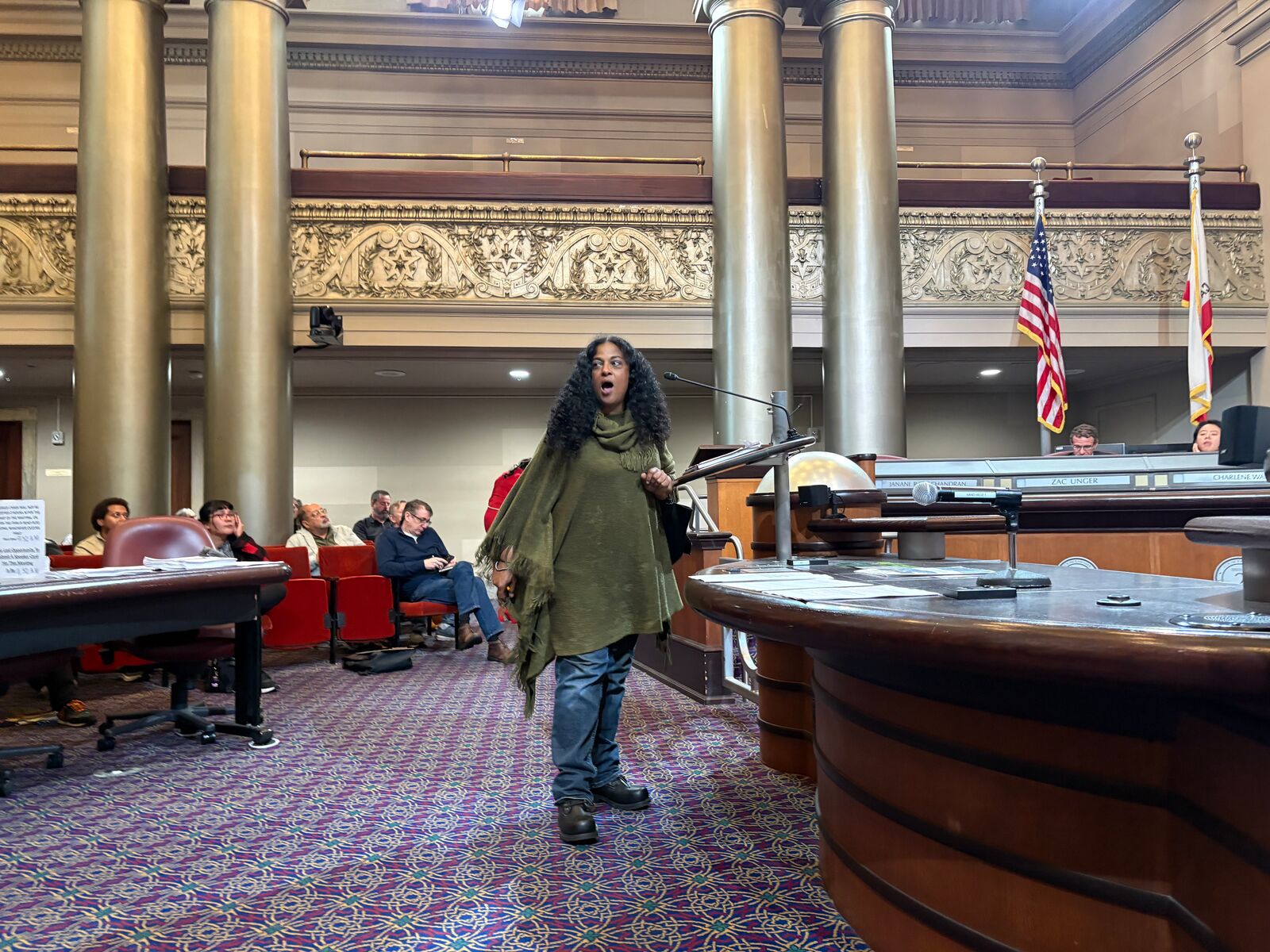 Unhoused resident Nikki Cooper criticizes Houston’s policy, saying the city already leaves people out when they close encampments. Credit: Natalie Orenstein/The Oaklandside
The city is no longer always required to offer alternative shelter or housing to residents before clearing an encampment.
This change stems from a U.S. Supreme Court ruling in 2024 finding that cities can constitutionally ban homeless camps regardless of the availability of other shelter.
Houston faced blowback for this proposal from unhoused residents and supporters who pointed out that Oakland has fewer than 1,300 shelter beds but 5,500 homeless people. California’s homelessness council initially warned that the policy could jeopardize Oakland’s shot at state funding because it designated most of the city as off-limits to encampments without offering clear alternatives. (The state council later gave it the green light.)
In response, Houston and co-author Patricia Brooks updated the policy to require city staff to make “reasonable efforts” to offer shelter to residents in standard camp closures. This includes offering at least one shelter spot to each resident, and holding the placement for 48 hours. The city is also instructed to “pace” closures based on shelter availability.
But “in no case will emergency or urgent closures be delayed for shelter unavailability,” the policy says. “Individuals who must be displaced without a shelter offer shall be permitted to move to a low-sensitivity area and shall not be subject to arrest or citation.”
Emergency and urgent circumstances are defined as locations where there are fires, criminal investigations, storage of propane or gasoline, damage to light poles, proximity to train tracks or construction sites, and other specific conditions.
Houston also walked back an original proposal to allow arrests of people who are simply camping but not engaged in other criminal activities.
Unger said the idea of arresting people for being homeless had been a “red line” for him. But he supported the newer version of Houston’s policy because it offered the city guidance on how to address urgent needs today while raising money for longer-term solutions like housing.
Unger, Council President Kevin Jenkins, and councilmembers Charlene Wang and Rowena Brown all voted yes on the policy after introducing amendments that were approved. Carroll Fife also provided amendments but abstained from the vote. Noel Gallo voted no, and Janani Ramachandran was excused.
“Our resources are incredibly constrained,” Wang said. “For us to consistently be the region’s social safety net, it’s just not fair. This is about providing relief to the neighborhoods that have had encampments in their backyard.” But she conceded, “We have to come up with a better shelter plan.”
The policy is written to help residents of the flatland neighborhoods most impacted by encampments, debris, and disinvestment. Houston represents District 7 in deep East Oakland, which has a large concentration of camps. However, the “low-sensitivity areas” designated in the policy — the locations where camps won’t be prioritized for closure — are also largely located in these areas.
Houston: ‘I’m not happy’
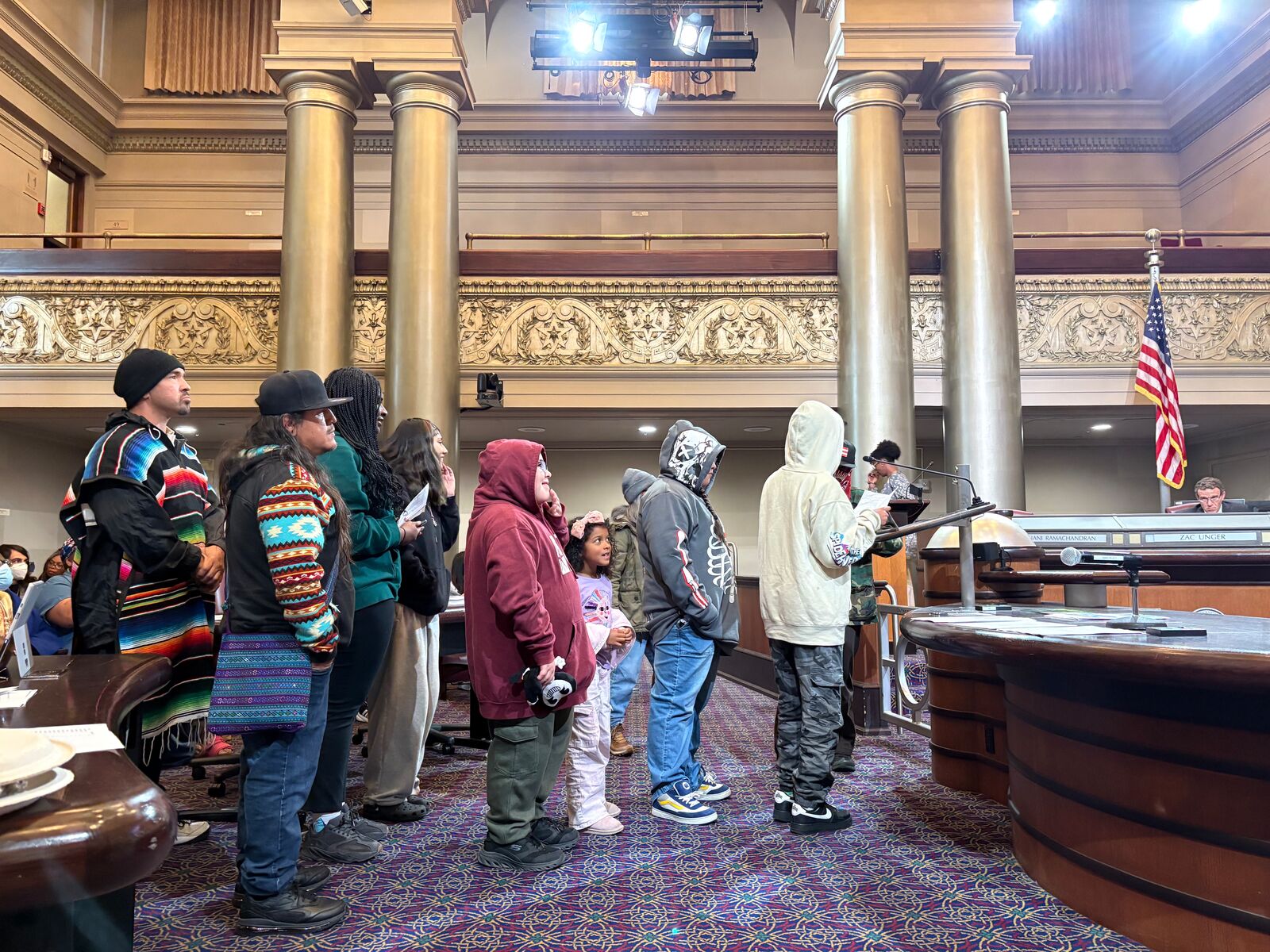 Children from POOR Magazine, an arts and education organization, proposed a moratorium on sweeps at Tuesday’s meeting. Credit: Natalie Orenstein/The Oaklandside
During the meeting, some West Oakland business representatives, including from the Oakland Ballers, urged the council to declare more areas in their neighborhood “high-sensitivity.”
Houston’s policy gives the city administrator new authority to alter the high- and low-sensitivity map. The councilmember and Brooks, who works for Jenkins, met with the administration and Mayor Barbara Lee’s office recently to tweak the policy and get closer to an agreement.
Lee’s Office of Homelessness Solutions recently put out a plan that takes a distinctly more accommodating approach to encampments. The report shows that camps have continued to grow in Oakland — to some 1,700 locations — despite a ramp-up in closures. It cites research on adverse effects of closures on unhoused residents.
Gallo said he cast the sole no-vote on the policy because it makes excuses for police and transportation staff who already have the authority to tow cars and address crimes.
“I’m out there making calls and nobody shows up,” he said, adding, “Jesus said take care of the needy.’”
Fife said she couldn’t vote in favor because the policy doesn’t answer the fundamental question of where people can go after an encampment is swept or an RV is towed.
“I can’t support legislation that’s going to perpetuate racist policies that affect my people,” she said. A majority of homeless people in Oakland are Black.
Dozens of members of the public weighed in at the Tuesday morning meeting, about twice as many opposed to the policy as those supporting it.
By allowing the city to tow inhabited vehicles without offering other shelter, “you have not solved a problem, you’ve moved it to the curb,” said James Burch of the Anti Police-Terror Project.
Jenkins said he and Houston are working to establish more safe-parking locations in East Oakland. Under the policy, the city administrator will provide the council with a list of locations in all council districts that could be converted to shelters or low-sensitivity zones.
Other speakers criticized the council for taking up the policy without it first passing through a committee. The Homeless Action Working Group, a grassroots advocacy organization, had also urged the council to first seek input from the city’s Commission on Homelessness, calling Houston’s proposal the “emotional itches of a single councilmember.”
Real estate investor Nick Myerhoff said his tenants in Oakland suffer from encampments with unhealthy conditions right around their homes.
“Their rights matter too,” he said.
After the meeting, Houston was surprisingly subdued.
“I’m not happy,” he told reporters. “To move a policy this big is hard, with this much individuals that are against it and this many that are for it. But this is the starting point, we have to do something. It’s inhumane for us to allow people to live like that on the street.”
“*” indicates required fields