
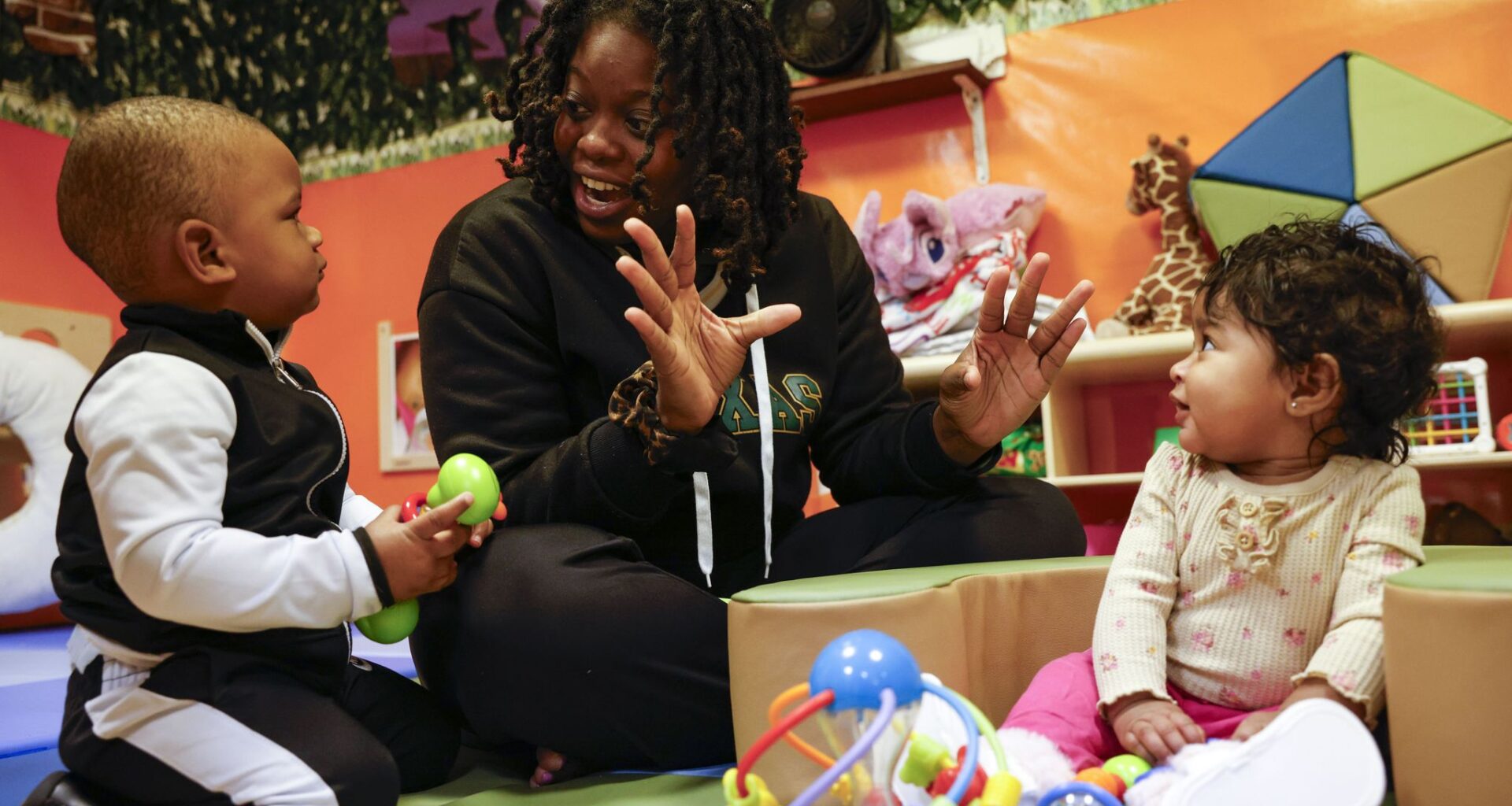
Tamia Miller (center), infant program teacher, talks to 1-year-old Landon Roberts (left) and 6-month-old Keyloni Pipkins (right) at Journeys Child Development Center in Grand Prairie, Texas, on Tuesday, Jan. 28, 2025.
Liz Rymarev/Staff Photographer
As child care costs strain families across North Texas, a coalition of nonprofits wants Dallas County voters to consider a new property tax to fund services – though its chances of reaching the ballot this fall is uncertain.

Miguel Solis, president of Commit Partnership, met April 3 with county Judge Clay Lewis Jenkins and county Administrator Darryl Martin to propose an election on raising homeowner property taxes by 3 cents per $100 assessed valuation to fund child care services.
Article continues below this ad
Early-stage proposal: Advocates pitched a 3-cent property tax increase to fund child care services, but Dallas County commissioners have not formally discussed the proposed ballot measure.
Officials weighing idea: County Judge Clay Jenkins said “We’re looking at that model now,” though no vote has been scheduled to place it on the Nov. 3 ballot.
Need is growing: About 9,500 families are on a waitlist for assistance, with costs near $11,000 a year per child in Dallas County.
Mixed reception: Some commissioners support exploring the idea, and one said the issue should be handled at the state level.
Within a week, Jenkins announced at a Dallas Regional Chamber event that the county was exploring the idea as a way to help families and businesses cope with child care needs.
“We’re looking at that model now,” Jenkins told the crowd of about 130.
It’s not yet clear whether a child care tax will reach the Nov. 3 county ballot, but any proposal to raise property taxes is likely to be contentious.
Article continues below this ad
Make Dallas News a preferred source so your search results prioritize writing by actual people, not AI.
Add Preferred Source
The idea, crafted by a coalition of four nonprofits, is still taking shape and the all-Democratic commissioners court has not yet discussed whether to advance the measure. Jenkins’ four colleagues had not been briefed on specifics before he announced the county was exploring the potential 3-cent tax measure at the chamber banquet.
Dallas County would not be the first to try.
In November 2024, Travis County voters passed the first child care levy in Texas – a 2.5-cent tax expected to generate $75 million a year for early childhood, after-school and summer programming for 9,000 children.
Locally, the coalition of Commit, Dallas Area Interfaith, North Texas Early Education Alliance and United Way of Metropolitan Dallas has been looking for solutions to the early childhood education crisis rippling across the region.
Article continues below this ad
Cost burden
The need is substantial, the nonprofits told The Dallas Morning News.
About 9,500 families are on a waitlist to receive child care assistance through Workforce Solutions of Greater Dallas. Child care in Dallas County can cost about $11,000 a year for one kid, according to the Living Wage Institute, approaching the cost of public college tuition.
“We have reached a point where we have got to do something,” said Melanie Rubin, director of the North Texas Early Education Alliance. “We’re losing on our future workforce, we’re losing on family stability, we’re just losing every which way we go and this is an opportunity to right that ship a little bit.”
Article continues below this ad
Members of Dallas Area Interfaith talked to Commissioners Theresa Daniel, Elba Garcia and Andrew Sommerman about the concept of a child care tax in November, though details at that time were vague.
Sommerman said the 3-cent levy described by Jenkins at the April 8 chamber event was welcome news to him, and he supports letting voters decide it. The current county tax rate is 21.55 cents per $100 assessed valuation.
Sommerman said he has scheduled an initial discussion on the child care measure for the May 11 meeting of the county’s Continuous Improvement Steering Committee, which he chairs, and he wants to explore a component to pay for homeless needs.
“It is very challenging for us to come up with dollars every year out of the budget to fund homelessness,” he said. “Child care is equally as important though because if you have good child care people can go to work.”
Article continues below this ad
The Dallas County Commissioners Court would have to vote to place the question on the Nov. 3 ballot. Martin, the county administrator, said an agenda item has not yet been scheduled as he is gathering financial data.
Details in flux
Even among commissioners key questions remain.
Garcia said she had not been briefed on the 3-cent tax structure before Jenkins raised it at the chamber. She said she needs more detail about which families would qualify for the funds, what types of early education programs would be eligible and other specifics.
Article continues below this ad
Nonprofit leaders said those details are still being worked out.
Walker Moore, lead organizer of Dallas Area Interfaith, said the group had its first discussion with Commissioner John Wiley Price on the concept on Monday. Price did not respond to a request for comment.
Garcia said the scope of the problem calls for a broader statewide solution, saying a child care tax should be taken up by the Legislature and featured in the current campaigns for governor rather than handled county by county.
Business groups have increasingly raised alarms, with Texas employers losing $7.59 billion in 2021 from employee absences and turnover related to child care issues, according to the U.S. Chamber of Commerce Foundation.
Article continues below this ad
“This is a great idea but it should be for every Texan, not just in Dallas County,” Garcia said.
Ballot fatigue
Garcia also pointed to the timing of a possible new tax request.
Dallas ISD voters will consider a $6.2 billion bond package on May 2, the commissioners court is expected to vote on a $350 million bond package on May 19 and Elba said asking residents to vote on a child care tax in November may be an overload.
Article continues below this ad
“This is not the economy to be asking people to pay more taxes,” she said.
Additional changes in early education also could shift demands.
Beginning next school year, Dallas ISD will offer universal pre-K for all 3 and 4 year olds, expanding the free model previously open only to families in certain income levels.
While Jenkins has urged other school districts in the county to follow suit, he told the Dallas Regional Chamber event attendees an exodus of 3 and 4 year olds will put extra pressure on child care facilities left to care mostly for younger children.
Article continues below this ad
Because centers are required to staff more workers for infants and toddlers than pre-K-aged kids, losing older children can negate any slim margins facilities make.
Jenkins told the crowd a child care tax election is “one possibility” to address this imbalance.
After the event, Jenkins declined to answer follow-up questions about the proposed tax but said in an email “it’s in everyone’s best interest that our childcare facilities remain strong and viable.”
The issue is complicated by low pay. In 2022, the median hourly wage for early childhood education workers in Texas was $11.67, and roughly 43% of those households relied on public assistance, according to the University of California at Berkeley.
Article continues below this ad
Last year, the commissioners court set aside $1 million to cover a portion of child care costs for employees at qualified businesses. The program allows business owners to receive about $1,500 per employee annually for child care costs if they also match that amount.
Officials have acknowledged that effort is not enough to fill the gap.

By signing up, you agree to our Terms Of Use and acknowledge that your information will be used as described in our Privacy Policy.
Moore, of Dallas Area Interfaith, said his organization began looking for ways to respond after child care struggles repeatedly surfaced during community listening sessions.
Article continues below this ad
Some congregations, he said, have already shut down infant and toddler programs because rising costs made them unsustainable. He said revenue from a child care tax could be one option to make up the difference.
“Investing in our young … is such an important part of their development,” he said. “This is something we need to be considering very seriously.”