
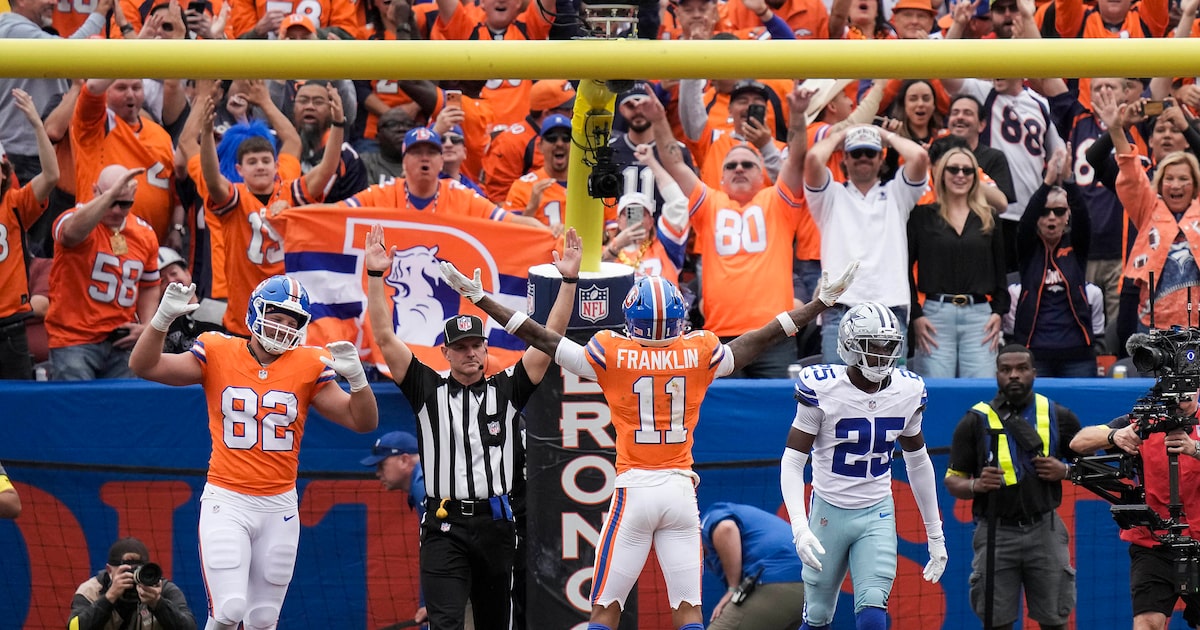
How bad was it for the beleaguered Cowboys’ defensive backfield in Dallas’ 44-24 blowout loss to the Broncos on the road in Denver on Sunday?
Four of the Cowboys’ top five safeties were unavailable due to injury. Only two safeties were healthy enough to play. If anything happened to one of them, backup cornerbacks who had cross-trained at safety during the week of practice would have to enter the game.
Both starters, Donovan Wilson (elbow/shoulder) and Juanyeh Thomas (migraine), were ruled “out” on the official practice report, and Malik Hooker (toe) remains on injured reserve. Markquese Bell started the game in place of Thomas for the second week in a row. And rookie Alijah Clark, who was promoted from the practice squad to the active roster on Oct. 4, would make the first start of his NFL career. Clark had a total of five defensive snaps on the season before Sunday’s game; Bell had played only 87 snaps through the first seven games.
Backup cornerbacks Reddy Steward and Corey Ballentine served as “break glass in case of emergency” at safety.
Cowboys
Surely it couldn’t get any worse in terms of depth… until it did. In the third quarter, Clark suffered a rib injury and did not return to the game. Steward, who normally plays in the slot as a nickel, was pressed into service at safety.
Ballantine, who was signed to the practice squad Sept. 25, is a veteran with six years of NFL experience and 70 career games played, but those were at cornerback… not safety. The Cowboys are his ninth NFL team in those six years. He did not have to play defense this week, but what happens moving into Week 9 if Wilson and Thomas are still unavailable? Hooker won’t be ready to return, and how bad is Clark’s rib injury?
The Cowboys did sign Julius Wood to the practice squad two weeks ago, so he could be activated for the Monday night game hosting the Cardinals. But as of today, Bell is the only healthy safety on the Cowboys’ active roster.
By the way, Clark’s injury occurred on one of the many ‘explosive runs’ (10+ yards) allowed on the day. In this case, it was JK Dobbins’ 25-yard run. The Cowboys played the next snap with only 10 defenders as Clark was receiving medical attention far down the sideline. Steward entered the game the next play. Interestingly, the Broncos gained “only” five yards on a run play when the Cowboys had just 10 men on the field. Overall, the run defense allowed 6.4 yards per carry.
Ugly numbers yielded by Cowboys’ defense: The Broncos scored on 7 of their 12 possessions (six TDs, one FG). Their other possessions ended with: one turnover (Trikweze Bridges’ interception on the opening series), two punts and two kneel-downs at the end of the first and second halves.
Forget about the defense consistently getting the Broncos off the field. They could barely get them to third down. Only three times in the first half did the defense even force a third-down play.
That’s right… the Broncos faced only three third-down plays in the first half because the Broncos were gaining chunks of yardage on first and second downs.
In fact, the Broncos had more first-half touchdowns (four) than third-down plays (three) in the first half. Yowza!
Offense unable to take advantage of Surtain’s absence: The reigning NFL Defensive Player of the Year, Broncos CB Pat Surtain II, didn’t play in the second half because of a shoulder injury. He had already received medical attention in the first quarter for a right ankle injury.
The high-octane Cowboys offense would exploit his absence, right? Wrong.
Under a relentless pass rush, the Cowboys managed only 134 net passing yards in the second half compared to 97 net passing yards in the first half, but 58 of those second-half yards came after Joe Milton replaced Dak Prescott midway through the fourth quarter to protect Prescott from a further pounding. Milton did connect with WR Jalen Tolbert on a 35-yard TD, which is Milton’s first scoring toss as a member of the Cowboys.
CeeDee Lamb and George Pickens both finished with 9 catches each for 74 and 78 receiving yards, respectively. But CeeDee didn’t quite look the same after a play early in the game in which a defender was blocked into CeeDee’s left ankle as CeeDee was being tackled.
After that play, CeeDee seemed to be more on-and-off the field than normal. The athletic training staff reviewed the play on the video screen behind the bench, which can be used by a team’s medical staff for a better look at what happens to a player on a specific play. But CeeDee never entered the blue medical tent.
CeeDee played 71.6% of offensive snaps on Sunday, his lowest percentage for games played in 2025 since suffering a high left ankle sprain in Week 3 at Chicago. He did draw back-to-back pass interference penalties in the end zone on CB Riley Moss to set up Javonte Williams’ 1-yard touchdown run in the third quarter.
Shooting themselves in the foot: Penalties continue to plague the Cowboys, including a costly offside penalty on DE James Houston in the first quarter. That penalty negated a third-down stop, which would have forced the Broncos to punt from their own 29-yard line, trailing 3-0. Instead of the Cowboys’ defense forcing a three-and-out and getting off the field, Houston’s penalty extended the drive. Three plays later, rookie RB R.J. Harvey ran 40 yards untouched for a touchdown to give the Broncos a 7-3 lead. The Cowboys never regained the lead, playing from behind the remainder of the game.
The pre-snap penalties, like the one committed by Houston, as well as the false start with the Cowboys’ offense at the 1-yard line, are particularly infuriating for the coaching staff because pre-snap penalties can be controlled as opposed to ‘competitive’ penalties, which occur during game action.
DE Sam Williams’ unnecessary roughness penalty after Harvey’s 1-yard TD run late in the second quarter will likely result in Williams being fined by the league. A post-play penalty like the one by Williams, along with the pre-snap errors, are particularly galling.
Entering Sunday’s game, the Broncos had actually committed more penalties (61) than the Cowboys (58), making them the second- and third-most penalized teams in the league heading into Week 8.
Well, if the Cowboys beat the Broncos in one area on Sunday, it was in the ability to commit untimely penalties.
The final count was nine for the Cowboys (80 yards total) and seven for the Broncos (only 42 yards). But the first half totals were much more lopsided: eight accepted penalties on Dallas, only two on Denver.
Going for a record: Communication and the ability to hear the QB’s cadence were issues and contributed to the Cowboys’ pre-snap penalties on offense. Yes, it was super loud and provided a boisterous Broncos homefield advantage.
‘Mile High Thunder’ is what the Broncos call the reverberating noise provided by their loyal fans. When the defense is on the field, the video board shows the decibel levels of the crowd. On Sunday, the board was exhorting the crowd to break their stadium record of 115.3 decibels.
I don’t know if they topped it Sunday, but I did see the decibel meter on the scoreboard hit 115.1. That level is equivalent with the noise produced by a snowmobile (source: Pulsar Instruments). 115 is also louder than a typical rock concert, jackhammer or power saw, which measures roughly 110 decibels.
The Seahawks and Chiefs crowds have reached 130+decibels. If you’re wondering about which stadium is the loudest in the league, the Seahawks’ previous record of 137.6 is louder than an air raid siren or stock car race.
Fun fact about the ‘Mile High Thunder’… the old Mile High Stadium was built with bare metal in the upper decks, so when the fans stomped their feet to either stay warm or create noise, the ‘thunder’ sounded like it was reverberating. When the current stadium was built, it included steel floors in the upper deck to preserve the acoustics.
Officiating crew shuffle: Referee Carl Cheffers and his crew worked the game, but there was a change in the officiating lineup. Nate Jones, the former Cowboys cornerback, is the field judge on Cheffers’ crew. But because the NFL won’t assign Jones to work the games of a team for which he played, Jones was re-assigned to work the 49ers-Texans game in Houston on Sunday. John Jenkins swapped spots with Jones, so Jenkins was the field judge for Cheffers.
Streak continues: 75,877 fans attended Sunday’s game, which extends the Broncos’ home sellout streak to 457 games (including 22 playoff contests). The streak began in Week 1 of the 1970 season. The Pittsburgh Steelers boast the second-longest streak dating back to September 1972.
Unless the Cowboys return to Denver for a preseason game, Sunday was likely the last time they play at the current stadium. The Broncos are expecting to be in a new stadium by 2031. Last month, the team announced that Burnham Yard, a former downtown railyard, will be the site of a new retractable-roof stadium. The targeted completion date would align with the expiration of the team’s current lease of Empower Field at Mile High.
Nail salon sponsorship? Early in the third quarter, after returning to the sideline following Javonte Williams’ second 1-yard TD run of the game, I spotted center Brock Hoffman with fingernail clippers and an emery board trimming his nails. Yes, I’ve seen a Cowboys center trim his nails during a game one time before, but it was at least 20 years ago and I cannot remember who it was. Nail clipping. It’s certainly something you expect to see at a nail salon, not an NFL game.
Find more Cowboys coverage from The Dallas Morning News here.