
As e-bikes and minibikes grow in popularity, Corpus Christi police warn minibikes are illegal on public roads and could lead to fines or impoundment.
CORPUS CHRISTI, Texas — As Corpus Christi looks to expand its network of trails and bike lanes, more residents are turning to alternative ways to get around — including electric bikes and scooters capable of speeds approaching 30 miles per hour.
But while many of these devices are legal, others are not — and local law enforcement says confusion is growing.
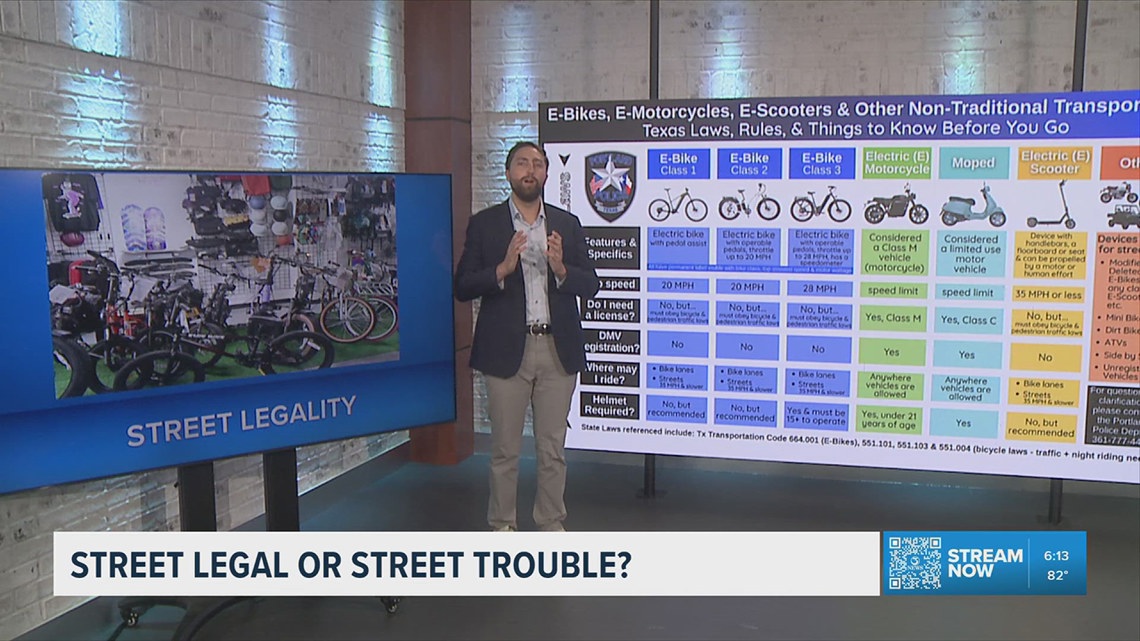
Electric bicycles, commonly known as e-bikes, are divided into three classes under Texas law and are generally allowed on bike lanes and neighborhood streets. Some models can reach speeds of up to 28 miles per hour without modification.
Melanie Salinas, owner of Hype Byke, said her shop primarily sells traditional bicycles but has seen increasing interest in electric options.
“Our primary business is conventional, traditional — or what some people call ‘acoustic’ — bikes,” Salinas said with a laugh. “But we do carry electric bikes as well.”
She said parents should be especially cautious, noting that some e-bikes can be modified to reach higher speeds and may be difficult for younger riders to control. In Texas, riders must be at least 15 years old to operate certain higher-speed models.
National data shows children under 15 account for a disproportionate share of injuries involving e-bikes and e-scooters.
However, Corpus Christi police say the bigger concern locally is the use of minibikes — small, gas-powered or electric bikes that are not street legal.
Lt. Michael Peña said officers are increasingly seeing young riders operating minibikes on busy roadways such as Rodd Field Road and Ocean Drive.
“It’s when you get these mini bikes and you’ve got a young kid traveling down a major roadway when they shouldn’t be,” Peña said. “The vehicle is small, often without proper lights, and it’s illegal to operate on public roads.”
Peña compared minibikes to fireworks — legal to purchase, but not to use within city limits.
“Just because you can buy it doesn’t mean you can operate it on the roadway, sidewalk or in a park,” he said.
Violations can come with consequences, including citations and impoundment of the vehicle — costs that often fall on parents.
“If that child gets stopped, the bike could be impounded,” Peña said. “Parents could be out additional funds.”
As alternative transportation grows in popularity, officials say understanding the rules could help riders stay safe — and avoid costly penalties.